



Story by Emily Brown
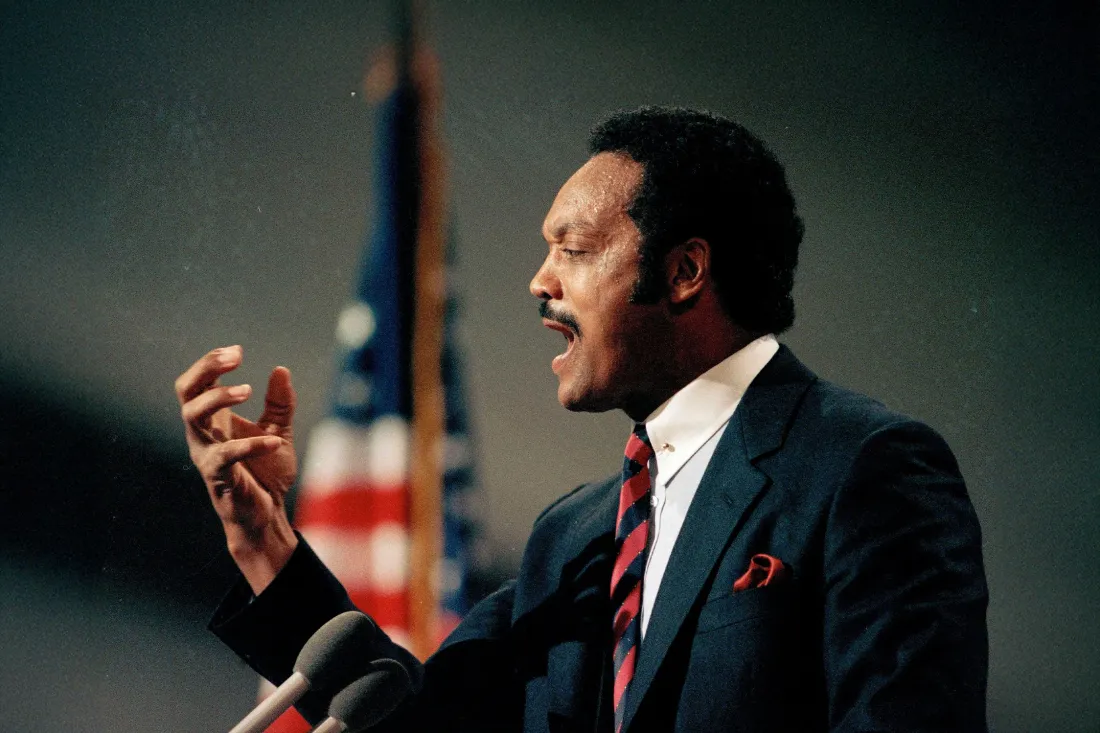
Rev. Jesse Jackson, the fiery civil rights leader, presidential candidate and longtime Baptist minister who helped shape modern American political activism, has died at 84.
His family confirmed the news in a brief statement.
“We shared him with the world, and in return, the world became part of our extended family,” the statement said. “His unwavering belief in justice, equality and love uplifted millions, and we ask you to honor his memory by continuing the fight for the values he lived by.”
For more than five decades, Jackson stood at the crossroads of faith and public life, insisting that the Gospel demanded engagement with injustice. A protégé of Martin Luther King Jr., Jackson was at the Lorraine Motel in 1968 when King was assassinated. In the years that followed, he carried forward the movement’s moral language, blending the cadences of the Black church with calls for economic equity, voting rights and racial reconciliation.
“If my mind can conceive it, and my heart can believe it — then I can achieve it,” Jackson often told crowds.
Ordained as a Baptist minister, Jackson founded the Rainbow PUSH Coalition, an organization devoted to civil rights, economic justice and political empowerment. His preaching style — urgent, rhythmic and unapologetically rooted in Scripture — fueled rallies and marches across the country. He frequently framed civil rights as a spiritual mandate.
“Justice is what love looks like in public,” he said.
During a 1971 appearance on Sesame Street, Jackson led children in a call-and-response affirmation that became one of his most enduring moments.
“I am somebody … I may be poor, but I am somebody. I may be on welfare, but I am somebody … I am God’s child!” he declared.
In 1984 and again in 1988, Jackson ran for president, becoming one of the first Black candidates to mount a serious national campaign. His 1988 bid won millions of votes and expanded the political imagination of what was possible for marginalized communities. The campaigns were grounded in what he called a “Rainbow Coalition,” a multiracial, multi-faith alliance built around shared economic and social concerns.
“Keep hope alive!” he urged supporters during his 1988 campaign, a chant that became synonymous with his movement.
Throughout his career, Jackson traveled globally, advocating for the release of political prisoners, meeting with world leaders and pushing for diplomatic solutions in tense international conflicts. At home, he remained a visible presence at moments of crisis, from urban unrest to high-profile cases of racial injustice.
In later years, Jackson faced significant health challenges, including a Parkinson’s disease diagnosis. Still, he continued to speak publicly about justice and hope.
“If you don’t know what tomorrow holds, you need to know who holds tomorrow,” he said in sermons reflecting on faith and perseverance.
Now, as tributes pour in, his family’s request hangs in the air: honor his memory not only with words but with action.