


Supplied by Partner News Agency.
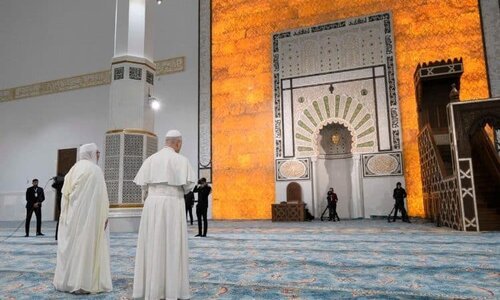
Pope Leo XIV’s recent visit to the Mosque of Algiers–where he removed his shoes, stood in silent reflection before the mihrab, and expressed gratitude for being in “a place that represents the space proper to God”–is not a harmless gesture of goodwill. It is a deeply consequential moment that raises serious questions about how the highest office in the Catholic Church is choosing to represent Christian truth in the public square.
Because this is not simply about respect. No one is arguing against basic courtesy toward Muslims or any other religious group. Christians are called to love their neighbors and treat sacred spaces with dignity. But what happened in Algiers went beyond respect and entered the realm of symbolic participation–actions that inevitably communicate theological agreement where none exists.
Standing in silent reflection in a mosque, directly before the mihrab–the directional focal point of Islamic worship–is not a neutral act. It is not the same as visiting a historical site or engaging in dialogue in a conference room. It is entering a space defined by a specific act of worship to God as understood in Islamic theology, and participating in its atmosphere of devotion without any accompanying doctrinal clarification.
When the Pope then describes the mosque as “a space proper to God,” the problem intensifies. Proper to which understanding of God? Christianity and Islam do not simply differ in language; they differ in the most foundational claims about who God is, how He is known, and how He has revealed Himself. To speak in generic terms of shared divine space is not bridge-building–it is theological flattening.
This is not an isolated misstep. It sits within a wider pattern of interfaith language emerging from the Vatican over recent years, particularly under Pope Francis, that has repeatedly blurred distinctions between Christianity and other religions in ways that have caused legitimate concern among clergy and theologians.
Pope Francis famously stated that “every religion is a way to arrive at God,” and described religions as “different languages” pointing toward the same divine reality. He also declared that “God is God for all,” and placed Sikh, Hindu, Muslim, and Christian traditions within a shared framework of spiritual pathways.
Those are not minor semantic choices. They represent a shift in tone that directly challenges the historic Christian claim that salvation is found uniquely in Jesus Christ. When the Pope speaks in this way, confusion is not just possible–it is inevitable.
This is precisely why the Algiers visit matters. It is not an isolated gesture of kindness. It is part of a trajectory in which symbolic actions and ambiguous language increasingly replace doctrinal clarity.
The Core Problem: Symbolism Without Theology
Religious leadership carries weight precisely because symbols are never just symbols. When the Pope stands in silent reflection in a mosque, the global audience does not see a neutral academic observer. They see the visible head of Catholicism engaging in a posture of reverence within a non-Christian act of worship.
Silence in such a setting does not clarify intent–it obscures it. And when combined with language about shared divine “space,” it creates the impression that Christianity and Islam are simply different cultural expressions of the same faith. That impression is not only inaccurate–it directly contradicts core Christian teaching.
The issue is not that Catholics should be hostile toward Muslims. The issue is that the distinct claims of Christianity are being visually and verbally diluted at the highest level of representation.
The Five Irreconcilable Differences That Are Being Blurred
If there is any clarity needed in this discussion, it is here. Christianity and Islam are not parallel routes up the same mountain. They are fundamentally different religious systems built on incompatible claims.
1. Jesus Christ: Divine Son or Human Prophet
Christianity declares Jesus Christ to be the eternal Son of God, not merely a messenger but God incarnate. This is not a symbolic title–it is the center of Christian faith. Jesus is worshipped, not merely respected, because He is understood as God made flesh.
Islam explicitly denies this. Jesus (Isa) is honored as a prophet, but the idea of His divinity is rejected as theological error. This is not a minor disagreement–it is the single most important dividing line between the two faiths. If Jesus is not divine, Christianity collapses into something entirely unrecognizable.
2. The Cross: Central Event or Theological Rejection
Christianity is built on the crucifixion and resurrection of Christ. The cross is not optional theology–it is the foundation of salvation. Without the death and resurrection of Jesus, there is no Christian Gospel.
Islam rejects the Christian understanding of the crucifixion. Traditional Islamic teaching holds that Jesus was not crucified in the manner Christians believe, and therefore the entire redemptive framework of sin, atonement, and resurrection is denied. That alone makes the two faiths structurally incompatible.
3. The Nature of God: Triune Revelation or Strict Unitarianism
Christianity teaches that God is one being in three persons–Father, Son, and Holy Spirit. This is not polytheism, but relational unity within the divine nature.
Islam rejects this entirely. God is absolutely singular, indivisible, and without internal relationship. Any suggestion of “Sonship” or Trinitarian structure is considered a distortion of monotheism. These are not small doctrinal differences–they represent entirely different understandings of who God is.
4. Salvation: Grace Through Christ or Judgment by Deeds
Christianity teaches salvation as a gift of grace through faith in Jesus Christ. Human effort cannot earn reconciliation with God; it is received through Christ alone.
Islam emphasizes submission to God’s will expressed through obedience, prayer, fasting, and righteous deeds, with final judgment based on a balance of actions and mercy. While both traditions value moral living, the mechanism of salvation is fundamentally different: grace versus merit, redemption versus accountability.
5. Revelation: Fulfilled in Christ or Finalized in the Qur’an
Christianity holds that God’s revelation reaches its fulfillment in Jesus Christ, with the New Testament bearing witness to Him as the culmination of God’s self-disclosure.
Islam teaches that the Qur’an is the final, perfect, and unaltered revelation, superseding previous scriptures, including the Bible. This creates not just different interpretations, but competing claims about final authority.
Respect Does Not Require Theological Confusion
It must be said clearly: respect between Christians and Muslims is not optional in a plural world. Civility, peace, and dialogue are necessary. But respect does not require symbolic actions that blur essential distinctions. It does not require standing in silent quasi-devotional posture inside another religion’s place of worship while using language that implies shared theological space.
That is not unity–that is confusion.
The danger in the Pope’s actions is not that he visited a mosque. It is how he did it, what was said, and what was left unsaid. In a world already drowning in relativism, religious leaders do not have the luxury of ambiguity. Their words and gestures define how millions understand God.
And when those gestures begin to suggest that Christianity is simply one language among many ways of reaching the divine, the result is not harmony–it is the erosion of Christian identity itself.