



By Noah Franklin/Staff Writer PNW News
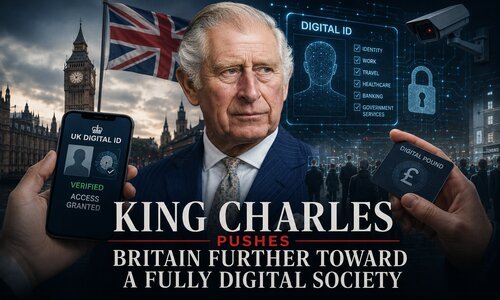
For generations, many Americans assumed the warnings about “papers, please” societies belonged to dystopian novels or authoritarian regimes far removed from the English-speaking West. Yet this week, alarm bells rang across both Britain and the United States after King Charles III formally announced the U.K. government’s push toward a national digital ID system as part of its legislative agenda.
To supporters, it sounds harmless enough: modernization, convenience, fraud prevention, border security. But to critics, the proposal represents something far more significant — another major step toward a fully trackable digital society where governments increasingly control not only identity, but eventually access itself.
And many Americans are now looking across the Atlantic and asking a troubling question: if it can happen in Britain, why couldn’t it happen here?
The proposal, championed by Keir Starmer and the ruling Labour Party, would create a government-backed digital identity system designed to verify citizens for employment, services, and interactions with the state. Officials insist the program is necessary to combat illegal immigration and streamline public services.
On paper, the argument sounds practical. Britain is facing enormous migration pressures. Tens of thousands of migrants continue crossing the English Channel by small boats every year. Government systems are strained. Fraud is expensive. Bureaucracy is slow.
The solution, the government says, is digital efficiency.
But critics point out an uncomfortable reality: Britain’s immigration crisis is not happening because the government cannot identify illegal migrants. In many cases, authorities already know exactly where they are. As commentator Konstantin Kisin observed, many asylum seekers are already housed in taxpayer-funded hotels and tracked within existing systems.
The issue is not identification. It is political will.
That distinction matters because history shows governments often introduce sweeping systems during moments of crisis. Fear becomes the catalyst for powers that would otherwise face enormous resistance.
And once those systems exist, they rarely remain limited to their original purpose.
That is where the deeper concern begins.
Governments repeatedly promise that digital IDs are about convenience, not control. Officials in Britain insist police will not randomly demand digital credentials and that participation will not technically be “mandatory.” Yet even their own language reveals the shift underway: digital ID may not be compulsory in name, but it will increasingly become mandatory for employment, services, and verification.
In practice, that creates a two-tier society.
Those fully integrated into the digital system gain seamless access. Those who refuse, dissent, or fall outside approved standards risk exclusion.
That concern intensified during the COVID era, when governments across the West implemented unprecedented restrictions on movement, work, worship, and commerce. Vaccine passports — once dismissed as conspiracy theories — became reality in many countries almost overnight.

And people remember.
Canadians especially remember what happened during the 2022 trucker protests, when the government invoked emergency powers and froze bank accounts connected to demonstrators and supporters. Many Americans viewed that moment as a warning shot: modern governments no longer need tanks in the streets to pressure dissenters. In a digital financial system, access itself becomes leverage.
Now imagine combining digital ID with centralized digital currency systems.
Suddenly, the potential power becomes staggering.
A government-linked identity tied directly to banking, employment records, tax status, travel permissions, healthcare access, social media verification, and eventually central bank digital currencies creates something previous authoritarian governments could only dream about: real-time behavioral control.
Spend too much carbon allowance? Transactions restricted.
Post “harmful misinformation”? Access reviewed.
Attend the wrong protest? Accounts flagged.
Fall afoul of evolving hate speech laws? Digital privileges suspended.
Critics argue this is not paranoia because pieces of this infrastructure already exist separately across the Western world. Digital vaccine passes. Facial recognition systems. Online censorship regimes. Financial deplatforming. AI-driven surveillance. Programmable digital currencies currently being explored by central banks globally.
The fear is not one single dramatic takeover.
The fear is gradual integration.
Britain’s proposal arrives at a particularly sensitive time because concerns about free speech in the U.K. have already been growing. The U.S. State Department recently raised concerns about restrictions on speech deemed “offensive” or “hateful” in Britain. High-profile cases involving arrests over online posts, protests, and even silent prayer near abortion clinics have fueled anxieties that the definition of unacceptable speech continues expanding.
That context changes how many people interpret digital ID.
Trust matters.
A population that believes its institutions are fair and restrained may tolerate centralized systems. A population that increasingly fears ideological enforcement sees the same systems as potential tools of coercion.
That is why opposition has exploded. Millions signed petitions opposing the plan, warning about mass surveillance and state overreach. Civil liberties organizations such as Big Brother Watch have warned about the danger of creating centralized databases capable of tracking interactions across society.
And perhaps most importantly, critics warn that the convenience argument itself is seductive precisely because it works.
Most people willingly trade privacy for ease every day. Smartphones already track locations. Banking is increasingly digital. Boarding passes live on apps. Younger generations often view physical documents as outdated inconveniences.
That normalization is exactly why critics say digital ID systems advance so quickly once introduced.
The debate unfolding in Britain is therefore much bigger than immigration policy or government modernization. It represents a crossroads facing much of the Western world: how much centralized digital authority should governments possess over the daily lives of citizens?
Supporters argue these systems are inevitable and necessary in a modern society.
Opponents argue they fundamentally reshape the relationship between citizen and state.
Americans watching this debate from afar should pay close attention. History shows freedoms are rarely lost all at once. More often, they erode incrementally through systems introduced during moments of fear, instability, or convenience.
And once a society becomes fully digitized, opting out may no longer truly be possible.