



Noah Franklin/Staff Writer PNW News
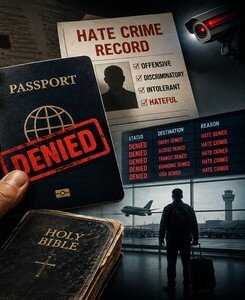
Imagine boarding an international flight.
The airline agent scans your passport, pauses, types a few more keys, then quietly picks up the phone. After a brief conversation, she returns with an apologetic smile.
*”I’m sorry, but you cannot transit through this country because of your criminal record.”*
You ask what crime you’ve committed.
“Hate speech.”
Your offense wasn’t assault. It wasn’t vandalism. It wasn’t inciting violence.
You publicly affirmed what Christians have believed for nearly 2,000 years–that marriage is between one man and one woman.
If that sounds like dystopian fiction, ask Finnish parliamentarian Päivi Räsänen.
After a seven-year legal battle, the physician, grandmother, former cabinet minister, and sitting member of Finland’s Parliament was convicted over a 22-year-old church booklet defending the biblical understanding of marriage. Although Finland’s Supreme Court unanimously acquitted her over a 2019 social media post quoting Scripture, it convicted her for the older publication, retroactively declaring her biblical teaching to be criminal “hate speech.”
Now the consequences are extending far beyond the courtroom.
According to author Rod Dreher and attorneys with Alliance Defending Freedom, Räsänen recently learned she could not even transit through London’s Heathrow Airport because British authorities considered her a convicted hate criminal.
She wasn’t traveling to campaign. She wasn’t organizing a protest. She wasn’t entering Britain to preach.
She simply wanted to change planes.
That should stop every Christian in their tracks.
Most believers assume persecution begins with pastors being arrested or churches being shut down. History suggests otherwise. It usually begins much more quietly–with labels.
First you’re “offensive.”
Then you’re “harmful.”
Then you’re “dangerous.”
Finally, society concludes that restricting your freedoms isn’t persecution at all. It’s simply protecting everyone else.
That is why Räsänen’s conviction matters far beyond Finland.
Across Europe, governments continue expanding hate speech legislation while the European Union explores broader standards for combating so-called hate crimes and online speech. Canada has spent years empowering human rights commissions to investigate speech complaints while proposing new online harms legislation and broader censorship measures.

Australia has expanded hate speech laws in several jurisdictions while pursuing misinformation regulations. In the United States, many progressive politicians have advocated stronger hate speech restrictions despite the significant protections afforded by the First Amendment.
The pattern should look familiar.
First, redefine traditional Christian teaching as discriminatory.
Next, classify it as harmful.
Then criminalize it.
Finally, ensure the consequences extend well beyond paying a fine.
That final step may prove the most dangerous.
If governments can officially declare biblical teaching to be hate speech, then the conviction itself becomes only the beginning.
Today, it may mean difficulties traveling internationally.
Tomorrow?
Could governments decide that people convicted of hate crimes should be barred from holding public office because they supposedly promote “extremism”?
Could professional licensing boards conclude that pastors, counselors, teachers, physicians, or attorneys convicted of hate speech are unfit to practice?
Could universities refuse to hire professors with hate crime convictions? Could churches face increasing financial scrutiny? Could charitable organizations lose tax benefits if their leaders have criminal records tied to biblical teaching? Could banks, insurers, or employers decide that someone officially labeled a “hate criminal” represents too great a reputational risk?
None of those possibilities require outlawing Christianity.
They simply require treating Bible-believing Christians as citizens who cannot be trusted with positions of influence.
That may sound speculative–but so did the idea of prosecuting a parliamentarian for publishing a biblical booklet twenty years before same-sex marriage was legalized in her country.
History offers an important warning.
Governments have always relied on labels before they relied on force. The Roman Empire branded Christians enemies of the state. The French Revolution labeled faithful clergy enemies of the people. Communist regimes called believers counter-revolutionaries. The terminology changes with each generation, but the strategy remains remarkably consistent: redefine virtue as danger, then justify punishment in the name of public safety.
Today’s preferred label is “hate.”
Once that label sticks, many people stop asking what was actually said.
Who wants to hire a hate criminal?
Vote for one?
Invite one to speak?
Trust one with children?
Allow one to travel freely?
The label itself often becomes more damaging than the original conviction.
Christians should be clear about one important distinction. Scripture commands believers to love every person because every individual bears the image of God. Genuine hatred has no place in the Christian life.
But loving people does not require abandoning biblical truth.
Nor should governments possess the authority to redefine historic Christian doctrine as criminal hatred.
Päivi Räsänen’s case is not simply about one Finnish grandmother or one unfortunate airport incident.
It is a glimpse into a much larger question every Christian should be asking.
What happens after the state officially labels biblical Christianity as hate?
The greatest danger may not be prison cells. It may be persuading ordinary citizens that faithful Christians deserve whatever restrictions come next.
Today it’s an airport.
Tomorrow it could be a profession.
One day it could simply be full participation in public life.
The question is no longer whether governments can make biblical Christianity unpopular.
The question is whether Christians will remain faithful when obedience to Scripture carries an ever-growing personal cost.