


(Contributed) OPINION: Horus Media
A party whose board has no skin in the game it’s designing.
This party was the first party I was a member of, because of disillusion with society’s degradation and government’s contribution to that. My life was tumultuous — kicked out of home at 17 by my solo-mother — a talented rugby player with a gift for pattern recognition and a sharp memory buttressed by a passion for many things. I managed to finish high school at Rosehill College anyway and got into Auckland University to study Psychology, Philosophy, and Ancient Greek History.
My attendance there didn’t last long. An unstable upbringing with next-to-no father presence developed a lack of consistency in my constitution. Instead of going inward and dealing with that issue so I could move on from my troubled past, I focused on external societal problems. I decided that something was wrong with this country and politics had something to do with it. Luckily, my departure from university into the trades helped me come in contact with good masculine role models.
The above demographic is not too dissimilar to the target voter class of The Opportunity Party — university students who are concerned about how they make it in a country with a fast-vanishing middle class. Or at least, that’s who it used to be.
I was right about something being wrong with this country, and that politics had something to do with it. Yet that had little to do with my situation. There were many things I could have done to insulate myself and my family from the difficult reality we are in now. Sadly, it would take over a decade to figure that out. Thankfully, there was a silver lining to a journey that started with resentment — it culminated in far more perspective than many get to attain. But it doesn’t always work out that way for most who are trapped in an understandable cage of resentment.
I joined TOP in 2017 because Gareth Morgan was saying things about politics that registered with what I was noticing. The issues with house price inflation, calling Jacinda Ardern lipstick on a political pig — which she was — and the complete destruction of innovative kiwi industry in favour of speculative real-estate fraud. In my mind, we used to be a country that genuinely aimed at what we proclaimed to be. We weren’t, and that led to a Neoliberal experiment that would eventually make things much worse, much faster. Our country went from producing an abundance of real things under the hypothetical banner of clean and green, toward producing a bunch of speculation under the hypothetical banner of clean and green.
The apparent existence of pattern recognition within this party resonated with me.
In this documentary, at 15:10, farmers march on Wellington — the first sector stripped bare by the experiment and asked to take the pain before anyone else was asked to share it. A suited onlooker shouts “bludgers” at the protest. Every person in that march grows what he eats. The word is the tell: the class that designed the theory called the productive class parasites for objecting to being an actual parasite’s test case.
According to Gareth and Geoff, we were going to become a party that relied on “evidence-based policies”. And yet their flagship policies — UBI and housing tax — were not, in any meaningful sense, evidence-based. The revenue projections for the UBI rested entirely on property value tax receipts that had never been tested at national scale in any comparable economy. They were based on Gareth Morgan’s unscientific beliefs. Pair this with their stance on 1080, which I knew to be flat-out wrong from rural experience and the ability to read studies properly. This led to understandable friction between me and the party. Today most of their failings can be proven — not just through the evidence, but by the party’s quiet retreat from these policies the moment coalition negotiations became a real possibility.
The party now operates under a pure land value tax: 1.75% on urban land, 0.5% on rural. At current values this projects approximately $24 billion in annual revenue. Their universal income of $19,400 per adult costs approximately $79.5 billion against New Zealand’s 4.1 million adult population. The gap is not a rounding error, and no published model closes it.
In 2021, I put a question directly to the party’s leader — Shai Navot: shouldn’t you be finding out precisely why Germany’s house prices have not moved much at all in all this time, and building policy toward that outcome instead? The question went nowhere under the previous leaders, but Shai showed genuine interest. It should have. The question was aimed at finding the root cause of our problem by looking at everything Germany was doing right and comparing it with the whole scope of what we had been doing since the 1984 economic revolution.
What the evidence now shows is that Germany’s housing stability has nothing to do with taxes. It comes from four things the party never proposed: a manufacturing-to-GDP ratio kept high through the Mittelstand model — industrial policy, family-owned enterprise, and vocational training working in combination; a sophisticated rental market with strong tenant protections; conservative mortgage lending that kept debt-fuelled demand in check; and supply flexibility that allowed density where demand existed. Germany’s own land tax experiment — introduced quietly in Baden-Württemberg from January 2025 — was set at a revenue-neutral rate. No housing outcome data has been published. The party cited Germany. The party did not propose a single meaningful thing Germany actually did.
Now they have shifted away from Germany as a legitimate example and chosen to cite “Denmark, Taiwan and several Australian states.” I find political parties to be leaning toward incompetence and laziness when it attempts to tax its way toward hypothetical solutions. It’s like a company trying to make itself profitable by reducing wages and increasing prices instead of reducing waste, and encouraging efficiency through lawful innovation execution.
Through my research, everything is funded through the land tax, and this is no small problem. You cannot tax land — you can only tax the beneficial interest in a land title, and to do that lawfully requires both authority and consent. The maxim is unambiguous: that which is mine cannot be lost, transferred, or taken away without my own act, consent, or forfeiture. Government does not own land; under common law it holds radical title at most. What a registered proprietor holds is beneficial interest — their own creation through purchase, improvement, and stewardship. The party proposes to levy against that interest without establishing the authority that would make the expansion legitimate. Declaring the power to do so does not confer it.
If you identify as “Māori”, or more accurately; native. You may consider yourself exempt. Which is a real possibility with this party, their policy virtue signals toward Te Tiriti make them an obvious contender for unfair race pandering policy amendments. Therein lies another contradiction — an exemption from a universally applied land levy justified through racial distinction is a divisive policy. The party that positions itself as post-racial progressive politics would be, in practice, legislating racial categories to make its flagship policy workable. That is not a solution to the problem. That is the problem in different clothing. You may think this is ok because you identify as Māori, but be forewarned — the measure of the swing to the left is the measure of the swing to the right.
None of this would matter much if the party were at least honest about what it is. The most significant thing Opportunity has done in this election cycle isn’t any of the above. It’s what their leader says in interviews.
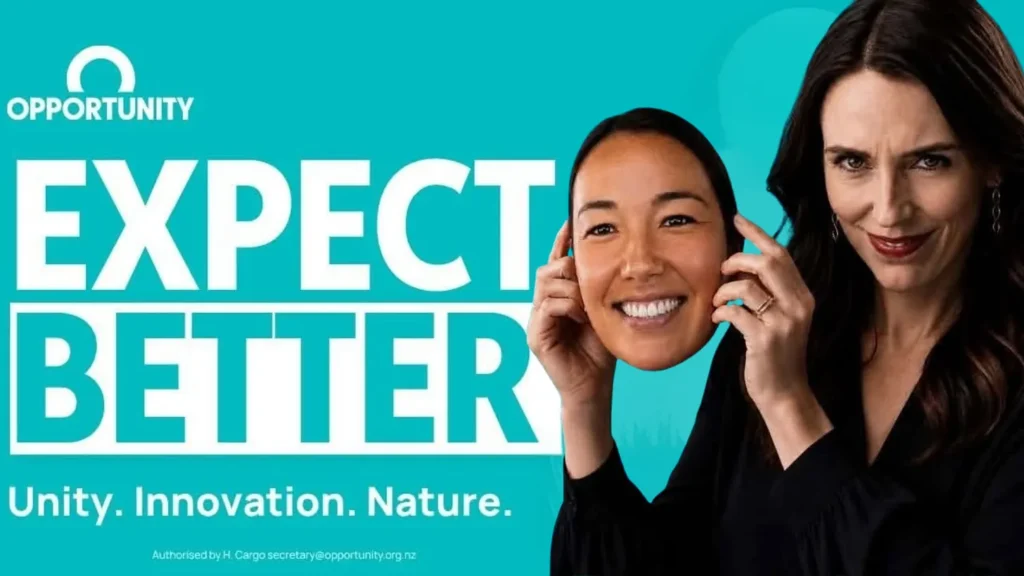
In a recent interview with Jack Tame, Qiulae Wong openly stated that the party suspends its stated principles in order to acquire power, with a promise to restore them once in Parliament. She didn’t hide it. She said it out loud.
What you are watching is a performative contradiction — and I want to be precise about that term, because it matters. A performative contradiction is not a mistake. It is not an inconsistency born of ignorance. It is the act of asserting a principle while the very act of asserting it contradicts the principle being asserted. The party that campaigns on cleaning up politics is explicitly telling you it will play dirty politics until it has enough power to stop itself. The party that proposes capping donations at $30,000 per election has accepted $221,160 from one man in a single year — and that’s before you count what his company put in separately.
That man is Alan Wilderland — co-founder of Serato Audio Research, and currently a sitting member of Opportunity’s board. In 2025, Wilderland sold a 66% majority stake in Serato to a Canadian holding company called Tiny for US$66 million. Since then, he has donated $221,160 to Opportunity personally, with his company Alajamber Limited making additional donations on top of that. When asked by RNZ about the obvious tension between his giving and the party’s own “Clean Up Politics” policy — the one that would cap donations at $30,000 per election — his response was: “You have to play the game.”
You’ve heard that phrase before in this piece. It’s the same logic Qiulae Wong deployed on Jack Tame. The largest donor, the party leader, and a sitting board member have independently reached for identical language to justify the same suspension of principle. That is not a coincidence. That is the operating philosophy of the organisation, stated three times, from three directions, without apparent awareness of how damning their moral relativism is.
Here is why this matters structurally, not just ethically. Under Opportunity’s own constitution — clause 11.3 — the board holds a veto over caucus decisions. That veto requires 75% of the board to exercise. The board has five members. Alan Wilderland is one of them. The man who has donated more than seven times what the party’s own policy would permit sits on the body that can constitutionally override the elected Members of Parliament he helped fund into office.
In a corporate structure you’d call that a controlling interest. In political philosophy you’d call it capture. In plain English, it means the people writing the cheques have a constitutionally embedded mechanism to direct the people cashing them.
Now, to the board itself — because the composition is instructive. Penny Fairbrother chairs it; she is a Senior Advisor at Greater Wellington Regional Council. Darren Savage manages projects at Waikato Hospital. Scott Pollok is a patent attorney. Dan Thurston Crow volunteers for Taranaki’s startup ecosystem and chairs an environmental NGO. Alan Wilderland built music software. Every single person on this board operates in sectors that are either asset-light or publicly funded — none of them are sitting on significant land assets. The flagship policy of the party they govern — the land value tax — would fall hardest on exactly the people structurally absent from this room: farmers, commercial property owners, elderly New Zealanders on fixed incomes in homes they have held for thirty years.
This is not an accident. It is an echo chamber with constitutional authority.
When criticism of this structure emerged publicly, one of the most energetic defenders of the party in the resulting comment section turned out to be Dan Thurston Crow — Opportunity board member, former candidate in Mt Albert 2017 and New Plymouth 2020 — who spent considerable effort pushing back on critics without once identifying himself as a member of the governing board of the party he was defending. His was the highest-liked comment in the entire thread, with 107 endorsements:
“The game is the game. You don’t get to change it by sitting, hamstrung, on the sidelines. The money going into Opportunity is for that precise end: to strengthen democracy, to reform tax so that it’s equitable, and to stop kicking down the road the cans that are leading us inexorably into an unsustainable future.”
Another commenter, Bobbi Pagani, did what Crow would not:
“Dan Thurston Crow is a Board member of Opportunity and stood for it in Mt Albert 2017.”
The organic public response from people with no knowledge of clause 11.3 was more perceptive than anything the official defenders managed. Jo Calascione’s comment drew 81 endorsements:
“Wong is an employee. She will do and say exactly what she’s told to do by those who pay her wages.”
People’s pattern recognition, given sufficient observation, tends toward accuracy.
Which brings me to the party’s targeting strategy — because the echo chamber doesn’t sustain itself without recruitment. Opportunity’s support base is drawn predominantly from younger voters gaining intellectual confidence through university: people at the developmental stage where newly acquired analytical tools feel like they apply universally. I know that demographic well. I was in that demographic. The arrogance that comes with newly acquired intellect is not a character flaw — it is a stage, and most people pass through it. But it is a precise window of vulnerability to a very particular kind of argument.
The argument Opportunity makes is game theory dressed as ethics. Suspend the principle now, apply it after you have power. The greater good justifies the temporary suspension of the stated principle. This logic has a formal name in philosophy — consequentialist rationalisation — and its distinguishing feature is that it can justify almost anything, depending on how confidently you assert the hypothetical future benefit. It is the logic that has preceded every political betrayal you have ever watched. Not occasionally. Systematically.
When this argument was challenged publicly, not one defender was able to deny the contradiction. Not one. The responses were: “you have to play the game,” “pragmatism over purity,” “this is how it’s done.” These are admissions with decoration. The structure of the argument was acknowledged each time, and then excused. An excuse is not a reason when it does not serve reason.
The reason I left this party once, and decline to return to it, is that none of this has changed. The names have changed, the leader has changed, the party has been renamed. Yet, the performative contradiction is the same one that was present under Gareth Morgan, and the structural governance problem is the same one that was present under Geoff Simmons. What has been added in 2026 is a donor-board member who has already exceeded the party’s own proposed donation cap by a factor of seven, and who reached for the exact same phrase as the leader when asked to account for it.
This is not about Qiulae Wong’s character. It is about the architecture of the organisation she “leads” — and that architecture was built before she arrived, has persisted across every leadership change, and will persist after the next one too.
New Zealand was not built on the courage to change. It was built on the courage to be honest about what change actually requires. That bar, this party has not cleared.
Verdict
Before concluding, it’s worth asking the question the party never answers publicly: who do these policies actually benefit?
Not the young renter. The LVT falls on land title, and the young renter holds none — yet. The moment they succeed at the aspiration the party claims to support, the policy turns on them. The UBI, funded through an untested revenue mechanism, offers precarity relief now at the cost of a potential lawful claim on future property.
The people these policies genuinely protect are people who have already converted their productive capital into intangible assets that aren’t land-based. People in salaried public-sector roles, professional services, and technology — people for whom a land value tax is simply not a cost. People like every member of the board that governs this party — this is not a coincidence, it is the explanation.
The target demographic is the demographic the board fits. The recruited demographic is the demographic that hasn’t figured out — that they’re their flying monkeys.
Designation: Captured Pied Piper
A Pied Piper plays music the children want to hear, a captured one doesn’t even write the tune.