


Liam Rondi
Almost nothing you’ve been shown online explains why almost half a million people marched last Saturday
On October 6th, Donald Trump told his followers on the ironically named Truth Social that what was happening in France “isn’t about schools”. It was about Islam, he explained, wanting to take over a once-great country. He offered no evidence, as is his custom, yet the post travelled the way his posts always do.
Fifteen days earlier, pupils at the Lycée Saint-Exupéry in Créteil, on the south-eastern edge of Paris, had blockaded their own school gates. Their complaints were about that building specifically, namely teachers who hadn’t been replaced, classes too big for the rooms and a school falling apart around them. Within days, the blockades had spread across Île-de-France, then the country. By early October, hundreds of schools had closed.
It was about schools, and I want that on the record before anything else, as the rest of this piece is about how it’s been distorted since.
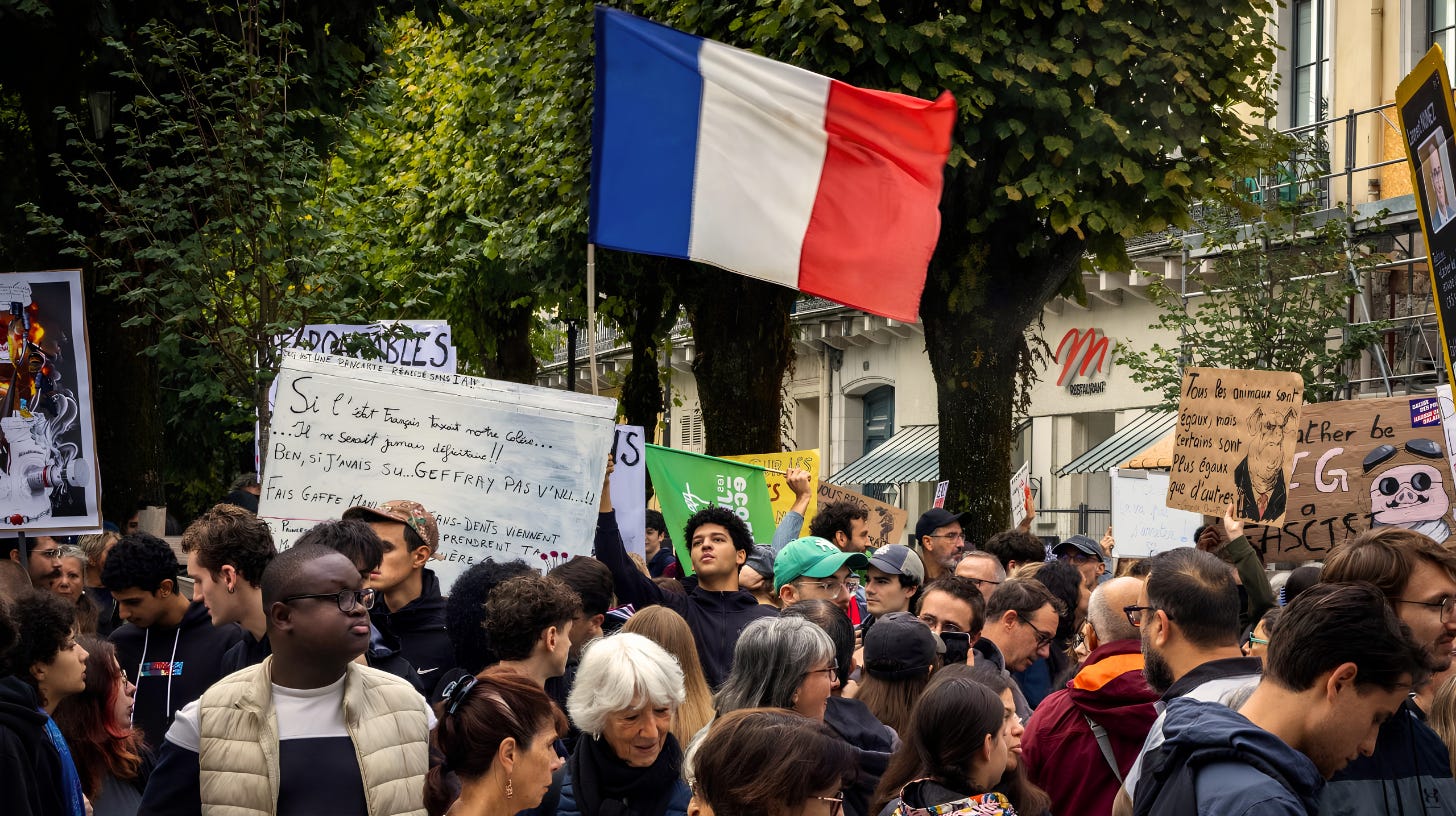
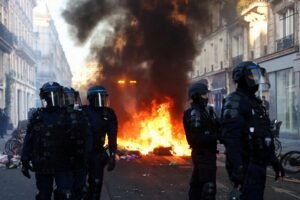
I’m British, and I’ve lived in Montpellier for over two years. On Saturday, the local newspaper counted around 35,000 people marching through my city, with sixth formers at the front. The interior ministry put national turnout at 550,000; organisers have said 800,000. By Sunday night, a 22-year-old police officer was dead in Nantes after being struck by a vehicle. A protester died north of Paris after a cardiac arrest, and Limoges’ town hall, built in 1883, was gutted by fire. At the end of the weekend, a total of over 2,000 people had been arrested.
Although all of this is very much true, none of it is the entire story. Watching from here, in the middle of a supposed Islamist warzone, I can tell you the version being offered to those of you across the Channel is vastly different to the reality.
I’d like to be very clear about where I stand – I’m with the majority of the people who marched. I’m with the sixth formers who started all of this, the teachers, the parents, the union members, retirees and farmers who came out alongside them on Saturday, because they’re struggling and nobody in charge wants to listen. Nothing I say in this piece negates that. In fact, being on their side is the reason I won’t soften the violence for you, and it’s the reason why I’m so utterly frustrated about what’s been done with it.
The student movement is the spine of this, and its demands are far from outrageous. Student unions have asked for teachers to be recruited at scale, as well as more university places and €10 billion in emergency funding to fix school buildings. That number may sound eye-watering, but so is the magnitude of the problem.
Parents have joined them over school days that, in some areas, can stretch to ten hours. France is one of the OECD countries where your social background weighs heavily on how you do at school, and a lot of the teenagers protesting have clocked that the sorting starts in buildings like the one in Créteil. By one estimate from Thomas Piketty and Lucas Chancel, higher education spending per student in France fell by nearly 15% in real terms between 2017 and 2023. Quite frankly, the kids are not imagining it.
Everyone else’s money is fast running out, too. The call to march on October 17th started online – as most things do – stemming from anger about fuel prices, before widening into the cost of living in general (energy bills are up by around a fifth on last year). Prime Minister Sébastien Lecornu is trying to get a deficit-cutting budget through a hung parliament just months before an election. The gilets jaunes – the movement that started over fuel tax in 2018 – came out to stand alongside the students, and then the unions followed, and some farmers.
A blockade at one lycée turned into half a million people. No one person or group organised a widespread takeover – it was simply many different people discovering they had the same complaint about having no money and being talked over, with the teens happening to lead the charge. By Sunday morning, someone had sprayed “those who sow misery reap anger” on the statue of Marianne at République. Even if you don’t like it, you must surely understand it.
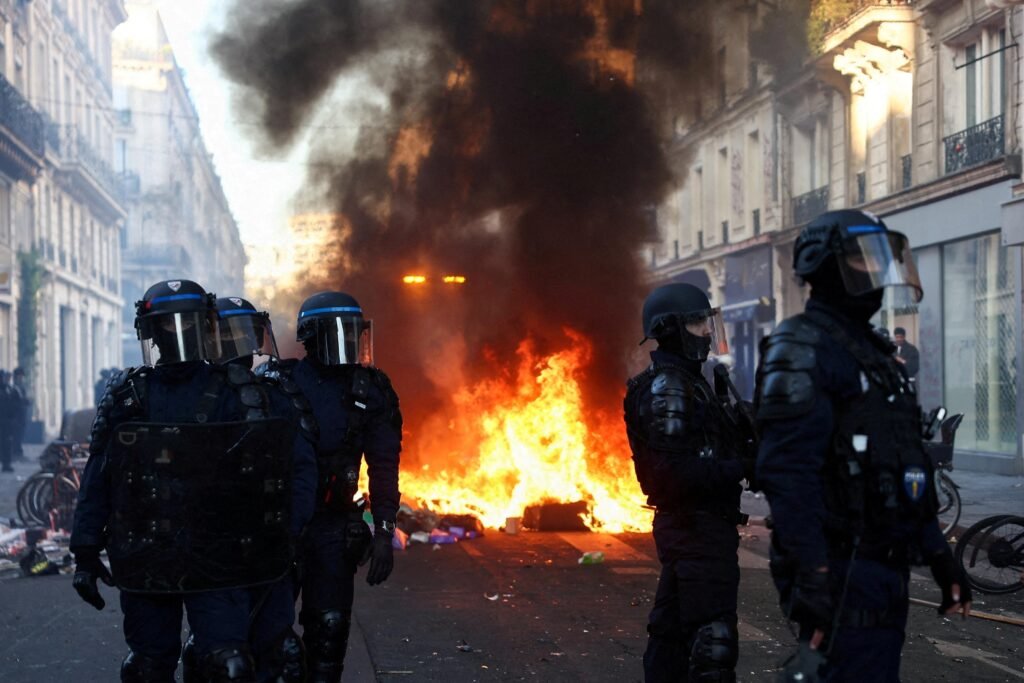
I won’t downplay the reality of what occurred this weekend. In Paris, a reporter watched masked men smash shopfronts with what looked like golf clubs, leaving with bags of stock. An elderly couple was robbed and stripped by rioters, according to a police source (note: this has now been debunked). In Marseille, a group forced its way into the city hall. The Limoges fire spread through the building while councillors and staff were still inside – nobody was hurt, which was more luck than anything else. More than 600 police officers were injured.
It happened here in Montpellier, too. The Monoprix window on the Comédie was put through, with food being handed out from inside. Foot Locker was broken into and looted, even though some protestors unsuccessfully tried to stand in front of it. The prefecture reports 63 arrests and 36 officers hurt. Our mayor has blamed a minority for discrediting the people who’d come to protest, and I agree with him on that. A student in Paris told Al Jazeera much the same thing from the other side, which is that she marched start to finish without seeing any trouble, yet the trouble is all anyone is seeing now.
The men smashing windows and looting stores clearly weren’t sixth formers protesting poor school conditions. Groups who turn up to French marches prepared to disrupt things are a known quantity here – the press calls them casseurs – and so are the opportunists who arrive once things have kicked off. Macron’s government blames organised ultra-left groups. If that’s the case, they should answer for it in court like anyone else, and the students they wronged should be first in the queue. These agitators wrecked a largely peaceful march and handed the government a convenient story. Jean-Luc Mélenchon blames the police. With an election months away, none of this bodes well.
However, some blame does lie with the police, and it cannot be denied. A “violent minority” may be culpable for some smashed shop windows, but it doesn’t explain why Saturday was so much angrier than the protests that came before it. The honest answer has to include how this entire movement has been policed.
By October 13th, four days before the big march, France’s police watchdog had opened 36 investigations into alleged police violence at the school protests. Lawyers acting on behalf of injured pupils have compared some of the wounds to what you’d see in a war zone. One boy has lost a hand, another had his jaw smashed, a third lost his sight in one eye. Stun grenades were doing so much damage at student demonstrations that the French government stepped in to suspend their use on October 7th. A girl in Alençon was filmed being put in a headlock by an officer, a move French law bans outright. By the start of October, more than 6,000 people had been arrested, a majority of them under 18.
In Dunkirk, police drove a 4×4 at a crowd of school students and a 14-year-old girl was taken to hospital. That vehicle, it turns out, was paid for by British taxpayers – bought under the Sandhurst treaty to stop people boarding small boats on French beaches. The French interior ministry has opened an investigation, and the Home Office declined to comment.
On Saturday in Paris, police fired tear gas and stun grenades before the march had even begun. If you’re 16 and you’ve spent a month being gassed outside your own school for asking to be taught, you’ll arrive on the day in a particular mood. I’m not defending whoever set fire to a town hall, but it’s an accurate description of how a crowd gets riled up. Governments that refuse to look at the reality of it will most likely experience it again.
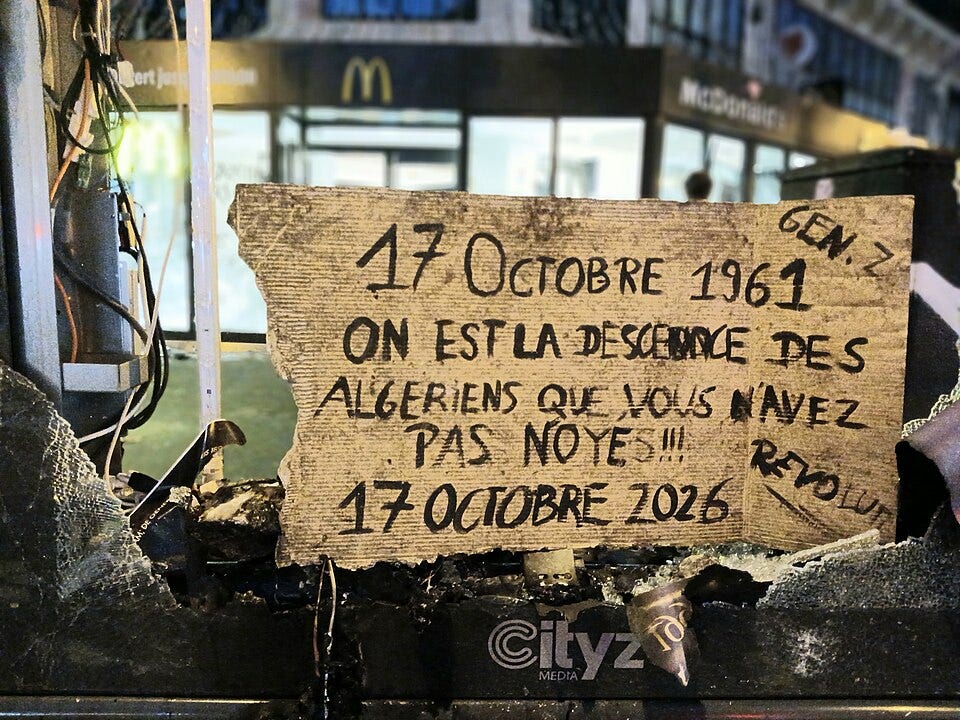
Something else I haven’t seen mentioned much is the relevance of the date. In Montpellier, somebody tagged the Jeu de Paume with “17 octobre, ni oubli ni pardon” – no forgetting, no forgiveness. Saturday marked the 65th anniversary of October 17th, 1961, when Parisian police officers killed Algerian demonstrators and threw some of them into the Seine. Plenty of people on that march know exactly how long the memory of the French state is, and how long their own is.
What I find disturbing is the version of events that has apparently reached Britain and the US. Weeks before Saturday, NewsGuard had already caught videos from 2017 and 2023 being recirculated as fresh footage of the student protests, as well as a Russian influence operation pumping out 20 fake news reports in two days, disguised as legitimate stories from reputable outlets such as AFP, Deutsche Welle and Le Monde. One had the Pope cutting short a visit to France after an attack by Muslims; another had 54 teachers killed. Neither happened.
France 24 found Alex Jones telling his audience he’d seen at least a dozen videos of Catholic priests being set on fire, and traced a much-shared “France has fallen” clip back to a football celebration. Tommy Robinson was posting footage with anti-immigration captions. In fairness, being purposefully misleading isn’t one-sided – NewsGuard also flagged far-left accounts passing round a misleading video of a police dog charging at students.
On Saturday night, GB News presenter Alex Armstrong told viewers the French riots were down to mass migration, Islamism and “parasitic far-left ideologies”. The day before that broadcast, Armstrong had apologised through his barrister at the High Court and agreed to pay substantial damages to Mothin Ali, a Muslim Green councillor he had falsely linked to the 2024 Harehills riots. Less than 24 hours after paying out for pinning a riot on a Muslim man, he was on national television pinning one on Muslims in general.
By Sunday, though, GB News’ website had moved on. The French government was blaming the “ultra-left”, so the headlines were about a crackdown on ultra-left criminals. They ran Trump blaming migrants with “hatred in their hearts” on the same page. GB News itself ran the story that French police had rammed student protesters with cars funded by the British taxpayer – money meant for stopping small boats, a subject the channel rarely struggles to find airtime for.
On the same evening as the riots, according to GB News, France’s students were an Islamist vanguard. By Sunday lunchtime, they were ultra-left criminals who were also, somehow, children being run down by a British-funded police car. Nobody there seems to even want to try to tell a cohesive story. The explanation keeps changing because, believe it or not, it isn’t the most important thing. The product is the footage – a burning town hall is perfect for a feed, because it arrives without context and whoever shares it gets to dictate what it means. The algorithm pays out the same, whether the caption blames Islam or socialism.
Britain, of all places, should know how this works. In 2024, a false name and false claim that the Southport attacker was a Muslim asylum seeker travelled around social media, and within days there were violent riots outside mosques and hotels housing migrants. In June of this year, Bev Turner looked at footage of a house on fire in Belfast and told GB News viewers that actually, there were no riots in Belfast. Whether this behaviour is condemnable or not, it turns out, depends on who’s to blame.
From where I’m sitting in Montpellier, this weekend didn’t look or feel like a country falling. It looked like France. This is a country that quite notoriously protests as a civic habit, in 1968, in 2006, in 2018 and in 2023, and whose state polices protest hard. Both of those things were on full display this weekend, along with the people who come to disrupt. The most accurate thing anyone can say is that it all happened at once, the ugly culmination of people’s collective anger and frustration. It’s an unexciting conclusion, which is exactly why it doesn’t travel nearly as far.
When Macron addressed the nation on Sunday evening, the weight of his speech fell on the far left and the “delinquents and criminals” who’d joined them, on shame, and on prosecutions as fast as possible. The hundreds of thousands of French citizens who marched with legitimate demands got a passing acknowledgement and the promise of a meeting this week. He announced nothing on teachers, school buildings, fuel or the budget. A young Frenchwoman on my For You page was frustrated that he’d gone straight for the extreme left without dealing with why anyone was out in the first place, and I think she has a point. If the core reasons for the protests only get one line in the president’s speech, it isn’t a surprise they get none on GB News.
Reassuringly, France’s students aren’t backing down. The main high school union, USL, is boycotting its meeting with the education minister because it wants the prime minister in the room too. The unions have already called for a national strike on November 5th. These kids have been tear gassed outside their schools, arrested by the truckload, blamed wholesale for a weekend of arson and told by an American president that they’re a front for Islam. They’re still asking for the exact same things they were demanding in Créteil, when all of this began. They have my full solidarity, and they deserve a lot more of people’s attention than the disruption has had.
I guarantee that none of those upcoming events will make it to your timeline unless something catches fire. If it does, remember what they were asking for before it did.
About the Author: Liam Rondi is a Brit living in the south of France.