




The early years matter, but no window slams shut at three. The brain keeps rebuilding for decades.
The worry arrives with the newborn and then refuses to leave. It says that the brain is being built in a
hurry, that these first months and years are the ones that truly count, and that whatever is missed now is missed for good. It is the reason a tired parent props a flashcard against the cereal bowl, or feels a small drop in the stomach when the baby group is skipped for a second week running. It is the familiar sense of a clock running down while everyone is just trying to get dressed.
The worry has a slogan behind it. The first three years became a rallying phrase decades ago, borrowed loosely from real findings about early brain growth, in particular the burst of new connections that a baby’s brain makes in its first years. That burst is real. The deadline is not. A young brain does overproduce connections and then quietly remove the ones it is not using, but that trimming carries on well into the teens. The biological switch that opens a learning window turns out to be a switch that can be opened again.
Where the slogan came from
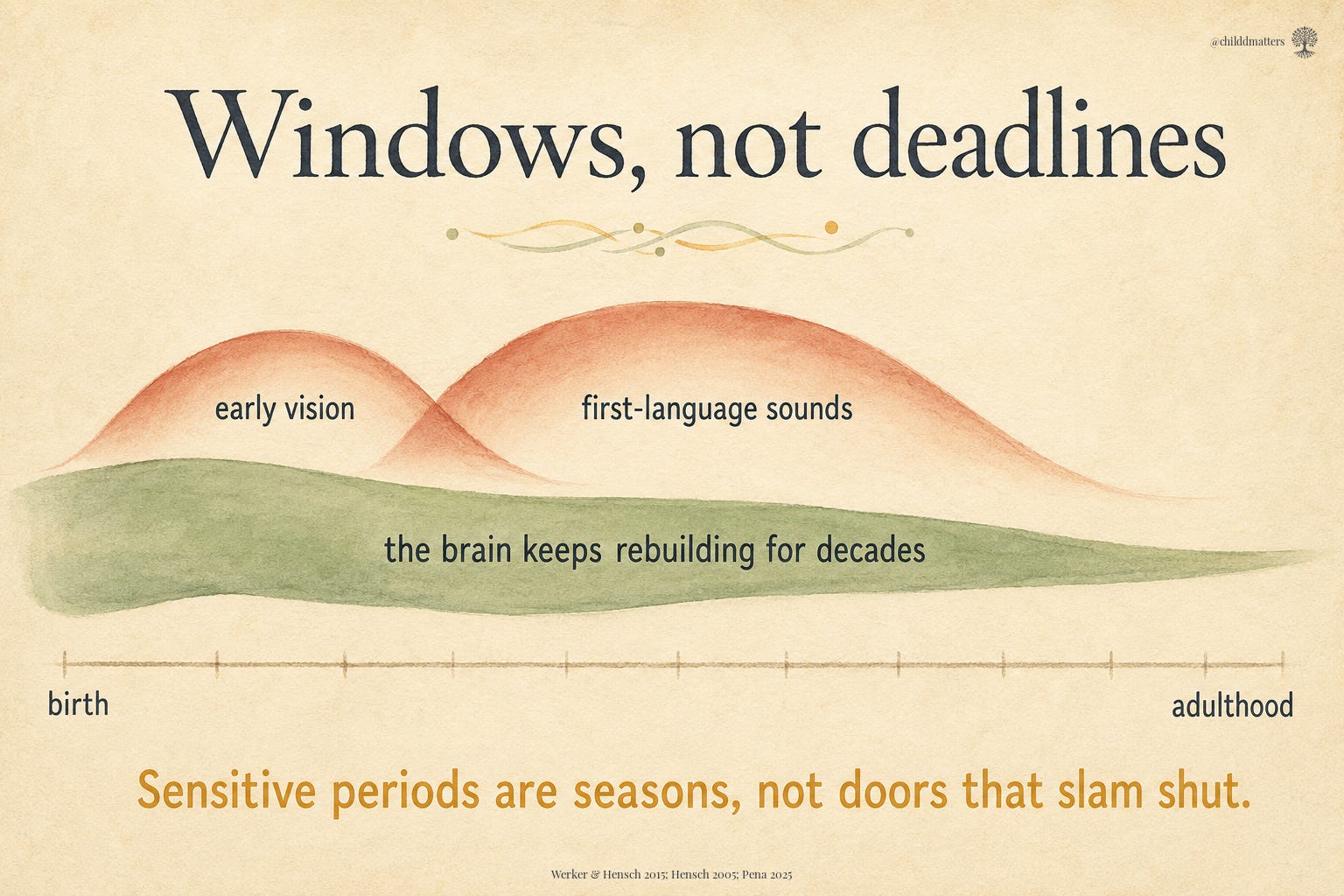
The idea did not appear from nowhere. There genuinely are stretches of early life when the brain is especially ready for a particular kind of input, and scientists call these sensitive periods. A few are strict enough to earn a harder name, a critical period, where a chance once missed is largely gone for good. Vision is the clearest example of that strict kind. A baby born with a clouded lens who is not treated in the first months can lose sharp sight in that eye for life, because the visual part of the brain needs patterned light early in order to wire itself properly. That is a true window, and it is why newborn eye checks matter.
The trouble is what happened next. A few specific windows, early vision and the particular sounds of a first language among them, were stretched into a general law that seemed to cover love, maths, music, and manners all at once, with a firm cut-off somewhere around a child’s third birthday. That leap, from a handful of narrow biological phenomena to a countdown hanging over the whole of childhood, is the part that was never in the evidence.
What a window actually is
It helps to know what is happening underneath. A window opens when the brain’s calming signals, its brake, finally mature enough to balance the excitatory ones, its accelerator. It closes when a mesh of molecular scaffolding hardens around the new connections and locks them in place. Here is the part that changes how the whole thing feels: in the laboratory, that scaffolding can be loosened again, and the window reopens. Even the real windows behave less like a door slamming and more like a growing season, the easiest time to plant, not the only time anything will ever grow.
So when a parent hears that the brain is being wired early, the accurate version is gentler than the slogan. The wiring is ongoing. The early years are busy, but they are the start of a long build, not a frantic last chance.
A brain that keeps rebuilding
The evidence for lifelong change is hard to argue with once you look. Learning to read reshapes the visual system of a school-aged child, years after the supposed window has closed. Adults may recover speech and movement after brain injury by recruiting new tissue for the job. People learn new languages, new instruments and new skills into old age, more slowly than a small child in some respects, but the brain doing the learning is the same kind of adaptable organ at eight and at thirty-eight as it was at three.
This is where the ordinary things a parent already does turn out to matter most, and not for the reason the slogan implies. Talking with a child and answering them, day after day, is powerful precisely because it happens again and again over years, not because a timer is about to run out. A missed month is not a missed life. The relationship is the intervention, and it stays open.
The case where early years truly are high-stakes
There is one situation where the early years really do carry heavy weight, and it is worth being honest about it. Children raised in extreme deprivation, where the ordinary input a brain expects, being talked to and being allowed to explore, is largely absent, can show lasting effects, and earlier support seems to improve the odds. That is a serious and well-documented finding. It is also a completely different thing from whether a typical, loved toddler did enough educational apps. Blurring the two takes a finding about severe neglect and turns it into a source of guilt for parents who are already doing the thing that counts.
The takeaway
The first years matter because children are learning constantly then, not because a door is about to close. Real windows exist for a few specific things, mostly early vision and the sounds of a first language, and even those behave more like seasons than deadlines. For almost everything else, the brain keeps rebuilding itself for decades. If you are reading this while your child is already past three, you have not missed your chance. There was no single chance to miss.
Key references
Hensch, T. K. (2005). Critical period plasticity in local cortical circuits. Nature Reviews Neuroscience, 6(11), 877-888. https://doi.org/10.1038/nrn1787
Peña, C. J. (2025). Epigenetic regulation of brain development, plasticity, and response to early-life stress. Neuropsychopharmacology, 51(1), 5-15. https://doi.org/10.1038/s41386-025-02179-z
Werker, J. F., & Hensch, T. K. (2015). Critical periods in speech perception: new directions. Annual Review of Psychology, 66, 173-196. https://doi.org/10.1146/annurev-psych-010814-015104