


Katy Nolan/PNW News Agency
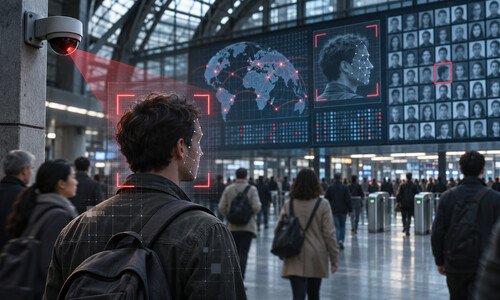
Imagine walking through a train station, a public square, or a checkpoint. A camera records your face. Software compares it with millions of stored images, finds a possible match, and pulls up a name and a file. You may never know it happened. You may never learn what the system thinks it knows about you.
That technology can help a country track down terrorists and search for hostages. After the October 7 attacks, Israel had urgent reasons to identify the people who carried them out. But facial recognition is spreading well beyond one battlefield and one purpose. The deeper question is what happens when the ability to identify people at scale becomes part of everyday life.
A recent report says the Israeli military uploaded 3.5 million Palestinian photographs to Amazon Web Services, or AWS, for analysis using Amazon Rekognition—Amazon’s facial-recognition and image-analysis service. The report describes a striking expansion in the scale of facial data available for searching. And that raises a question no country can avoid: Who will be able to use these systems tomorrow, and who will they be looking for?
A Face Becomes a Searchable Record
A photograph used to capture a moment. Someone had to recognize the person, identify them, and connect that face to other information. Facial recognition changes the equation. Software can compare an image with a large collection of stored photographs and produce possible matches in seconds.
Now imagine that capability connected to cameras in public spaces and databases containing names, family details, travel records, work permits, or past encounters with authorities. A face could become the key that ties those pieces together. Someone walking through a crowded area might be identified without speaking to an official or showing identification.
That does not mean every camera is watching every person all the time. Nor does a software match prove someone has committed a crime. But when facial-recognition software is connected to extensive databases and used at enough locations, it can make people’s movements and associations far easier to trace.
And the consequences of a mistake can be serious. A false match could lead to questioning, detention, or a lasting record that follows someone long after the system got it wrong. A person cannot simply change their face the way they can change a password.

The Purpose Can Change With the People in Power
The technology does not decide who is dangerous. People do.
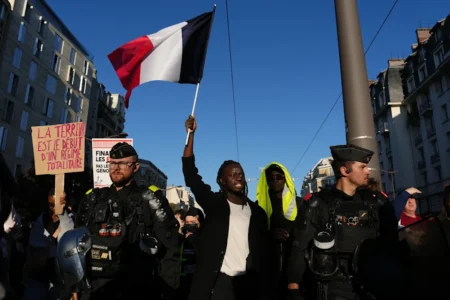
Today, officials may say they are looking for terrorists, violent criminals, or missing hostages. Those are urgent and understandable goals. But a database built for one purpose can be kept, expanded, and searched for another. A new administration might define “extremist” differently. A security agency might decide that attending a protest deserves scrutiny. A government hostile to Christians might use similar tools to identify church leaders, track people attending a gathering, or map networks of believers.
The concern is that the capacity to identify and follow people does not belong to one government or one political moment. Once it exists, other governments can build similar systems—and future leaders can inherit systems created by their predecessors.
The progression could be gradual. First, cameras are installed to address a real danger. Then they are used for another serious crime. Later, authorities expand the watchlists or lower the threshold for an alert. Each step can be defended as a practical response to a new threat. Over time, the public may discover that being watched has become routine and that challenging a match is difficult.
“Now What?” Is the Question We Cannot Ignore
The Israeli security threat is real, and the search for those responsible for October 7 is not morally equivalent to the hypothetical persecution of Christians by a future government. But the legitimacy of one mission cannot settle every question about a technology that may outlast it.
Who is allowed to enter someone into a database? What evidence is required before an alert can trigger action? How long are images and records retained? Can people learn that they were misidentified and correct the record? Who checks whether the system is being used for the purpose officials originally promised?
Those questions matter because facial recognition can quietly shift the balance between the individual and the state. The government does not have to stop every person on the street. It may be enough to know who attended, where they went, whom they met, and which names to search later.
A camera can be installed in a day. A database can grow for years. And the officials who decide what the system is for today will not necessarily be the ones who control it tomorrow.
The danger is not that every face will immediately be tracked everywhere. It is that technology is making that kind of reach increasingly possible—and making it easier to tell the public that the people being watched have nothing to fear.
Until the day the target changes.