

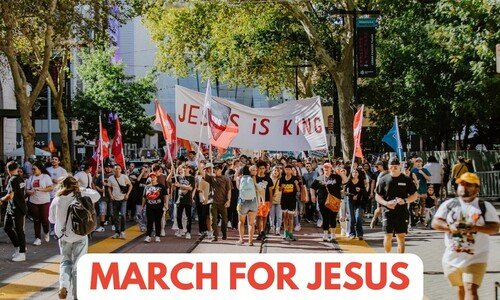
Britain has always claimed to be a land of faith and freedom–but those words ring hollow in Whitechapel. A planned “Walk With Jesus” march has been banned, not because it is illegal or violent, but because authorities fear it might offend others. Peaceful Christians are now being told they cannot proclaim their faith in public without risking arrest. This is more than a local police decision; it is a warning about the direction of an entire nation.
The Metropolitan Police’s decision to halt the event, scheduled for January 31, centers on Whitechapel’s large Muslim population. Organizers promoted the procession as a Christian worship event during what they called “the month dedicated to the holy name of Jesus.” Yet, authorities deemed marching there “reckless,” citing intelligence suggesting a hostile reaction that could lead to disorder. The march can proceed elsewhere–but not in the neighborhood chosen by the faithful.
Deputy Assistant Commissioner James Harman emphasized that the decision rested solely on public safety, not politics or offense. Anyone defying the ban would face arrest. But even framed as a safety precaution, the message is clear: in certain neighborhoods, publicly walking with Jesus is too dangerous for Britain to allow.
The troubling reality is that this ban sets a dangerous precedent for Christian expression. Public worship is no longer protected simply because it is peaceful and lawful; it is now conditional on whether it might provoke others. The message is unmistakable: if your faith risks offending someone, you must stay silent, stay home, or march somewhere “safe.”
This is not neutrality–it is a surrender of fundamental rights. A nation that once proudly carried the name of Jesus through its streets, schools, and institutions now treats His name as a potential threat. When peaceful Christians are told they cannot publicly honor their Savior for fear of angering others, the very idea of religious freedom is eroded. Authorities are effectively placing the burden of tolerance on those who simply seek to live out their beliefs, while rewarding hostility with de facto control over public space.
In essence, Britain has transformed from a country that once celebrated its Christian heritage to one where worship must be carefully managed to avoid conflict. The right to assemble, to proclaim faith, and to walk openly with Jesus is no longer guaranteed; it has become negotiable, contingent on the reactions of others.
Whitechapel has long been home to one of Britain’s largest Muslim populations. That fact alone should not–and historically did not–preclude Christian expression. Britain is not a theocratic Muslim state. It is, or at least was, a nation shaped by Christianity, whose laws, liberties, and institutions were built upon biblical foundations. The freedom to assemble, worship, and publicly proclaim one’s faith was never meant to be conditional on whether it offends another religious group.
Police claim they are motivated purely by safety, but this logic raises a disturbing question: When did expressing Christian faith in public become a threat to society? If peaceful worship is now seen as dangerous, what does that mean for other forms of Christian practice–sermons, school nativity plays, or public prayers? Today it is a march; tomorrow, it could be a hymn, a cross, or a sermon that is suddenly too provocative.
The cultural implications are profound. Once a nation unafraid to celebrate its Christian roots, Britain now treats those roots as liabilities. Public expression of faith is no longer a matter of conviction but a matter of caution, measured by the likelihood of provoking others. And in this calculus, Christians are expected to self-censor to accommodate potential hostility.
This erosion of freedom extends far beyond Whitechapel. It touches schools, workplaces, civic events, and neighborhoods across the country. When one group’s potential reaction dictates whether another group may worship, liberty is not protected–it is suspended. And in that suspension, the very identity of the nation changes.
Britain’s Christian heritage is not merely a historical footnote. It is the soil from which its freedoms grew. To now treat public Christian worship as a destabilizing threat is to deny the nation’s own soul. The question is no longer whether Christianity is being sidelined in the UK. That debate is over. The question now is how far this retreat will go–and how many freedoms will quietly disappear in the process.
A nation that once sent missionaries to the ends of the earth now hesitates to let believers walk its own streets. That should grieve us. And it should wake us up.