


Story by Anugrah Kumar:
The Taliban has codified slavery and formalized a class-based justice system in Afghanistan through a newly approved criminal procedure code signed by its supreme leader, Hibatullah Akhundzada. Legal experts and international rights groups say the new law strips away due process and institutionalizes privilege based on gender, religion and social status.
“The Taliban has now approved the return of slavery in Afghanistan. We must defund the Taliban,” Jim Risch, R-Idaho, chairman of the U.S. Senate Foreign Relations Committee, wrote on X. “Not only is it counter to US interests and an affront to all military members who served there, but the Taliban continue to slide farther backwards.”
The 119-article code, which includes references to free persons and slaves, divides Afghan society into four categories, namely religious scholars, elites, middle class and lower class, each of which faces different penalties for the same crimes, reports the human rights organization Rawadari.
A cleric receives “advice,” while someone from the lower class may receive both imprisonment and corporal punishment.
Insulting a Taliban official could lead to 20 lashes and six months in prison. Individuals who abandon the Hanafi school of Islamic jurisprudence can receive up to two years in prison.
Legal analysts who spoke with Amu TV said Article 58 prescribes life imprisonment with repeated corporal punishment for women who leave and return to Islam. Article 32 limits punishment for a husband who severely beats his wife to 15 days in jail, even if bruises or fractures are documented.
The law distinguishes between “free persons” and “slaves” in its language on punishment, which legal experts say constitutes recognition of slavery as a legitimate status. Slavery is banned under all circumstances in international law, but the Taliban code treats it as a normative legal category, raising serious human rights concerns.
The code omits basic legal protections such as the right to a lawyer, the right to silence and the right to seek compensation for wrongful punishment. It relies heavily on confessions and testimony as primary forms of evidence and removes the requirement for independent investigation.
The criminal code expands the use of corporal punishment and introduces vague offences, such as “dancing” or being in “gatherings of corruption,” allowing authorities broad discretion to arrest and punish. These changes have drawn warnings from rights groups that the risk of torture and arbitrary detention has increased significantly.
United Nations officials condemned the new law, calling it part of “gender apartheid.”
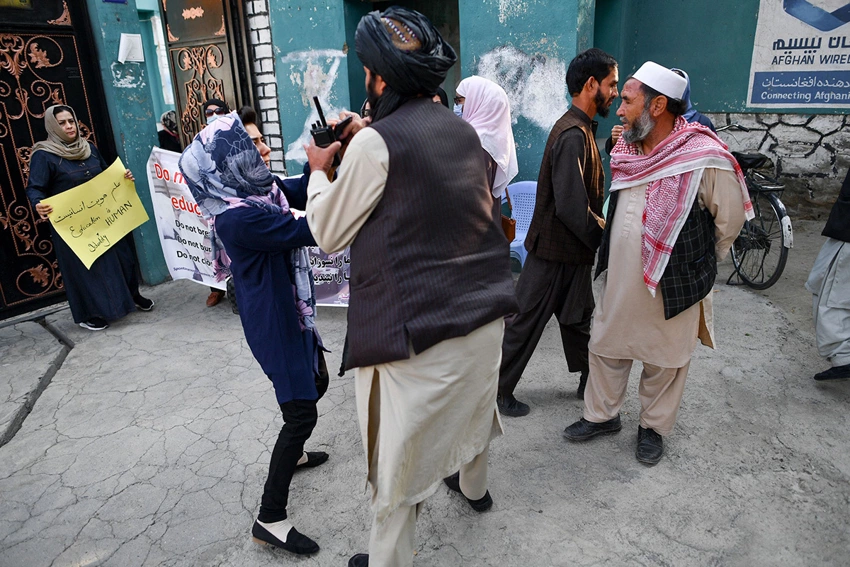
Since returning to power in 2021, the Taliban has issued decrees banning girls from secondary and higher education, restricting women from most jobs, enforcing full-face coverings and prohibiting their presence in parks, gyms and salons.
Former United Kingdom Prime Minister Gordon Brown, now a U.N. special envoy, warned in an op-ed for The Guardian that these policies may amount to crimes against humanity. He noted that internal splits within the Taliban over education and women’s rights have pushed key officials to flee the country. Brown cited Sher Mohammad Abbas Stanikzai, who fled after publicly criticizing the education ban.
In one incident reported by The Guardian, female journalist Nazira Rashidi was arrested in Kunduz in December. Another woman, Khadija Ahmadzada, was jailed for operating a women’s sports gym in Herat and was released only after intervention by Richard Bennett, the U.N. special rapporteur on human rights in Afghanistan.
Bennett has warned that the new penal code intensifies the legal basis for discrimination against girls and women. He has called for international mechanisms to hold the Taliban accountable, including efforts to define gender apartheid as a crime under international law.
The International Criminal Court’s pre-trial chamber last July issued arrest warrants for Taliban leaders Hibatullah Akhundzada and Abdul Hakim Haqqani on charges of gender-based persecution.
However, countries including Russia, China and India have strengthened diplomatic ties with the Taliban, with Russia being the first to fully restore relations without extracting rights concessions. India reopened its embassy in Kabul, while China accepted an official ambassador in January 2024.
European countries have expanded cooperation in deportation arrangements, indirectly legitimizing Taliban rule despite ongoing repression.
Last year, the U.S. House of Representatives passed a bill that would prohibit U.S. tax dollars from funding the Taliban, as critics claim humanitarian funding for the region from the Biden administration after the U.S. military withdrawal in 2021 benefited the Taliban-controlled government.
Amid the crackdown, underground education continues in areas like the Panjshir Valley, with home schools and radio broadcasts targeting girls and mothers. Some girls are leaving Afghanistan for education in Pakistan, Iran or on scholarship abroad, despite rising repatriation pressures.
A January 2025 recording of Akhundzada reveals internal rifts within the Taliban and warns that divisions could collapse the regime, according to reports. Sources told the BBC that two groups at the very top of the Tablian leadership structure are pushing competing visions for the country.