



OPINION: Michael Bassett.
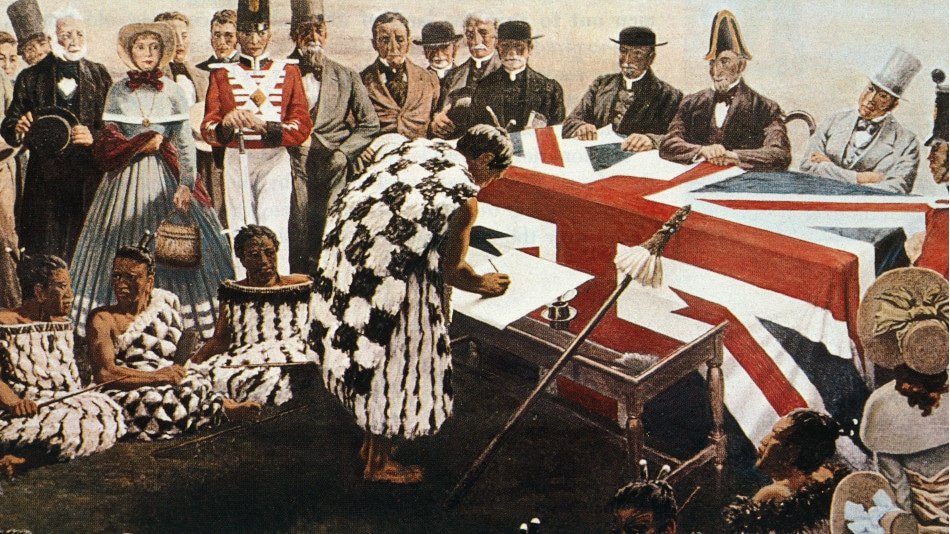
If you are watching the bizarre goings on at Waitangi, keep an eye out for which politicians use the term “The Treaty”, and which refer to what was signed on 6 February 1840 as “Te Tiriti”.
The Treaty is the term that was used originally, and it described a three-clause document that ceded sovereignty over New Zealand for ever to Queen Victoria. In return, the Queen guaranteed Maori chiefs control over their lands and “taonga”, and in the third clause guaranteed Maori the same “rights and duties” as were enjoyed at that time by Englishmen.
The Treaty of Waitangi is the name by which the document was known for more than 150 years. It is the name of the legislation that established the Waitangi Tribunal set up in 1975, and it was the name of the document that 150 years of existence was celebrated by the 1990 Commission that I chaired.
Two distinguished Maori, the Maori Queen, Dame Te Ata, and the Governor-General, Sir Paul Reeves, served as patrons of the 1990 Commission. Queen Elizabeth II called it “The Treaty” when she spoke at Waitangi on 6 February 1990. All New Zealanders recognise the Treaty by that name. Two decades later, many historical claims about ways in which the Treaty was inadequately recognised had been heard, and many settlements of grievances had been arrived at that were deemed in legislation to be “full and final”.
What followed is the cause of much of today’s angst. In 2008 Helen Clark’s government decreed quite sensibly that the time for lodging historical claims against the Crown was now over. In retrospect we can see there ought to have been a gradual reduction in the funds for the Waitangi Tribunal once a substantial part of its work had been concluded.
That didn’t happen. John Key’s incoming government instead sent Minister Peter Sharples to the United Nations where he signed New Zealand up to the Indigenous Rights Tribunal. There was no prior discussion about the fact that Maori, who by their own admission, had come from the Pacific Islands, weren’t indigenous. Before long, a whole load of claptrap about indigenous rights started flowing into New Zealand. No recognition was given internationally to the fact that unlike all other countries, Maori were uniquely blessed with their Treaty arrangements with the New Zealand government. Maori matters were never John Key’s strong point, and there was no significant reduction in the Waitangi Tribunal’s taxpayer-provided funds.
The result was that a full-sized Tribunal was soon awash with resources, and meddlesome Maori and woke Pakeha on the body started looking for ways to spend our money. By 2013-2014 the Tribunal was full steam ahead on a project to redesign the 1840 Treaty itself. They concentrated their attention on whether the chiefs had actually ceded sovereignty to the queen. Inevitably, they arrived at the conclusion that sovereignty was never ceded. This was a significant development. It meant that the Tribunal had concluded that Maori still exercised sovereignty over New Zealand and, by inference therefore, the rest of the Treaty’s clauses were less relevant. Maori were still in charge of their lands, lives and customs no matter how outdated they might be.
The Tribunal was too shrewd to declare outright that the Treaty had lost its most important clause. Instead their creation was referred to by a new name, “Te Tiriti”. Not many onlookers realised the significance of what the over-funded Tribunal had just done. Historians didn’t push back to much extent. Only Ewen McQueen in his One Sun in the Sky: the Untold Story of Sovereignty and the Treaty of Waitangi tackled the issue. He has shown that the Waitangi Tribunal’s report is nonsense. Maori ceded sovereignty alright, and were proud to have done so.
Nonetheless, trouble makers were soon on the scene. A young Waikato lawyer, Roimata Smail, produced a slim booklet “Understanding Te Tiriti” which concentrated on the sovereignty issue. She assiduously pushed it into school libraries so that the next generation could be taught bullshit. Many Maori, most of whom these days contain much more European ancestry, took up the call to rename the Treaty. Before long, some politicians also started talking about “Te Tiriti”. Not David Seymour. His Treaty Principles Bill was designed to enshrine the original under-standings about the Treaty in law. Most politicians, however, were too lazy to study the differences between the Treaty and “Te Tiriti” and just took the easy, politically correct way out, and referred to “Te Tiriti”.
Here is the danger. Carelessness over a long time develops a life of its own. The Waitangi Tribunal is still carrying on with hearings on absurd claims which threaten our future, while the assertion about not ceding sovereignty is in danger of winning widespread acceptance. It is high time that the Tribunal is brought down to earth, its budget severely clipped, and its Maori sovereignty assertions shown the backdoor.