



Story by Barbara Miller/ABC News and Colin Ambler/cvnznews.com
The Australian man who shot dead 51 people at two Christchurch mosques in March 2019 has appeared in a Wellington court as he seeks to vacate his guilty pleas.
In a hearing set down for five days, the court is examining his claims that when he pleaded guilty in March 2020 to charges of murder, attempted murder and terrorism, he was incapable of making rational decisions because of the harsh conditions of his confinement.
He has filed two applications, including one asking for more time to appeal his sentence and conviction, and another seeking to vacate the guilty pleas he entered and move the matter to a trial.
“The primary issue is whether at the time he entered those guilty pleas, he was unable to make a rational decision due to his prison conditions,” president of the New Zealand Court of Appeal Justice Christine French told the court as she opened the hearing.
The 35-year-old from Grafton, New South Wales, appeared this morning via video link from the high-security facility where he is being held.
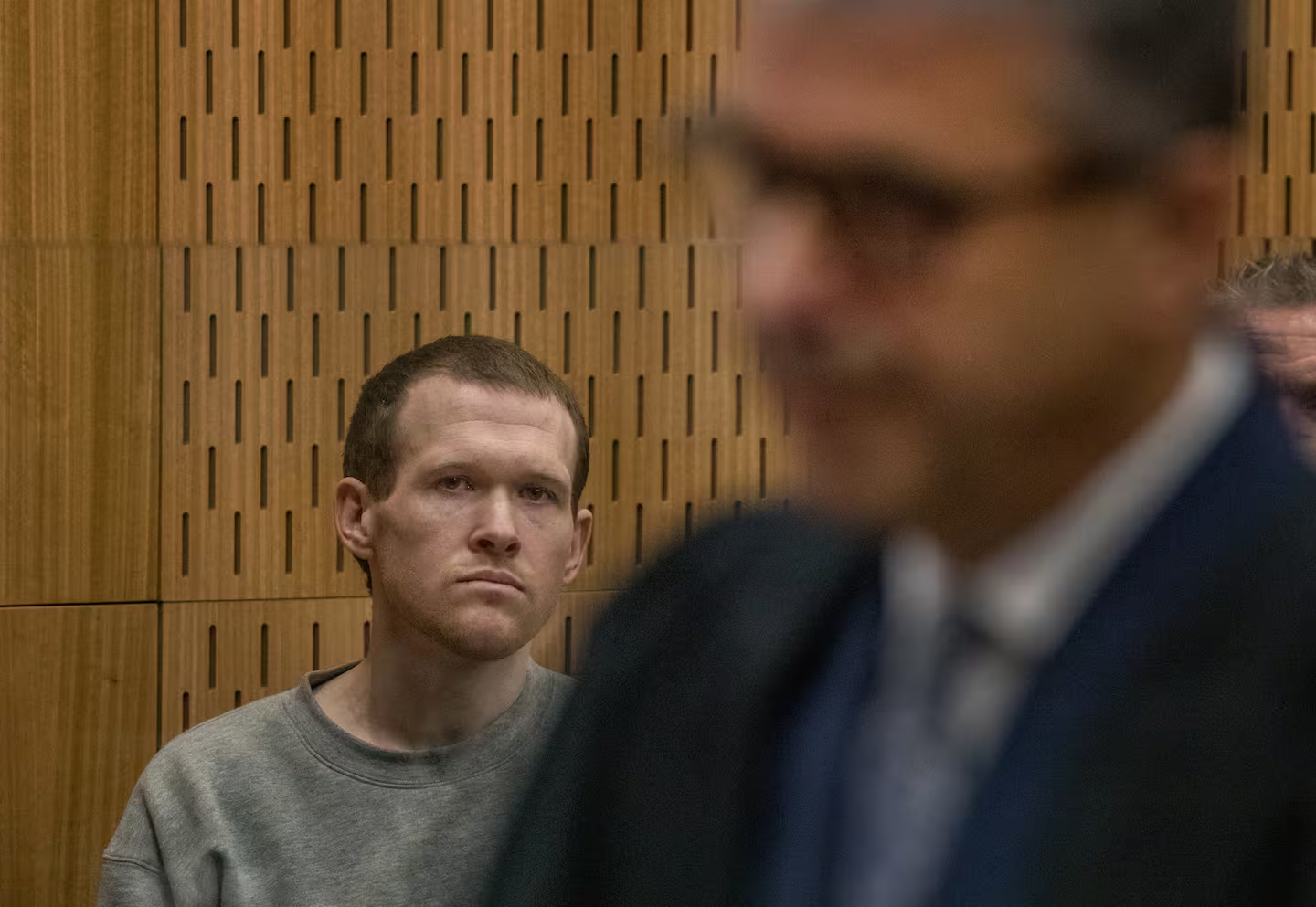
Brenton Harrison Tarrant looked strikingly different from when he was last seen in public at his sentencing hearing in August 2020.
Then, he was dressed in grey prison clothes and sat quietly as family members of those killed delivered victim impact statements.
They called him names, saying he was a “coward,” a “low-life”, a “maggot”. One called for him to be sent back to Australia.
In court today, he wore a white collared shirt and dark-rimmed glasses. His head was shaved.
Tarrant gives testimony
In sometimes testy exchanges with crown solicitor Barnaby Hawes, Tarrant appeared engaged and confident.
The questioning focused on Tarrant’s state of mind in the months leading up to his guilty pleas.
He agreed he had had multiple, sometimes lengthy in-person and phone meetings with his lawyers, and that he understood their advice.
He agreed that by August 2019 he had told them he intended to plead guilty, which he ultimately did in March 2020, but he said he was not in a fit state of mind. The Christchurch terrorist who pleaded guilty to mass murder has changed his mind
Extraordinary arrangements are in place in Wellington, New Zealand, as a convicted terrorist prepares to address the country’s Court of Appeal.
Tarrant told the court that his mental health was deteriorating and that he had “wildly fluctuating beliefs and identity”.
Going to trial under those conditions, he said, would have been “a nightmare”.
“There was nothing else I could do,” Tarrant told the court. “I was forced to do it.”
The court heard Tarrant had been concerned that he would make a fool of himself if his case went to trial. He said he was concerned because of his mental health that he would twitch and be unable to speak.
He said he ultimately felt he “had no choice” but to plead guilty and avoid a trial.
Mr Hawes suggested to Tarrant that he did have other options, including applying for an adjournment. On this question Tarrant said he could not remember much about this time.
“I’d say it was a decision induced by the conditions, rather than a decision I’d rationally made,” Tarrant said.
Mr Hawes pressed Tarrant on why, during frequent meetings, his lawyers did not seem to have concerns about his mental state.
Tarrant said he was “downplaying” the impact of the prison conditions.
“I wanted always to put on the best front possible,” he said.
“So you say you were masking your true state?” Mr Hawes asked.
“I think it was more complicated than that,” Tarrant replied.
Tarrant said that when he was occupied, his mental health improved, and it was “nice” to get the news updates of what was happening in the outside world.
‘Pleading guilty is perfectly rational’
Tarrant said that at the time he pleaded guilty, he “was making choices but they were not choices made voluntarily, they were not choices made rationally.”
Mr Hawes asked: “Can I suggest to you that pleading guilty is perfectly rational?”
Tarrant did not accept that. “A far better option would be to go to trial and defend myself,” he said.
Tarrant admitted he had at one point expressed remorse for his actions, but said this too was a state of mind “induced” by prison conditions.
He is being kept in solitary confinement, where there is no television, and the court heard he was keen to hear about international news events: for example, asking his lawyers to bring in that information when they visited.
The court heard that Tarrant was a voracious reader in prison. At one point, Mr Hawes said, his lawyer had remarked that he was getting through the materials relating to the case faster than the lawyer.
“That’s not particularly hard to do, I have 24 hours of free time,” Tarrant said.
He said any prisoner could get through the material if they were in solitary confinement. He also read between two to three books a week, though he described the quality of some of them as “abysmal”.
He said the lack of reading material was “by far one of the biggest issues,” and was “really bad” for his mental health.
During several hours of testimony, Tarrant appeared highly engaged. He pressed Mr Hawes several times to be more specific with the material he was quoting from, he asked him to speak closer to the microphone and he was not afraid to interject.
During one fiery exchange, Tarrant quizzed Mr Hawes on whether prison guards counted as prison authorities.
When the lawyer did not answer, he appeared agitated.
“Sorry, I asked a question in regards to prison authorities, are we just going to skip that or what was that about?”
The lawyer did not respond directly.
Arrangements in place for hearing
Extraordinary arrangements are in place for the hearing. Extra security measures have been introduced and access to the court is tightly controlled.
The identities of the legal team representing Tarrant have been suppressed out of concerns for their safety and that of their families. They were introduced simply as counsel A, B, C and D.
Tarrant said he had concerns for his family. When questioned about his interactions with them from prison, he refused to answer.
“I won’t be going into details about my family in court — puts them in danger,” he said.
Victims and their families are viewing the recording of the proceedings on a delay in Wellington and Christchurch.
Only a small portion of Tarrant’s testimony will be released publicly by the court.
The identities of several other witnesses who the court will hear from in the course of the week will also be suppressed.