


Analysis by Brett H. McGurk – Global Affairs Analyst | CNN
The United States is positioning military forces across the Middle East capable of launching multiple waves of strikes into Iran. If ordered, this would mark a significant operation beyond President Donald Trump’s prior, more discrete uses of force. Unlike earlier operations that were time-bound and tethered to defined objectives — from targeting ISIS leadership to striking Syrian airfields after chemical attacks or the single night of strikes on Iran’s nuclear facilities last summer — this campaign would begin without a clearly defined end state.
How did we get here?
The answer lies in the convergence of three issues that were once distinct but are now fused: Iran’s missile arsenal, the regime’s violent crackdown at home, and its unresolved nuclear program. Taken together, they narrow the space for limited action and shape how a military operation may look like over the coming days or weeks.
Operational imperative: Iran’s missiles
On October 1, 2024, I was in the White House Situation Room as roughly two hundred Iranian missiles were launched toward Israeli cities. The flight time was about thirteen minutes. As the missiles arched into the upper atmosphere and descended toward their targets, US and Israeli defense systems engaged. US Navy destroyers in the eastern Mediterranean joined Israeli air defense batteries in intercepting the incoming barrage. Most of the missiles were destroyed.
The episode marked the first direct state-on-state attack in the region in decades. Israel subsequently struck Iranian air defense systems, which have yet to be replenished.

Missiles produced by Iran’s armed forces are displayed near a row of Iranian flags during commemorations to mark the anniversary of the 1979 Iranian Revolution on February 11, in Tehran, Iran. Majid Saeedi/Getty Images
Iran’s missile program is not only a regional threat. Tehran has transferred missile and drone technology to Russia for use in Ukraine, with Iranian-origin drones routinely striking civilian infrastructure. The United Nations Security Council last year reimposed sanctions related to Iran’s missile activities, reflecting broad international concern over the program’s expansion.
In any US military scenario, missile production facilities, launchers, stockpiles, and associated air defenses would likely be among the first targets. For military planners, degrading Iran’s capacity to retaliate is an essential prerequisite to any broader operation. That logic alone points toward an opening phase closer to Israel’s multi-day air campaign in June, as opposed to the one night of US strikes against Iran’s nuclear facilities towards the end of that campaign.
Political trigger: Iran’s crackdown
The precipitating event for this crisis emerged from inside Iran.
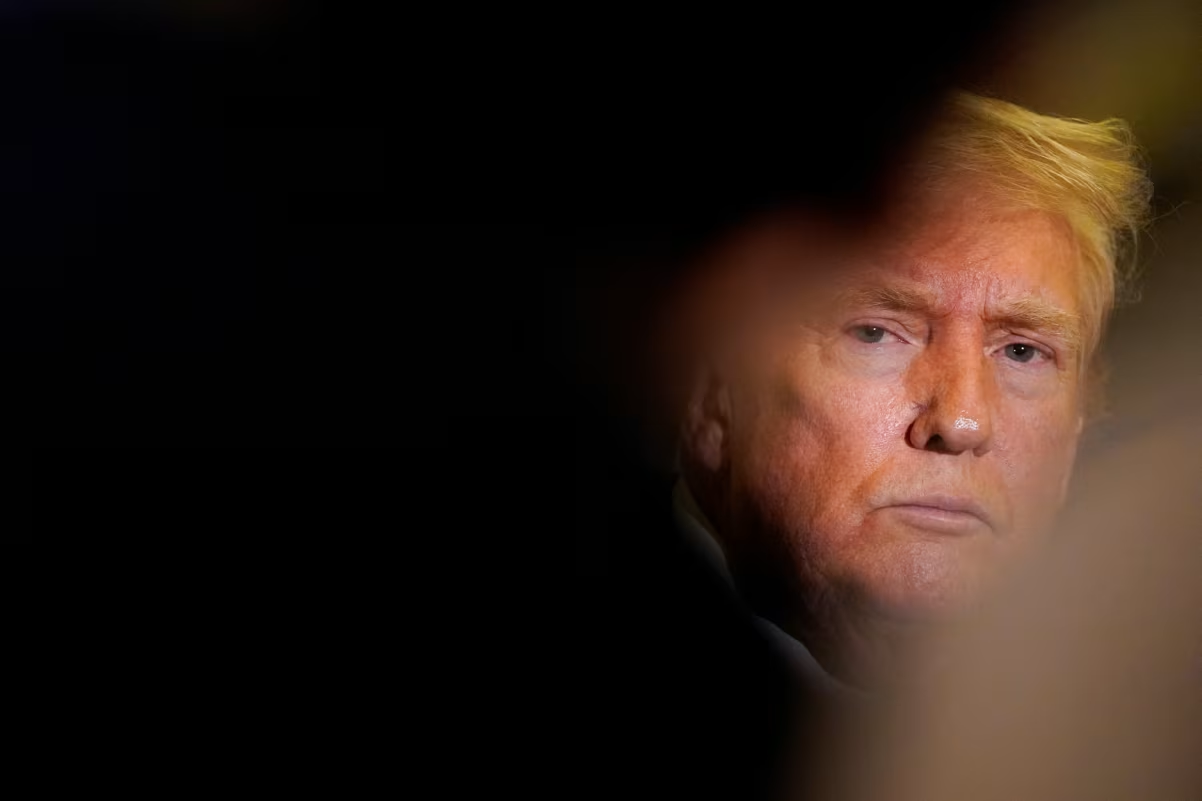
Nationwide protests that began shortly before the New Year were crushed. Trump had publicly encouraged demonstrators and warned that violent suppression would carry severe consequences for Iran.
“KEEP PROTESTING – TAKE OVER YOUR INSTITUTIONS. HELP IS ON THE WAY.” Trump wrote on his social media account. He also warned that if Iran’s regime “violently kills peaceful protestors … the United States will come to their rescue.”
That never happened.

The night Iran went dark
The tragic result was that Iranians remained in the streets, only to be massacred in the thousands (some reports are in the tens of thousands) at the hands of the regime.
The events shocked much of the world — for the first time, all 27 European Union members moved in concert to sanction the Islamic Revolutionary Guard Corps and label it as a terrorist organization.
The US military buildup in the region was triggered by these protests, Trump’s threats, and the crackdown that followed — not Iran’s nuclear or missile programs.
That matters operationally.
If the political impetus for US action stems from the regime’s violent repression, it becomes difficult to envision a campaign that does not account for Trump’s earlier warnings. Facilities, command nodes, and possibly leadership elements tied to the IRGC and Basij militia — the repressive apparatus that led the crackdown — are likely to enter the targeting matrix.
That further expands the scope of an operation, and the risk of Iran’s own retaliations, including against US facilities across the region. Should Iran inflict American casualties in its response, the US operation would surely expand further, perhaps against Iran’s economic infrastructure.
Strategic flashpoint: the nuclear program
The third track is Iran’s nuclear program.
The US strikes last summer targeted Iran’s nuclear enrichment infrastructure, with primary targets at Fordow, Natanz, and Isfahan. Iran’s stockpile of highly enriched uranium (fuel that can be fashioned into a bomb) is likely still buried underneath the Isfahan facility, according to the International Atomic Energy Agency. Military planners are likely to have follow-up targets in the deck, or areas to re-strike should Trump order an operation.
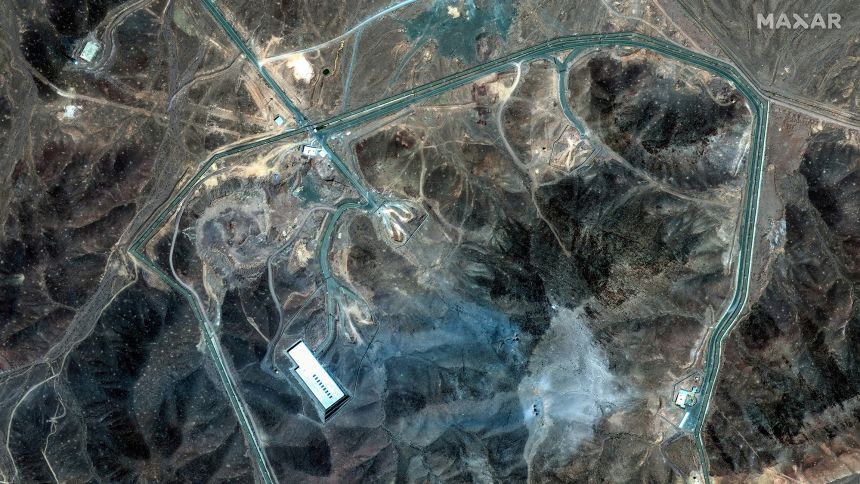
There is also a new facility buried underneath a mountain about a mile south of Natanz, the enrichment facility destroyed last summer. This is “Pickaxe” mountain, a site Iran declared to the IAEA in 2020 as a future facility to assemble the centrifuges that make nuclear fuel. Public reports suggest that construction of the facility picked up significantly in the wake of the US strikes in June, and the area is likely on the target list for military planners.
Ironically, strikes against Iran’s nuclear facilities were not on the radar screen or under serious contemplation before the Iranian protests and violent crackdown earlier this year. The crackdown precipitated the crisis, but Iran then once again refused diplomatic talks with the United States other than on its nuclear program — and then retained a hardline position against US calls to abandon enrichment. Domestic enrichment is unnecessary for a civilian nuclear program, and Iran is the only country in the world without a declared weapons program that routinely enriched uranium to levels a step below weapons grade — something the US military strikes stopped.
These factors have suddenly returned the nuclear program to Trump’s crosshairs. Even since the US strikes last summer, the UN Security Council reimposed Chapter VII sanctions on Iran’s nuclear activities, after France and the UK initiated a procedure known as “Snapback.”
Accordingly, it’s hard to imagine a military operation that does not also strike Iran’s nuclear facilities, to include the new facility at Pickaxe Mountain. The scope expands, further.
An expansive campaign
Individually, each of these issues might have been managed on separate tracks — deterrence on missiles (or Israeli — not American — strikes), diplomacy on the nuclear issues, sanctions in response to internal repression. The combination of Trump’s stark warnings earlier this year, however, together with Iran’s decision to defy those warnings with a violent crackdown, served to merge the issues into one basket for American planners.
This means, operationally, a strike campaign would begin with missile infrastructure and air defenses, expanded to elements of the regime’s security apparatus, and follow-on action against residual nuclear facilities. That would be a multi-day campaign, at least, and whether it expands from there — to include Iranian leadership and economic infrastructure targets —would depend on Iran’s response to initial attacks. The massive deployment to the region suggests the US military is poised and prepared to move up the escalation ladder, if necessary.

With the USS Gerald Ford carrier strike group set to arrive in days, President Trump weighs his options on Iran
Trump will hope such an operation remains limited, akin to his strikes last summer against Fordow, Natanz, and Isfahan. But the logic of this crisis and how it has developed now tends towards a campaign of days or weeks. There will not be a single blow.
Now, at the brink
That is how we arrived at the brink, an inadvertent sequence of events and choices leaving little maneuvering room for Washington or Tehran. Short of a last-minute diplomatic breakthrough, which is unlikely, what happens next will be in the hands of Trump and Iran’s Supreme Leader, Ayatollah Ali Khamenei, neither of whom — at this moment — seem prepared to build an offramp.
Should hostilities begin, the course is set for a campaign of indeterminate length, and multiple variables, unlike anything that Trump, as commander-in-chief, has known before.
Brett McGurk is a CNN global affairs analyst who served in senior national security positions under Presidents George W. Bush, Barack Obama, Donald Trump and Joe Biden.