
Story by William Fleeson
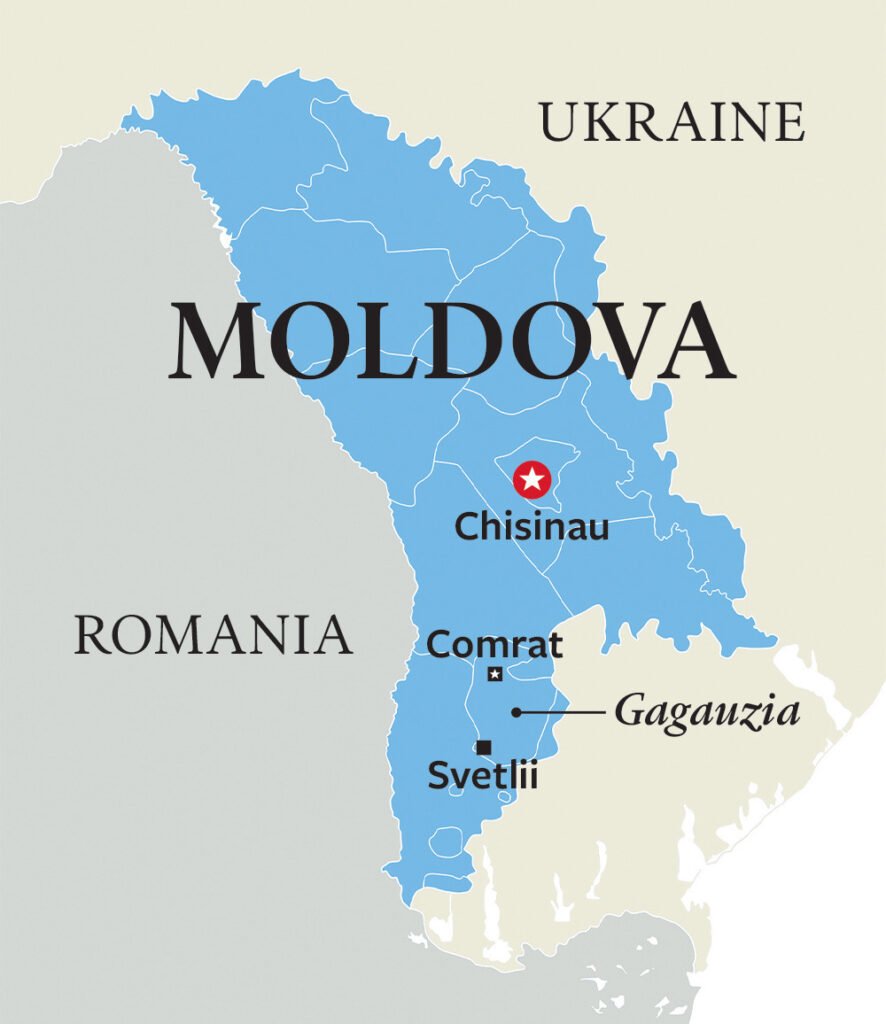
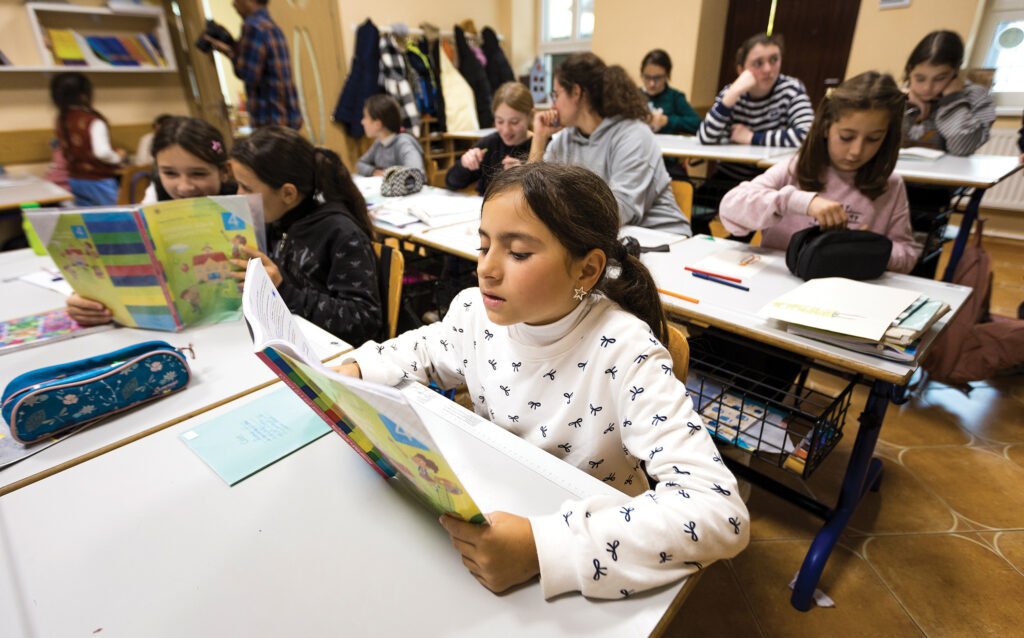
Nearly two dozen children fill the multicolored classroom at School Without Walls, an evangelical Christian mission in the village of Svetlii, Moldova. Their smiles convey curiosity, and relief that a group of visitors has temporarily interrupted their schoolwork. Some wear little crosses with a diagonal slat, signaling their Eastern Orthodox religion. Their dark hair and features typify the people of Gagauzia, a poor region of southern Moldova with its own Turkic language, a holdover from the Ottoman Empire that ruled this part of southeast Europe for three centuries.
The classroom space, warm and brightly lit, offers the children what they so often lack at home: support, safe conditions, and hope for better days ahead.
For her own future, 11-year-old Kseniya Russu has big ambitions. “I want to become an accountant,” she tells me, smiling. “Or a detective.” Her deskmate, 10-year-old Evalina Zebely, says she wants to become an accountant, too. Russu boasts about her studies in four languages besides her native Gagauzian: English, German, Romanian, and Russian.
Becoming proficient in foreign languages isn’t just for academic accolades. It could one day become vital for Russu and her classmates’ livelihood—and their survival.
More than 1 in 4 Moldovan adults leave to work abroad, given the country’s weak economy and the promise of better pay almost anywhere else. Russu’s parents live and work in Chisinau, Moldova’s capital, in the center of this crescent-shaped country of 2.4 million wedged between Romania and Ukraine. But even those fortunate to find a job in-country can face long stretches of time away from their homes. One in five Moldovan children spends at least three months each year without at least one parent, according to the Moldova Project, a family-focused charity. Extended separations from spouses and children can create a strain that destroys families altogether.
When I asked Russu where she would like to work one day, she didn’t hesitate. “I want to go to America,” she said.
Nataliia Nikolenko/Getty Images
THE FACTS OF MOLDOVA’S ECONOMY leave little doubt that labor emigration is necessary—or that its effects can hit poor families the hardest. The country is landlocked, which complicates its foreign trade. It lies outside the European Union (EU) but is seeking to join. The country has few high-value industries and instead engages mostly in light industry, mid-level services like tourism, and agriculture. According to a 2021 report from the EU’s European Training Foundation, Moldova has one of the highest overall rates of migration outflows in the world. Most leavers go to Russia or Romania, and sometimes to Italy or Ukraine. As more adults leave, fewer children are born and raised in Moldova, making the grim cycle of depopulation a threat to the country’s present and future, too.
“It’s a catastrophe for Moldovan families,” says Sergey Rakhuba, president of Mission Eurasia, a Tennessee-based Christian aid group that runs School Without Walls locations in 14 countries.
Moldova belonged to the Soviet Union until the bloc’s collapse in 1991, leading to economic chaos and an urgent need to find stable work. Moldova has lost a third of its population since then. Many parts of Eastern Europe and Central Asia—the former Soviet empire—remained economically depressed for decades. That fostered a set of practices that persist today: legal and illegal labor, with the kinds of exploitation that are typical in illicit work. A June report from the EU’s Council of Europe found widespread abuses against Moldovan men working abroad. Women are prone to trafficking for willing—and unwilling—sex work, usually in European cities.
The attractiveness of jobs abroad has only increased as countries in Moldova’s neighborhood have prospered. At the low point of its post-Soviet economic depression in 1999, Russia had a gross domestic product (GDP) of less than $200 billion. In 2024, it logged a GDP of $2.17 trillion—despite a bevy of Western sanctions in response to its war on Ukraine. That same year, Poland achieved a GDP of $915 billion, while Romania’s topped $383 billion. Poland, Romania, and Russia, like Moldova, share a Communist past, which made the transition to capitalism painful. But Moldova’s GDP last year came in at just $18.2 billion—many times below its neighbors, according to World Bank data.
With plentiful jobs elsewhere, even Moldovans who would prefer to stay must grapple with the push and pull of work opportunities abroad—and economic bleakness at home.
“In other conditions, parents could stay,” says Denis Griciuc, who runs the school in Svetlii alongside his wife, Lyuba. “They don’t want to leave, [but] they have to.” Sixty percent of the students’ parents work outside Svetlii, Griciuc tells me. The Griciuc family includes six children, three of whom Denis and Lyuba adopted from troubled homes.
For many Moldovans, challenges in work pair with equally serious social problems. More than 30% of the population lives below the national poverty line, per data from the World Bank published in April 2025. Alcoholism and rural poverty are especially acute. The same report held that two relatively recent shocks—COVID-19 and the war in neighboring Ukraine—have warped job markets, stalled homebound cash transfers, and sent inflation soaring to almost 35% per year. War-related disruptions to Ukraine and regional energy systems have sparked a heating shortage. Three in 10 Moldovans now say they cannot heat their homes adequately.
Apart from Moldovans’ private lives and homes, the country’s other problems play out at very public levels. Corruption is a significant concern: The country ranks 76 out of 180 on the main index of Transparency International, a governance watchdog. While scores have improved in recent years under the pro-Western presidency of Maia Sandu, Moldovan corruption often goes unpunished. The country’s most famous case of public graft involves a former politician, Ilan Shor, who was convicted in absentia for a 2014 embezzlement totaling almost $1 billion. Media reports dubbed Shor’s maneuver the “theft of the century”—the stolen sum totaled about 12% of Moldova’s GDP at the time.
Shor, a dual citizen of Moldova and Israel, remains beyond Moldova’s borders and the reach of justice—for now. And despite improvements, Moldova’s post-Soviet vestiges, like corruption, have discouraged the kind of job-creating foreign investment that has benefited its neighbors.
11-year-old Kseniya Russu wants to become an accountant.Dima Rakhuba / Mission Eurasia
AGAINST SUCH FORMIDABLE CHALLENGES, the School Without Walls is doing what it can. Beyond basic schooling, its ministries include vocational training. Some students, mostly girls, study floristry. Boys can hone skills in construction. Others learn to make bread and manage the local school-run bakery across the street from the school grounds.
After visiting the classroom and eating a meal with school staff, we make a stop at the training bakery. A Moldovan welcoming committee greets us, wearing traditional embroidered tunics and long skirts. Young women hold out bread and salt, Eastern Europe’s customary greeting for guests. They encourage us to take a hunk of bread, dip it in the salt dish, taste it—and feel fully welcomed, in the Moldovan way.
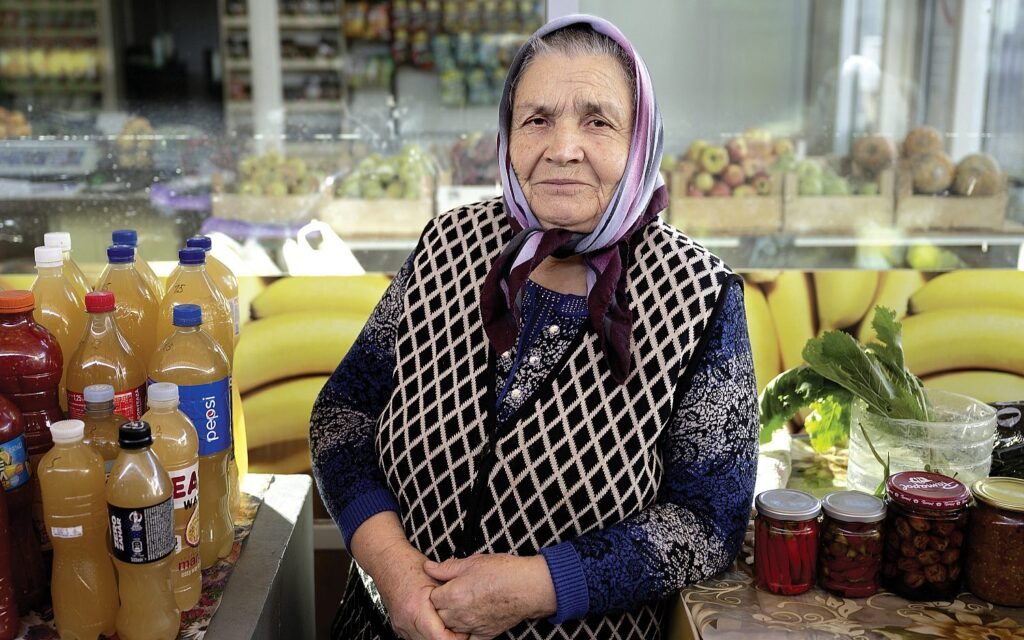
As the crowd mills in and outside the bakery’s interior, a cluster of senior women—all in the brightly colored headscarves common in Moldovan villages like this one—sits outside, waiting for the free bread the bakery provides as part of its mission. Speaking in Russian, Gagauzia’s most common language, they share stories of poverty, trials, and separation.
When I ask the group if they have family members working abroad, nearly all of them raise their hands. They rattle off the countries of their loved ones’ employment: Germany, Italy, Romania, Russia, the United States.
How does their absence make you feel? I ask one woman, whose few remaining teeth, all gold, glint in the sun.
“It hurts my heart,” she says, and looks away.
As evening sets in, the air in Svetlii changes from cool to chilly. The pale light dims over the surrounding farms and hills—striking a contrast between the beauty of the countryside and the ugly realities of life here. The scarved grandmothers, bread under their arms, shuffle home to feed their grandchildren and themselves.
I ask Griciuc what gives him hope for his six children and the many others in his care.
“We want them to see how we study God’s Word,” he said. “Our work is to sow. The rest is up to God.”
About The Author : William Fleeson is a freelance writer based in Washington, D.C. He’s a graduate of Columbia and Georgetown universities, and has spent more than nine months reporting from Ukraine since the start of the war in 2022.