


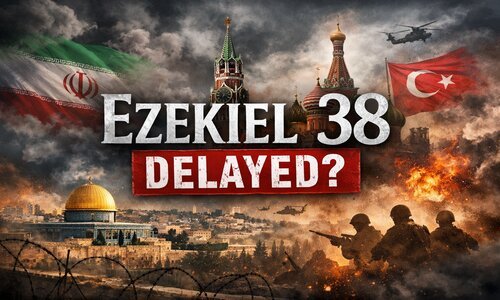
For decades, Bible prophecy teachers have pointed to one of the most dramatic passages in Scripture–Book of Ezekiel chapters 38 and 39–as a roadmap for a future war that would shake the Middle East and the world. The prophecy describes a coalition of nations rising up against Israel in the last days. Among the nations listed is Persia–widely understood to be modern-day Iran–alongside powers commonly associated with Russia and Turkey.
For years, the alignment seemed obvious. Iran’s revolutionary regime openly called for the destruction of Israel. Russia strengthened ties with Tehran and armed its proxies. Turkey drifted further from the West while often criticizing Israel. To many students of prophecy, the stage appeared to be slowly assembling for what is often called the “Ezekiel 38 scenario.”
But geopolitics has a way of complicating even the clearest expectations.
Today, Russia remains bogged down in the war with Ukraine, a grinding conflict that has drained military resources and strategic attention. Meanwhile, a dramatic shift may be unfolding in Iran itself. While the conflict involving Iran is far from finished, it increasingly appears possible–perhaps even likely–that the current regime could fall and be replaced by leaders more friendly toward the West.
If that happens, Christians who closely watch prophecy will have to wrestle with an perplexing question: What happens to the Ezekiel 38 scenario if Iran suddenly becomes pro-Western?
For many prophecy watchers, the idea feels like a wrench thrown into the gears of expectation. If Persia is no longer hostile to Israel, the alignment described in Ezekiel appears, at least temporarily, to drift farther away. A nation once viewed as a central aggressor could suddenly become a reluctant partner of Western powers.
But history–and Scripture–warn believers against assuming that today’s headlines define tomorrow’s prophetic reality.
Even now, the situation remains fluid. Russia and Turkey have expressed strong opposition to the attacks against Iran and have called for restraint showing they are still very much friends of Iran.
Moments like that may seem small, but they reveal something deeper: alliances in the region are fragile. What looks stable today can fracture tomorrow.
In fact, this kind of instability may actually move the world closer to the conditions described in Ezekiel rather than further away.
The prophecy describes Israel dwelling in relative security before the invasion occurs. The nation is portrayed as prosperous, confident, and somewhat at ease–conditions that historically have rarely existed in Israel’s modern history. Yet if Iran’s current regime were removed and tensions in the region temporarily cooled, Israel might indeed experience a greater sense of security.
Such a shift could paradoxically fulfill another key element of the prophecy: a moment when Israel appears less guarded and more stable than its enemies expect.
For Christians watching these events unfold, the lesson is both humbling and encouraging.
Prophecy has never unfolded according to human timelines.
Consider how believers once struggled with the prophetic promises about Israel itself. For nearly 2,000 years, Christians read passages predicting that the Jewish people would return to their ancient homeland. They read about Israel becoming a nation again, about deserts blooming, about prosperity and military strength.
Yet for centuries, there was no Israel. Many people assumed the prophecies regarding Israel were allegories or to be replaced by the Church.
The Jewish people were scattered across the globe. Empires rose and fell. Skeptics mocked the idea that the ancient nation described in the Bible could ever reappear.
And then, in 1948, the impossible happened.
At the United Nations, the modern state of United Nations recognized the rebirth of Israel in a single historic moment–an event many Christians saw as the fulfillment of biblical prophecy unfolding before their eyes.
Since then, the once-barren land has indeed blossomed. Israel has become a technological powerhouse, a military force, and one of the most dynamic economies in the region. Even discussions about rebuilding the temple–once unthinkable–are now spoken about openly in religious circles.
All of it happened in God’s timing, not humanity’s.
That same principle applies today.
Prophetic expectations should never be built solely on current alliances or political assumptions. The Middle East has proven time and again that its political landscape can change almost overnight. Alliances form, dissolve, and reform in ways few analysts predict.
Christians witnessed how quickly the world changed during the COVID era. Governments implemented sweeping policies in a matter of weeks. Economies halted. Borders closed. The global order shifted faster than most people believed possible.
If modern history has taught anything, it is that the world can transform rapidly.
The same could easily happen in the Middle East.
Even if a new Iranian government initially moves toward the West, decades of ideological hostility toward Israel cannot simply disappear overnight. Generations of Iranians have been raised under a regime that relentlessly demonized Israel and the Jewish people.
Cultural and political shifts take time. Internal factions remain. Power struggles emerge. And geopolitical pressures from nations like Russia or Turkey could pull Iran back toward a different alignment in the future.
In other words, today’s developments may represent a pause–not a cancellation–of prophetic expectations.
For believers, this requires patience and perspective.
Scripture never instructs Christians to force prophecy into current events. Instead, it calls them to remain watchful, humble, and faithful.
God is not reacting to world events. He is orchestrating history according to His purposes.
That truth should bring deep reassurance.
The same God who restored Israel after two millennia, who caused deserts to bloom and nations to rise, is the same God guiding the events that will eventually fulfill every remaining promise written in Scripture.
The path to those fulfillments may twist and turn in ways no one expects.
But the destination has never been in doubt.
For Christians watching the headlines today, the call is simple: remain attentive, remain hopeful, and remember that prophecy is not a puzzle for human timelines–it is a promise written by a sovereign God whose plans unfold exactly when He intends.