

Story by Jon Brown,
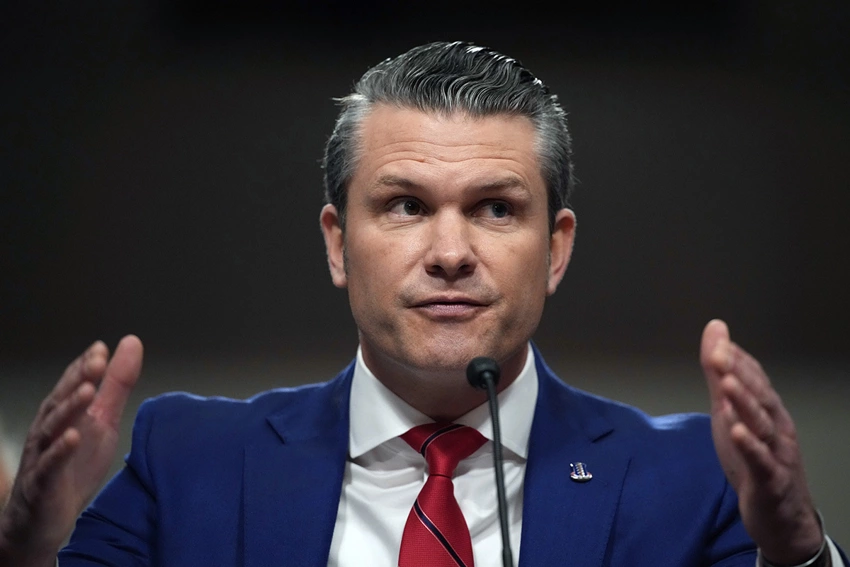
Secretary of War Pete Hegseth acknowledged during an interview with CBS’ “60 Minutes Overtime” that aired Sunday that the war in Iran has a religious element, a comment that comes amid concerns regarding the role eschatology is playing in the conflict.
When Hegseth asserted that U.S. troops involved in the conflict are protected by “the providence of Almighty God,” CBS News’ chief Washington correspondent Major Garrett asked the secretary to clarify if he “views any of this in a religious context.”
Pete Hegseth admits the war against Iran has religious meaning for him, according to his version of Christianity.
Hegseth says it’s important to give U.S. soldiers faith before they go to war.
“They need a connection with their almighty God.” pic.twitter.com/u45lnwhytm— Shadow of Ezra (@ShadowofEzra) March 9, 2026
Hegseth responded by at first pivoting to Islam, saying, “Obviously, we’re fighting religious fanatics who seek a nuclear capability in order for some religious Armageddon; but from my perspective, obviously I’m a man of faith who encourages our troops to lean into their faith, rely on God. There’s no atheists in foxholes. Your mortality is right on front of you.”
“I remember prayer, for me, on combat missions, how important that was. That’s why we’re making the chaplain corps great again and active again, making sure we’re pouring into the faith of our troops.”
Hegseth went on to note that Christian faith “and faith in general” is important to President Donald Trump and that he believes service members facing danger must be grounded in faith that steels them more firmly than “self-help, self-esteem nonsense.”
“They need a connection with their almighty God in these moments, and I’m proud of how our troops are conducting themselves, and I pray for them every day,” he added.
The eschatology of the Twelver Shia Islam that prevailed among the late Iranian leadership anticipates that Muhammad al-Mahdi, or “the Mahdi,” who is considered the “final imam,” has remained hidden since the ninth century and will reappear to restore justice at the end of the world.
The potential role such theology has played in driving Iran’s pursuit of nuclear capabilities remains highly debated. Former Iranian President Mahmoud Ahmadinejad, who was initially reported killed by the joint U.S.-Israeli attacks last month but later said to be alive, has invoked the Mahdi publicly.
Some have expressed concern regarding the potential role certain interpretations of Christian eschatology might also be playing in the Iran war. Last week, the nonprofit Military Religious Freedom Foundation (MRFF), led by Mikey Weinstein, claimed that hundreds of service members have sent him complaints alleging that they are being told there is a religious element to the conflict.
One complaint alleged that a commander told non-commissioned officers during a briefing on March 2 that Trump was “anointed by Jesus to light the signal fire in Iran to cause Armageddon and mark his return to Earth.”
The Pentagon did not respond to The Christian Post’s request for comment on Weinstein’s claims.
During a 2018 speech he delivered in Jerusalem that has recently resurfaced, Hegseth expressed optimism that a third temple might be rebuilt on the Temple Mount, which has been occupied by the Islamic Dome of the Rock since the seventh century. Some schools of Christian eschatology believe that a third temple must be rebuilt to usher in the reign of the Antichrist before the Second Coming of Christ.
US Secretary of War Pete Hegseth talking in 2018 about the ‘miracle’ of reconstructing the 3rd Temple of Solomon, the place where the Antichrist will be worshiped according to our Orthodox Christian faith. pic.twitter.com/SkWcBHHSk6— Orthodox Christian (@orthodox_33ad) March 3, 2026
“There’s no reason why the miracle of re-establishing the temple on the Temple Mount is not possible,” Hegseth said at the time. “I don’t know how it would happen, you don’t know how it would happen, but I know that it could happen.”
Political commentator Tucker Carlson, who has fielded intense backlash and accusations of antisemitism in recent months for his unfavorable attitude toward the Israeli government and his vocal opposition to military intervention in Iran, criticized Hegseth’s apparent eschatological views during a monologue last week, and questioned what role they might be playing in U.S. foreign policy.
Tucker Carlson exposes Pete Hegseth as a Zionist shill.
“I had no idea he had such evolved and specific and apparently very informed opinions on rebuilding the third temple. This is not something they teach you about in Sunday school.”
“That’s the Secretary of War right now.” pic.twitter.com/bmXtWCqq5f— Fractured Light (@FracturedLight0) March 6, 2026
Carlson also noted that Sen. Lindsey Graham, R-S.C., an outspoken supporter of the war, has characterized it as “a religious war” between radical Islamic terrorists and those whom they see as infidels, especially Jews and Christians.
Christians disagree on whether a third temple will be built in Jerusalem. Even the early church fathers disagreed, with figures such as Irenaeus and Hippolytus of Rome associating a rebuilt physical temple with the figure of the Antichrist. Later church fathers, such as John Chrysostom and Jerome, were skeptical at the notion of a rebuilt temple, teaching that the true temple is now spiritual.
Roman emperor Julian the Apostate’s attempt to rebuild the temple in A.D. 363 was abandoned when an earthquake shook the region of Jerusalem, prompting fire to erupt from the Earth and scorch the workers who were attempting to rebuild it, according to Jerome and Ammianus Marcellinus, a contemporary Roman historian.
Most pastors and church leaders in the Communion of Reformed Evangelical Churches (CREC), Hegseth’s denomination, are postmillennial in their eschatology, according to Douglas Wilson, a prominent CREC pastor in Moscow, Idaho, who helped found it.