



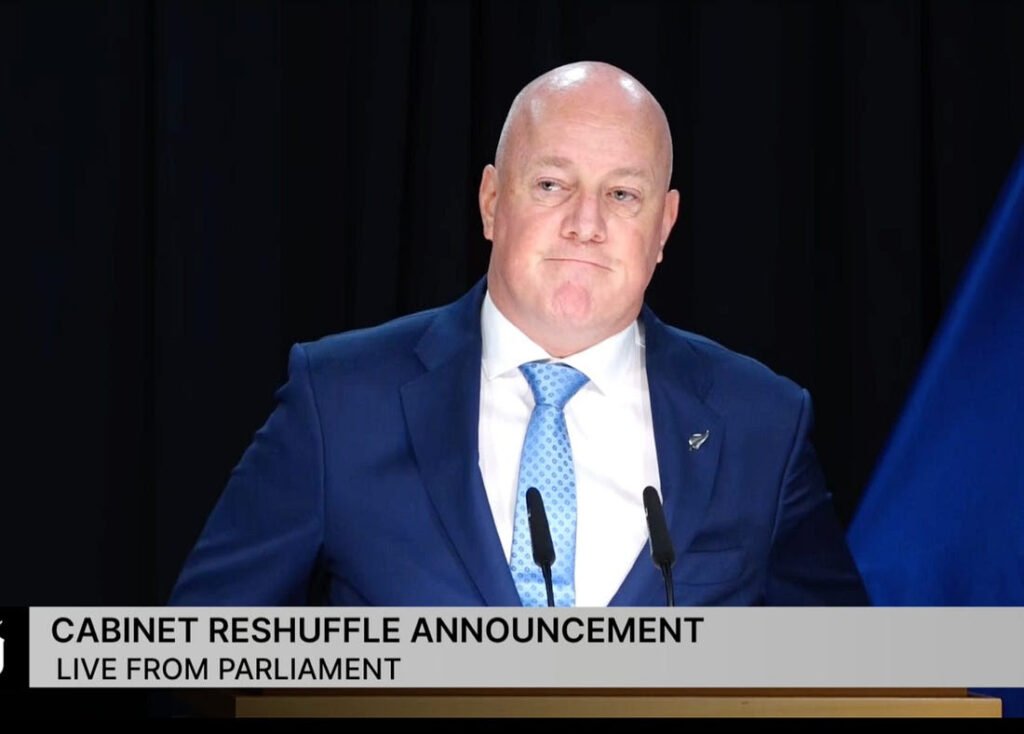
Christopher Luxon has unveiled his election‑year Cabinet reshuffle, elevating Chris Penk and Penny Simmonds into Cabinet and promoting Cameron Brewer and Mike Butterick as ministers outside it. Simeon Brown picks up Energy, Paul Goldsmith takes over the Public Service, and Louise Upston becomes Leader of the House. Those moves matter — but the real story is what happened to Chris Bishop.
Bishop has been stripped of three roles: Leader of the House, associate sport, and, most dramatically, his position as National’s campaign chair. In exchange, he receives the Attorney‑General portfolio. On paper, it looks like a sideways shift. In reality, it is a demotion disguised as a promotion.
The press gallery had been unusually aligned in the days before the announcement: this reshuffle would reveal more about Luxon’s leadership than about his ministers. They were right. The commentary leading up to the reshuffle read like an insider audit of National’s caucus — and it painted a picture of a Government struggling with instability and a Prime Minister under pressure.
Reporting from the Herald’s Thomas Coughlan captured the chaos. The reshuffle had been discussed since January, yet appeared “hastily arranged.” As of the night before, MPs directly affected still hadn’t been told their fate. When the caucus gathered for dinner — at KFC, no less — most had no idea what awaited them. For a Prime Minister who prides himself on people management, it was a revealing moment.

Much of the speculation centred on whether Luxon would use the reshuffle to clip Bishop’s wings. He has. Bishop had been carrying a massive workload: housing, transport, infrastructure, RMA reform, Leader of the House, and the campaign machine. The campaign chair role is the real power centre — controlling strategy, messaging, and resource allocation. Bishop ran the successful 2023 campaign. Removing him seven months out from the next election is a dramatic act.
Both of Bishop’s structural power bases now go to Luxon loyalists: Upston becomes Leader of the House, and Brown becomes campaign chair. Luxon left Bishop’s policy portfolios intact but removed the levers that shape the party’s internal direction. It is a pointed punishment.
The consolation prize is Attorney‑General — a role Bishop is qualified for, but one that requires shedding workload. Luxon has made that trade for him, but not gently.
Meanwhile, Simeon Brown’s rise continues. Already holding Health and SOEs, he now takes Energy and the campaign machinery. Luxon is betting heavily on his most loyal minister — and signalling clearly who he wants in charge of the election effort.