

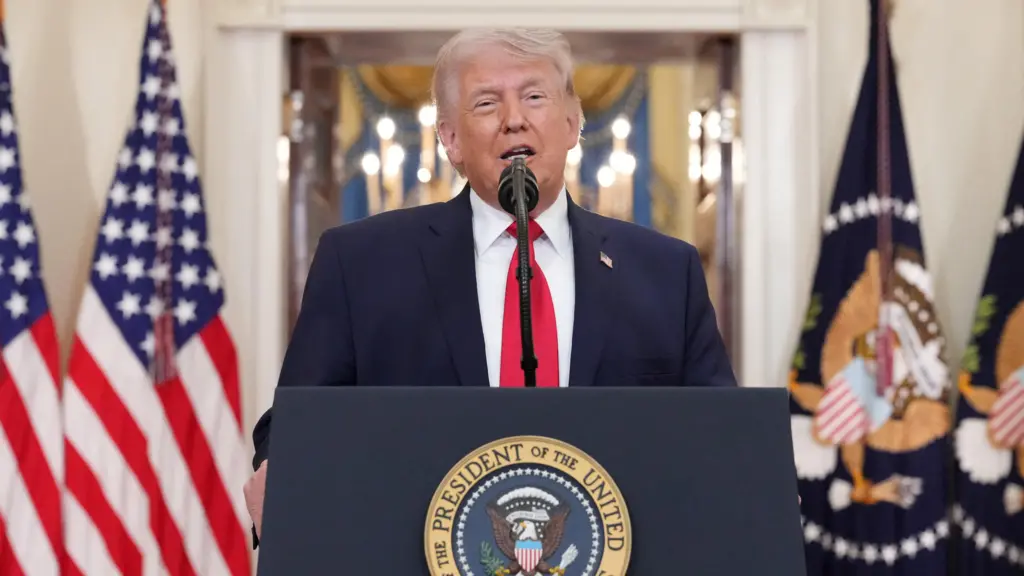
Donald Trump delivered a rare primetime address today, declaring that the United States is “nearing completion” of its military objectives in Iran while signalling that the conflict will continue for another two to three weeks. The speech, framed as an update on the month‑long US‑Israeli offensive, mixed claims of decisive battlefield success with warnings of intensified strikes ahead.
President Trump opened by praising what he described as “swift, decisive, overwhelming victories” achieved since the joint campaign began on February 28. He asserted that Iran’s navy had been destroyed, its air force “in ruins,” and its missile and drone capabilities dramatically reduced. Trump said the US had “achieved all of this,” insisting that the country’s military‑industrial base was being dismantled and that the war’s “hard part is done.”
Despite repeatedly declaring that the war is almost over, Trump extended the expected timeline, saying the US would strike Iran “extremely hard” over the next two to three weeks to “finish the job.” He vowed to bring Iran “back to the Stone Age,” reiterating that the US would not end operations until all strategic objectives were met, including preventing Iran from developing nuclear weapons and eliminating its ability to support regional militant groups.
The president also claimed—again without evidence—that Iran had asked for a ceasefire ahead of his speech, a statement Tehran immediately rejected as “false and baseless.” Iranian President Masoud Pezeshkian, in a message to the American public, accused Washington of waging an unjustified war and insisted Iran held no hostility toward ordinary Americans.
Trump used the address to highlight America’s energy strength, offering US oil to countries struggling with supply disruptions caused by the near‑closure of the Strait of Hormuz. He blamed Iran for global fuel price spikes while insisting the US economy remained resilient. Markets reacted sharply: oil prices surged past US$105 per barrel, and global equities dipped amid fears of prolonged instability.
The president thanked Middle Eastern allies—including Israel, Saudi Arabia, Qatar, the UAE, Kuwait, and Bahrain—saying they had been “great” partners and would not be allowed to “fail in any way.” He also referenced the families of 13 US service members killed in the conflict, promising their sacrifice “will not be forgotten” and pledging to honour their request to “finish the job.”
While Trump portrayed the war as nearly won, the situation on the ground remained volatile. Minutes after he concluded, Israel reported new Iranian missile launches, underscoring the ongoing risk of escalation.