




By Shaun Brooker.
If I were to ask you, which education sector would you expect to see the highest sense of belonging for students between Protestant, Catholic or non-religious schools, like me, I assume you would think either Christian or Catholic. WRONG!
In 2023, Cardus (1) released its most recent Education Survey. The survey is a major North American research project examining the long-term impact of various K-12 schooling types—public, Catholic, Protestant, non-religious independent, and home school—on adult lives. Conducted periodically (2011–2023), it analyses academic, spiritual, and civic outcomes, often highlighting that Christian school graduates show high levels of community engagement and faith-based practices.
While the majority of the findings highlighted the positive outcomes Christian and Catholic graduates had on preparedness for life and ongoing spiritual journey, there are three areas regarding graduates’ experiences of Christian and Catholic schools that we must take note of, and while experiences in Catholic schools were better than in Christian Schools, non-religious school better, sometimes significantly better, in the following survey questions:
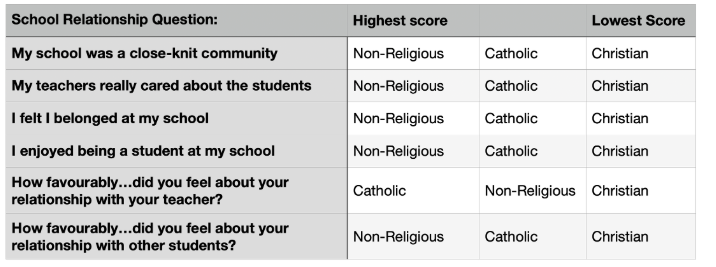
In three of the survey questions above (I felt I belonged, I enjoyed being a student, and relationships with other students), the non-religious school scores were more than a factor of 10 higher than the Christian school scores.
How can this be?
How can Christian Schools be so far behind non-religious schools in expressing the second part of the great commandment, to love your neighbour?
To rub salt into this wound even more, an earlier section of this survey, Preparation for Life, Christian Schools were scored significantly lower than both Catholic and non-religious schools for preparing students to interact with the range of people in society.
I think these findings cut to the chase about the development of worldview. How is it that we can be so successful, again according to the survey data, in preparing students to continue with prayer and reading their Bibles during and post high school, but we have not equipped them to love their neighbour, even while at school? Could it be that the most telling statistics in the table above are the teacher-to-student perceptions? How does that feeling of teachers not caring for students translate into students not caring for students, which results in students not feeling a sense of belonging and not enjoying their time at Christian Schools?
As we consider how we can take captive for Christ, all aspects of our school, we must, with urgency and honesty, interrogate why belonging and relationships in Christian Schools are experienced so poorly. After all, Christian schools should have the market on ‘loving your neighbour’, and it must be modelled first by the big people.
About Shaun Brooker: Passionate about Christian Education, leadership and technology in education.