




EDITORIAL: Mike Bain/cvnznews.com
New Zealanders were told for years that AI was something to “keep an eye on,” a future challenge, a slow‑burn disruption. But this week, the warning sirens stopped being theoretical. They became real.
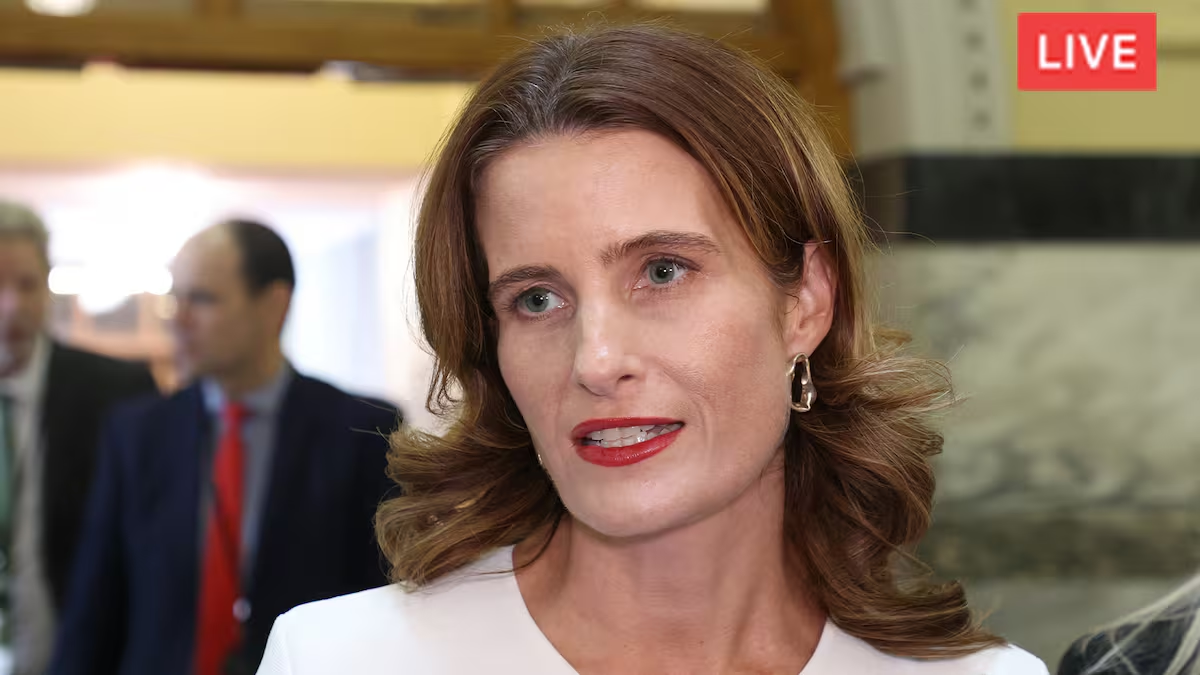
The Government has confirmed that just under 10,000 public‑sector jobs are being cut, and the Minister of Finance has made it clear: AI technology must now fill the gap.
For decades, Kiwis were assured that automation would mostly threaten factory lines overseas, not office desks in Wellington. White‑collar work — policy analysts, comms teams, finance units, legal advisers — was supposed to be safe. But that assumption is collapsing in real time.
And the question now hanging over the country is blunt:
Has the AI disruption finally arrived in New Zealand — and is this only the beginning?
The Warnings Are No Longer Coming From Sci‑Fi Films
Globally, the loudest alarms aren’t coming from fringe commentators. They’re coming from the very people building the systems.
Microsoft AI CEO Mustafa Suleyman recently warned that within 12–18 months, AI will be capable of performing most professional white‑collar tasks at human level. That’s not a prediction from Hollywood — that’s from the executive running one of the world’s most powerful AI divisions.
If even half of that proves true, the global labour market is heading for one of the biggest shocks in modern history.
And New Zealand may have just become an early test case.
The Public Sector Cuts: A Turning Point
For years, Wellington’s bureaucracy grew steadily — thousands of analysts, advisors, and specialists added across ministries. But now, almost overnight, the tide has turned.
- Thousands of roles are being eliminated
- Departments are being told to “do more with less”
- AI is being positioned as the replacement tool
This is the first time a New Zealand Government has explicitly linked mass job reductions with AI adoption.
That makes this moment historic.
The Collapse of the Old Promise
Kiwis were raised on a simple idea:
Get a degree, get a stable job, and you’ll be safe.
But AI is now drafting policy briefs, summarising legislation, analysing budgets, generating communications plans, and producing reports — tasks that once required teams of public servants.
The very roles that were considered “future‑proof” are suddenly exposed.
If the public sector — traditionally NZ’s most stable employer — is now replacing human work with AI, what happens when the private sector follows?
This Isn’t Just a White‑Collar Problem
Around the world, AI and robotics are reshaping:
- Warehousing
- Transport
- Customer service
- Retail
- Logistics
- Manufacturing
- Hospitality
Robotic systems are sorting packages faster than humans. AI customer service agents are replacing entire call centres. Autonomous trucks are being tested on long‑haul routes. Fast‑food chains are trialling automated kitchens.
New Zealand is not insulated from any of this.
We are a small, open economy.
We import global technology.
We follow global trends — whether we want to or not.
The Real Danger: Speed
The Industrial Revolution took decades to reshape society.
AI is evolving monthly.
If thousands of white‑collar and blue‑collar workers lose jobs at the same time, the consequences won’t just be economic. They’ll be social, cultural, and political.
- What happens when a 45‑year‑old policy analyst discovers their role is now automated?
- What happens when warehouse workers, drivers, and office staff all compete for a shrinking pool of human jobs?
- What happens when young people spend tens of thousands on degrees only to discover AI can do the work faster and cheaper?
Work isn’t just income.
It’s identity.
It’s dignity.
It’s purpose.
Remove that too quickly, and societies fracture.
New Zealand’s Moment of Reckoning
For years, AI warnings felt distant — something happening in Silicon Valley or Shenzhen. But with nearly 10,000 public‑sector jobs disappearing and AI being positioned as the replacement, New Zealand may have just entered the first real phase of the disruption.
The question is no longer:
“Will AI take jobs?”
It’s now:
“How many — and how fast?”
And perhaps the most unsettling question of all:
Is this the first wave… or merely the warm‑up?