

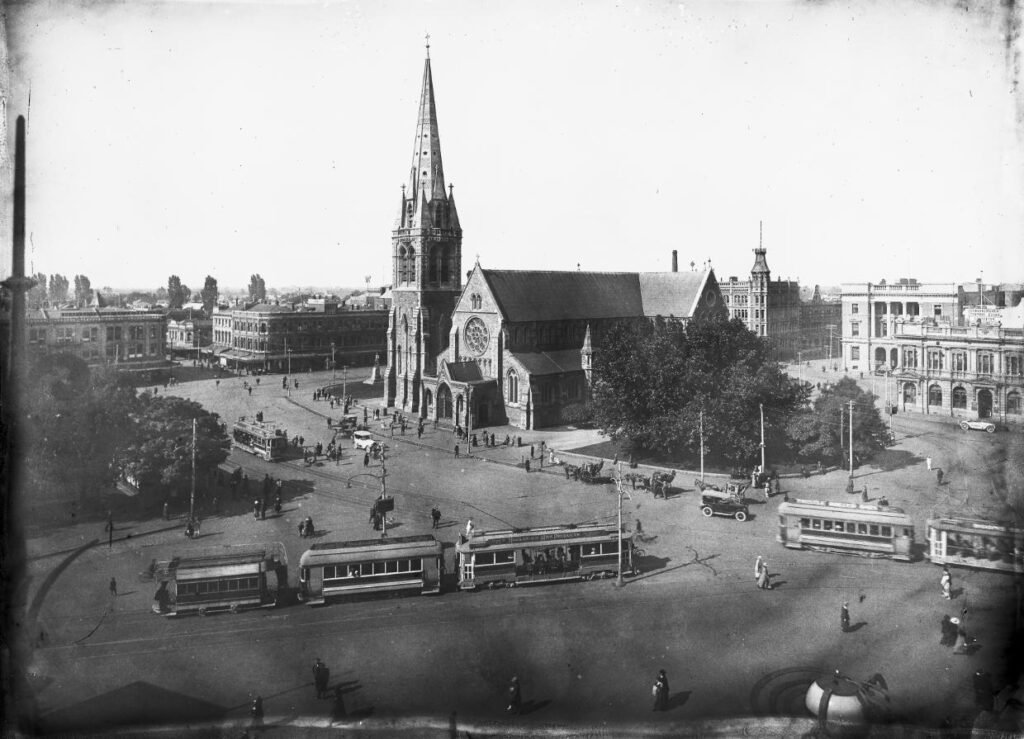
Image: Christ Church Cathedral was built between 1864 and 1904. Photo: Press archives
By Mike Bain/cvnznews.com
Fifteen years after the earthquakes, Christchurch has rebuilt almost everything — new bars, new offices, a new stadium and an entirely new identity. Yet in the centre of the city, its most symbolic building still stands broken: framed by ugly planks of steel, fenced off from the public and trapped in a cycle of political and financial deadlock.
Walking through the renewed streets, you feel the city’s pulse: cafés full of conversation, a stadium humming with anticipation, and laneways that have learned to be lively again. But when the path opens onto Cathedral Square the tempo changes; the fenced ruin holds a silence that is not absence so much as memory. The council is even weighing whether to divert $14m from a surplus toward the cathedral, a move that followed a public consultation that showed only 14% support, and a restoration process that was paused after costs blew out to $248m before being revised to $219m, leaving a shortfall of roughly $85m.
There is a scriptural echo in that pause. After the destruction of the First Temple, the people of Israel endured exile and debate; the Second Temple’s rebuilding was not a single triumphant day but a long, communal labour of faith, patience and shifting purpose. That story teaches a city that rebuilding is not merely replacing stone with stone but reweaving identity. Christchurch’s debate — about heritage, cost, and meaning — is less a failure than a prolonged act of discernment: what do we keep, what do we reimagine, and what do we let stand as a lesson?
Some argue for a faithful restoration; others for a new form that acknowledges fracture. There is precedent in Coventry, where ruins were kept beside a modern replacement so the scar itself became part of the city’s testimony. That compromise suggests a way forward for a place named for Christ: a centre that holds both lament and welcome, a space where grief and hope can meet.
If the Second Temple teaches patience, it also teaches that rebuilding requires a shared story. Christchurch has rebuilt its streets and its life; now it must decide what story the square will tell. Whether through careful restoration, staged rebuilding, or a new hybrid that honours rupture and resurrection, the work will be slow, communal and, if done well, faithful to both past and future.