
OPINION: Michael Swanson.
After being all about budget, budget, and more budget over the past fortnight…I decided to look at something a little different. Question Time. Or, more importantly, whether Question Time is actually doing the accountability thing in the way it is supposed to.
For most people it isn’t exciting, in fact some will roll their eyes and just move on. But it is a major spoke in the wheel of accountability that I believe is needs a major overhaul to actually be effective. That thing is Question Time – you know, the only bit of Parliament most people see because the news outlets love clips of MPs and Ministers yelling at each other. Good old fashioned adversarial fun.
I used to watch it regularly, especially on Tuesdays when both the PM and Leader of the Opposition could be relied on to be in the House. But after leaving Wellington, and moving into roles where I had too much on to bother with watching, I just got out of the habit.
A couple of weeks ago I decided to have a look at the list of questions, and something jumped out at me, of the 12 questions, five asked “Does he/she stand by all her statements and actions?”, another five asked about particular announcements made by the government (the remaining two asked about ‘government actions, and a “do you stand by” question on a specific topic). While none of this is new, it raises an issue for me – is Question Time actually doing the best job of keeping the Executive to account?
What is ‘Question Time’?
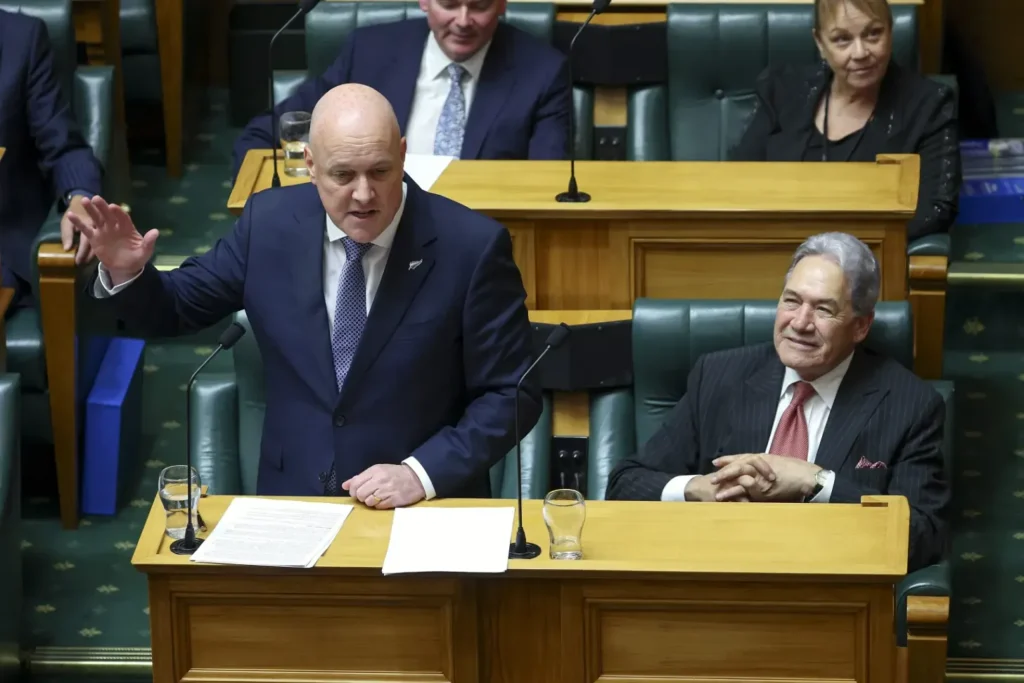
Question Time in the New Zealand Parliament is a daily oral session held in the House of Representatives, typically lasting around 45 minutes. During this Question Time, MPs put questions directly to Ministers of the Crown, including the Prime Minister. Each sitting day features a set number of oral questions (usually 12 primary questions), with supplementary questions allowed as follow-ups. It is one of the most lively and closely watched parts of the parliamentary schedule, broadcast live and is generally the most reported on part of Parliament by the media.
The key function of Question Time is accountability. It gives Parliament a formal mechanism to scrutinise the executive that is, to hold the government to account for its decisions, policies, and actions. Opposition parties use it to expose inconsistencies, challenge ministers on controversial issues, and draw public attention to areas where they believe the government has fallen short.
Question time is a political exchange. The adequacy of the performance of members, whether in Government or in Opposition, is judged on a political basis. The Speaker does not give them marks for performance as to the quality of their questions or their answers. Members cannot appeal to the Speaker every time they get an answer they do not like or are not satisfied with. (Jonathan Hunt, Speakers Rulings, 207/2)
The session also serves a transparency function, compelling ministers to explain and justify government actions in a public forum. While the government may use some of its own questions to highlight positive achievements (more on that next), the adversarial nature of the session generally means it should function as one of Parliament’s sharpest tools for democratic oversight.
It also acts as a bit of a shop-window for the government. A number of the questions are asked by MPs from the government side of the house, and affectionately referred to as “patsy questions”. These questions are usually a chance for Ministers to explain announcements they’ve made, discuss reports they’ve received, or to share positive (from their perspective) news on an issue they are dealing with.
Who is Question Time actually for?
In the New Zealand parliamentary context, Question Time is theoretically for holding the government to account, but in practice it serves several different audiences and purposes simultaneously, and not always the ones you’d hope.
In theory: it’s for opposition MPs to scrutinise ministers, extract information, and expose problems with government policy on behalf of the public.
In practice, it’s really for:
- The media – the most combative exchanges are designed to generate clips and headlines. MPs (especially opposition leaders) are often performing for the 6pm news (or the modern equivalent) rather than genuinely seeking answers.
- The party base – patsy questions (where government backbenchers lob softballs to their own ministers) exist almost entirely to let ministers deliver pre-packaged talking points that energise supporters and fill Hansard with favourable content.
- MPs themselves – it’s one of the few moments of genuine political theatre in Parliament, and a chance for ambitious MPs, and Ministers, to build a profile.
- Hansard and constitutional convention – it fulfils a formal accountability function that matters symbolically, even when the substance is thin.
Who it’s not really for: ordinary New Zealanders. Most people never watch it, the answers are routinely evasive, and ministers are skilled at running out the clock without saying much. The Standing Orders technically require answers to be “address the question” but enforcement is kind of hit and miss.
That said, it doesn’t do a terrible job, but can always be better. A persistent opposition MP can force a minister into a genuine corner over several supplementary questions, and that accountability is real.

Everyone’s asking the same thing, why?
Question Time in New Zealand Parliament is shaped less by genuine curiosity than by strategy. Opposition parties use their questions to build narratives, a line of attack is most effective when it’s sustained across days or weeks, which means asking variations of the same question repeatedly until a minister slips, contradicts themselves, or the story gains media traction. This rewards predictable, formulaic openers over genuinely probing ones.
Initial questions are deliberately non-descript for a specific tactical reason: they’re bait. Under Standing Orders, the supplementary questions that follow must relate to the subject of the primary question, so a vague, broad opener gives the questioner maximum flexibility to pivot based on whatever the minister says. A too-specific initial question boxes you in. A generic one keeps all your options open.
Government questions work differently but are equally formulaic. Patsy questions, where backbench MPs ask their own ministers, are typically drafted by the minister’s office and handed to a friendly MP to read aloud. They exist to deliver talking points into Hansard and generate usable media content, not to scrutinise anyone. Because they follow the same template (”What reports has the Minister recently received on…”), they’re almost indistinguishable from one another.
The result is a session that sounds overly scripted from both sides, because it largely is. The conventions of parliamentary language, the risk-aversion of performing on the record, and the media logic of generating clips all push questions toward a narrow, familiar register. Genuine spontaneity is a liability in that environment, not an asset.
Can we actually make it better?
Question Time in Parliament is meant to be a core accountability mechanism, but its current structure fails to hit the mark. The proportional allocation of questions means that government parties routinely receive at least half the available questions, which they use for patsy questions, essentially free advertising for government announcements and positive performance data. This consumes parliamentary time that could otherwise be devoted to genuine scrutiny, and reorients the session away from holding the executive to account.
Reform should focus on rebalancing Question Time toward its accountability purpose rather than allowing it to serve as a platform for government messaging. One structural option, drawing on the Westminster and Scottish Parliament models, would be to introduce a dedicated Prime Minister’s Questions session which operates a focused, high-profile forum in which opposition leaders can directly challenge the head of government. The Scottish system prioritises the leader of the largest opposition party, giving them first opportunity to question, and structures the session in a way that foregrounds adversarial engagement rather than diffusing it across twelve loosely related questions.
Such a reform would have both practical and symbolic effects. Practically, it would concentrate scrutiny at the apex of executive authority, where accountability matters most. Symbolically, it would elevate the visibility of opposition voices and reinforce the idea that politics is publicly contestable, something the current format tends to obscure. Giving opposition parties greater scope to ask supplementary questions would further strengthen the scrutiny function, allowing members to probe ministerial responses for consistency rather than being cut off before a line of questioning develops.
The overall direction of reform is to shift Question Time from a session that government can largely control to one genuinely oriented toward examining the executive, making it more useful for accountability, and more legible to the public as a democratic institution.