



Annie Ma, and Sharon Lurye,/ Associated Press
Younger students have regained ground academically after the pandemic’s disruptions while older students’ test scores continue to stagnate, according to the latest testing data released Wednesday by the federal government.
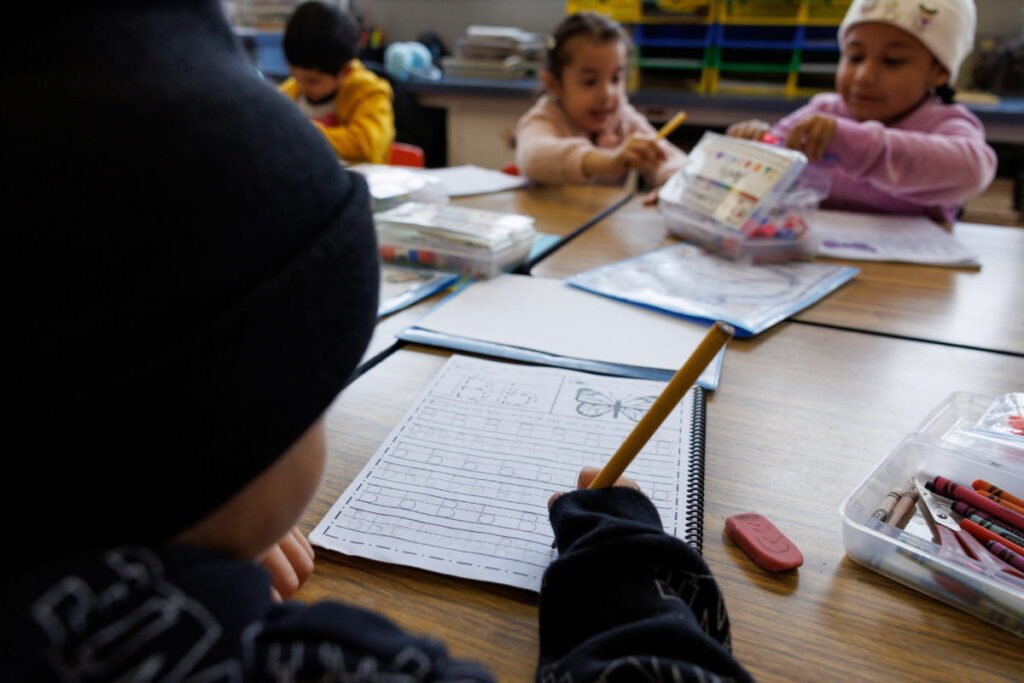
Nine-year-olds rebounded to pre-pandemic reading scores and saw some recovery in math, according to data from a test taken regularly in the United States since the 1970s. The same recovery has not emerged for 13-year-olds, whose average scores in math and reading remain below pre-pandemic averages. In fact, the latest reading scores, from teenagers who took the test in 2024, are essentially the same level as they were when the test started in 1971.
Since the pandemic, schools and state policymakers have focused on overhauling instruction for elementary students, especially in implementing the “science of reading,” which teaches kids to read by understanding how letters form sounds. But recent test scores show educators should also focus more intensely on adolescent learners and turning around academic outcomes in middle school, said Lesley Muldoon, executive director of the National Assessment Governing Board.
Indeed, the 13-year-olds who took the national test experienced the pandemic’s disruption during formative elementary years of schooling. In a few years, they will have graduated — and they may still be behind.
“The 13-year-olds who took this assessment last year are headed to high school now or are already enrolled,” she said. “Schools won’t have them much longer. We can’t hesitate or wait if we’re going to turn these trends around.”
What the test measures
Typically given every four years, the long-term trends assessment offers a snapshot into the academic skills of American students at ages 9 and 13. Roughly 31,000 students in public and private schools sat for the test in the 2024-2025 school year. Unlike the main Nation’s Report Card test for fourth and eighth graders, which is updated regularly with new skills to reflect changing curricula, the long-term test has stayed largely the same since the 1970s.
American students’ academic achievement was already declining when the pandemic hit. Test scores peaked around 2012, then started to fall, said Matthew Soldner, acting commissioner of the National Center for Education Statistics.
“We can clearly see that this isn’t just a pandemic story,” Soldner said.
The test results show younger kids are improving foundational skills, such as identifying facts in a simple news article or understanding basic multiplication and division. Seventy-one percent of 9-year-olds reached the benchmark in reading, and 84% reached that level in math, a few percentage points higher than in 2022.
Teenagers are tested on more advanced skills, such as making generalizations from a reading passage and comparing information from charts and graphs. Only 58% met the benchmark skill level in reading and 70% in math, with no statistically significant improvement from 2023.
Fewer students are reading for fun
Compounding the issue of stagnant literacy rates: Fewer students than ever are reading for fun.
Students who took the test also completed a survey. Only 14% of 13-year-olds said they read for fun every day, down from 27% in 2012 and a peak of 37% in 1992. Among 9-year-olds, 37% said they read for fun every day, a significant decline from 53% in 2012. Researchers have noted the decline in time spent reading corresponds with the rise of social media use on cellphones.
Still, younger children have shown an “incredibly encouraging” recovery academically in recent years, Soldner said. “Almost 50 years of progress has been eliminated” for 13-year-olds, he said.
The 13-year-olds who took the most recent test would have been in second or third grade during the first year of the pandemic. They would have returned to in-person learning in fourth or fifth grade and taken this national test in their last year or two of middle school.
In contrast, the 9-year-old group would have been entering kindergarten or first grade as the pandemic’s most acute phase ended and schools reopened. Their second and third grade years would have been more reflective of typical in-person teaching.
Those experiences are dramatically different, Soldner said, as the older group would have missed foundational years in building literacy and computational skills in school.
While more recent declines in student outcomes are alarming, decades of test data show it’s possible to change children’s trajectories over time, said Mark Miller, an eighth grade math teacher and former member of the National Assessment Governing Board.
“We have made progress in the past, from the early ’70s to 2012,” Miller said. “Can it be done again? Absolutely.”