


If I could measure one thing about a four-year-old and use it to predict how they would be doing at eight, at thirteen, at thirty, it would not be IQ. Not how many words they know, not how fast they count, not whether they can read their own name.
It would be self-regulation.
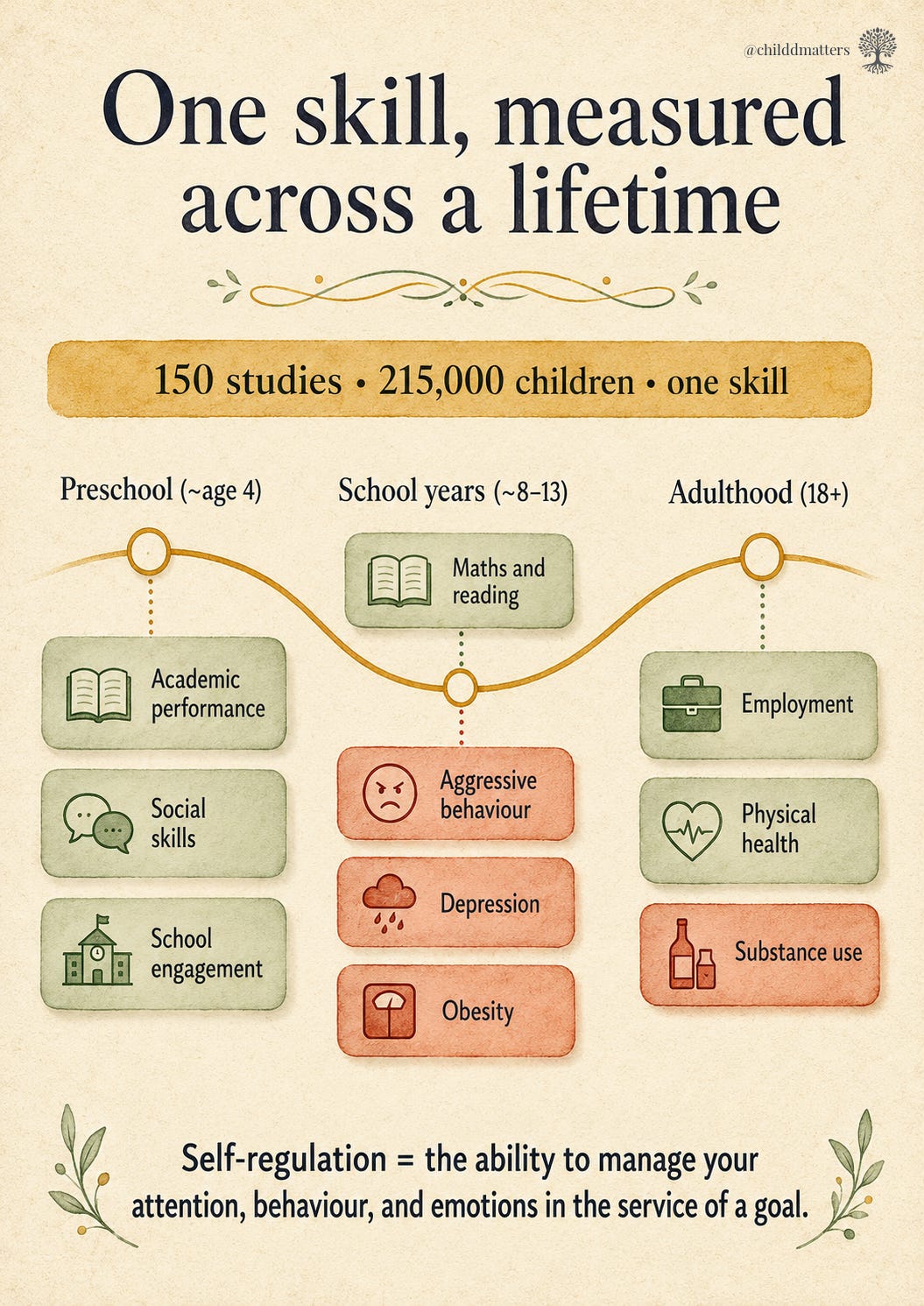
Researchers pooled 150 studies covering more than 215,000 children and asked a simple question: does self-regulation at four tell you anything about what comes later? It does. The children who could steer their attention, wait a turn, and ride out frustration at four were doing better at school at eight. By thirteen, they had fewer behavioural problems and better mental health. And it did not stop there. Childhood self-regulation still tracked with employment, physical health, and substance use decades on.
This is not one study reaching. It is 150, across many countries, with a combined sample big enough to fill a small city. The effect is real.
What self-regulation actually is
Self-regulation is not obedience. Not sitting still, not being the “good” child who does as told.
It is the ability to steer your own behaviour, attention, and emotions towards a goal. A five-year-old who waits for a turn instead of grabbing the toy is doing it. A seven-year-old who keeps going on the frustrating maths problem instead of throwing the pencil is doing it. A teenager who leaves the phone alone during revision while every fibre wants to check it. Same skill.
Under the bonnet, three brain skills carry most of it. Working memory, holding something in mind while you use it. Inhibition, stopping the first thing that springs up. And cognitive flexibility, switching between tasks or points of view. Together, these are the executive functions. They live mostly in the prefrontal cortex, just behind the forehead, which is also the slowest part of the brain to mature, and that is why a toddler’s self-control looks nothing like an adult’s.
Here is the part that surprises many of us. Self-regulation is not fixed at birth. It develops, it can be supported, and while temperament hands every child a different starting point, how far they get depends a great deal on what happens around them.
What helps
The research points one way: self-regulation grows through practice, and the practice looks different at different ages.
For preschoolers, it starts small. A three-year-old who waits while you pour the milk is practising inhibition in its simplest form. A four-year-old playing shop has to hold the rules in mind, resist grabbing everything, and adjust when a friend changes the game. Not dramatic interventions. Ordinary moments where the brain gets to rehearse stopping, holding and switching.
For primary-school children, the demands grow, and so do the chances. A strategy board game, not just a luck one, asks for planning and for handling a move that goes wrong. Cooking a recipe end-to-end exercises sequencing and patience. Learning an instrument means doing something hard over and over, noticing the mistakes, and adjusting. A review of what works found that school programmes combining social-emotional learning with cognitive challenge were among the most effective at this age.
For older children and teenagers, it becomes managing their own time, attention, and feelings without an adult holding the scaffold. A twelve-year-old who plans their own homework, notices the frustration rising, and takes a break before the meltdown is using self-regulation at a level their four-year-old self could not have imagined.
Two things come up at every age. Reading together asks for sustained attention, for holding back the interruption, for keeping the characters in mind, and guessing what comes next. And a real back-and-forth conversation, where the child has to think before answering, helps build flexible thinking. Neither costs a thing, and neither needs an app.
What doesn’t help
Drilling. Worksheets. “Brain-training” apps, the ones promising sharper focus and memory through repetitive screen games, pattern matching, number recall, or reaction time. The evidence that any of this transfers to real-world self-regulation is weak. A child who gets better at the game gets better at the game. They do not get better at waiting for a turn or holding it together in the playground.
Harsh, unpredictable discipline does not help either. Children need boundaries, so that is not the issue. The issue is the stress: constant fear of punishment works directly against the developing prefrontal cortex. Research on stress and the brain shows that even mild uncontrollable stress causes a temporary loss of prefrontal ability. A child living on edge about what happens next is running the stress system so hard that the very regions they need for self-control are working at reduced power.
The long view
Self-regulation is not a switch that flips at a set age. It is a slow build. A four-year-old who cannot share is not broken. They are working with prefrontal hardware still under construction. A seven-year-old who melts down after school is not failing at self-regulation. They have probably been doing it all day, and the tank is empty.
The most useful shift is to think of self-regulation as a muscle, not a character trait. It tires. It strengthens with use. And it grows best when the conditions are right: enough sleep, enough play, enough conversation, and an adult who shows what it looks like to handle frustration without falling apart.
This one skill connects to almost everything that matters: school, friendships, setbacks, looking after yourself as an adult. And the things that build it are not costly programmes or specialist interventions. They are the ordinary, unglamorous parts of good-enough parenting: letting a three-year-old fight with a zip before you step in, sitting through the chapter book when you are tired, asking your teenager what they actually think and then listening to the answer.
The takeaway
Self-regulation, the steering of attention, behaviour, and emotion towards a goal, is one of the strongest predictors researchers have found for how a child does across almost every domain that matters. A meta-analysis of 150 studies confirmed it. And it is not fixed at birth. It builds slowly, differently at each age, and it answers to what happens around the child.
This article was first published on Substack by Child Development Matters