





What the grit story leaves out
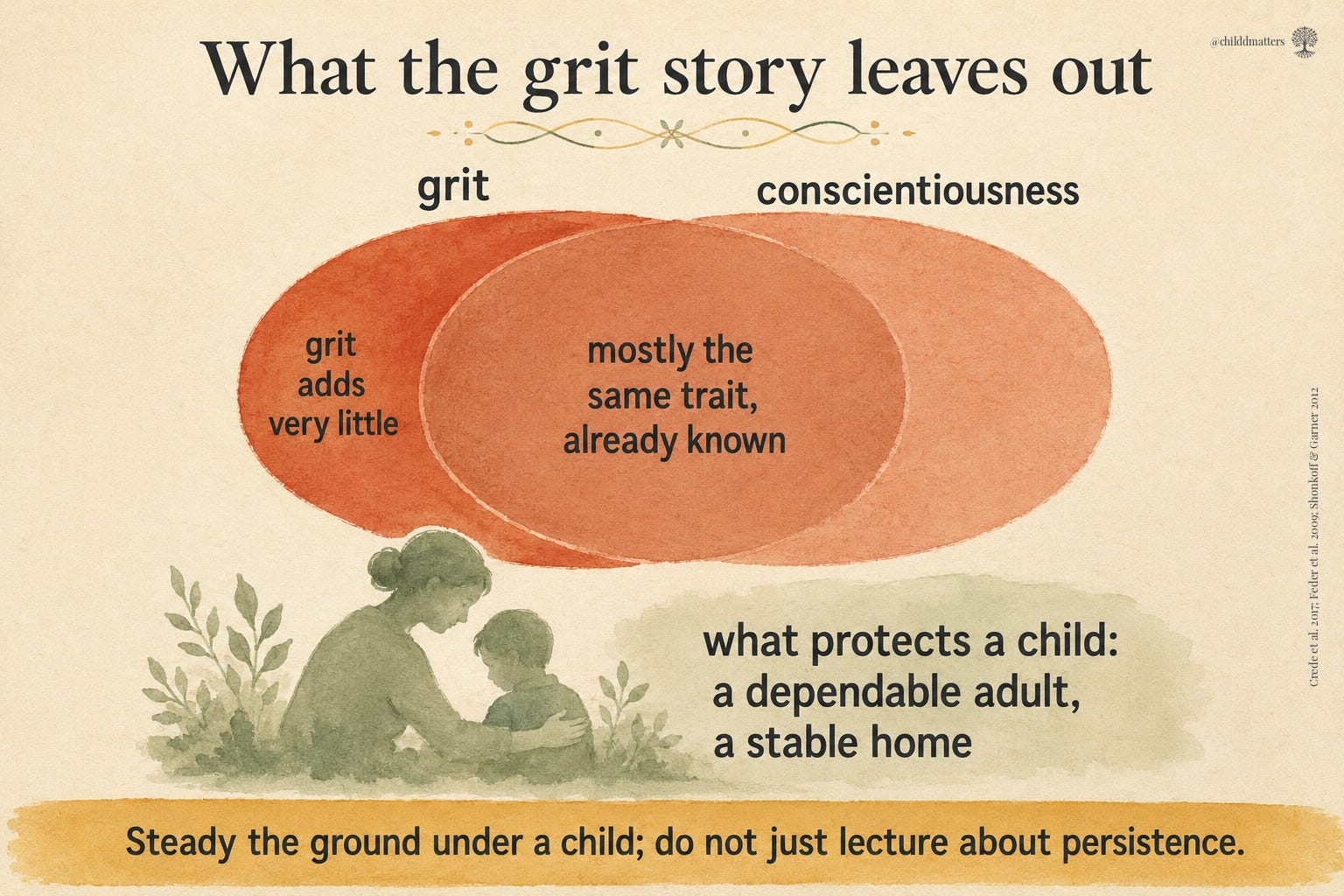
Grit is mostly conscientiousness with a bestseller behind it. What steadies a struggling child is a dependable adult.
Grit arrived with a bestseller and a viral talk and quickly became the thing every child was supposed to have: the secret ingredient behind success, not talent or luck but sheer stick-with-it-ness, something a good parent installs like a piece of software. Many of us bought it, and it is an appealing story with a real kernel inside, because persistence does matter. The trouble starts with how much weight the story asks that kernel to carry, and with what it quietly blames on the child when things go wrong.
When researchers looked hard at grit, two things came loose. It turned out to be mostly a familiar personality trait wearing a new name, and it predicted far less than the bestseller promised. Both findings point the same way: the ability to keep going is real and worth having, but it is neither a rare superpower nor something a child manufactures alone.
Grit is mostly conscientiousness
Personality researchers have measured conscientiousness for decades: being organised and dependable, the tendency to do the work and follow through. When grit is set beside it, the two overlap almost completely. Statistically, they are close to the same thing. And once you already know how conscientious someone is, grit adds very little to predicting how they will do. It also forecasts achievement more weakly than the popular version implied. So grit is less a new discovery than a rebranding of something psychology has long understood, and a fairly modest predictor even at that.
Resilience is not a solo act
The same overselling happens with resilience, usually pictured as an inner toughness a child either has or must build through hardship. But children do not bounce back on willpower alone. Whether a child weathers a hard patch depends heavily on what surrounds them, above all whether there is a dependable adult and a stable, safe place to return to. The research on children who do well despite adversity keeps landing on the same protective ingredient, and it is a reliable relationship, not a personality trait. Framing resilience as a private quality quietly shifts the load onto the child and away from the conditions they are living in.
What the brain says about bouncing back
Recovering from stress is not a single switch you either possess or lack. It draws on many systems in the brain and body working together, the stress-response machinery settling and adapting over time. Mostly that means the hormonal stress axis that floods the body with cortisol, together with a balance between the amygdala, which raises the alarm, and the prefrontal cortex, which learns to lower it again. It is also where a dependable adult does quiet biological work. The steady presence of a familiar, calm caregiver measurably lowers a child’s stress-hormone response, so a reliable relationship is not only emotional comfort. It is part of how the stress system itself learns to settle. And severe, ongoing early adversity can wear on those systems in ways that last, which is exactly why telling a child in a genuinely hard situation to simply be more resilient misses the point. The biology of bouncing back is shaped by what a child is asked to bounce back from, and by what they are given to bounce back with. Toughness is not conjured out of nothing.
What actually helps
None of this means persistence is worthless or that you cannot help a child cope. It means the lever is not a lecture about grit. It is the unglamorous, powerful work of being the dependable adult, keeping daily life predictable, and making sure a struggling child is not carrying the weight alone. It also asks for some humility about a child who is not thriving, because the missing ingredient is far more often a condition than a character flaw. A child who is going under is not failing for want of grit, and handing them a poster about perseverance is not the same as handing them a hand.
The takeaway
Grit turns out to be mostly a familiar trait, conscientiousness, in newer packaging, and it predicts success more weakly than the bestseller promised. Resilience, likewise, is not an inner toughness a child summons alone. It grows from dependable relationships and stable conditions far more than from willpower. So the way to help is not a lecture about persistence. It is being the reliable adult and steadying the ground under a child, so there is something solid to bounce back with.
Key references
Credé, M., Tynan, M. C., & Harms, P. D. (2017). Much ado about grit: A meta-analytic synthesis of the grit literature. Journal of Personality and Social Psychology, 113(3), 492-511. https://doi.org/10.1037/pspp0000102
Feder, A., Nestler, E. J., & Charney, D. S. (2009). Psychobiology and molecular genetics of resilience. Nature Reviews Neuroscience, 10(6), 446-457. https://doi.org/10.1038/nrn2649
Hostinar, C. E., Sullivan, R. M., & Gunnar, M. R. (2014). Psychobiological mechanisms underlying the social buffering of the hypothalamic-pituitary-adrenocortical axis: A review of animal models and human studies across development. Psychological Bulletin, 140(1), 256-282. https://doi.org/10.1037/a0032671
Shonkoff, J. P., & Garner, A. S. (2012). The lifelong effects of early childhood adversity and toxic stress. Pediatrics, 129(1), e232-e246. https://doi.org/10.1542/peds.2011-2663