



Walk into almost any school, and the message is on the wall: the power of yet, and a brain that grows like a muscle. You have probably seen the posters and sat through the assemblies, and the message is genuinely lovely, kinder than the alternative it replaced. Your abilities are not fixed, it says: believe you can improve, and you will.
There is even a neat brain finding underneath it. But the version that reached the school hall has grown well past its evidence in two separate directions, how much the classroom programmes actually achieve, and how far a belief can push against biology. Both matter, because the gap between the poster and the research is where a struggling child can quietly get blamed.
The real brain finding
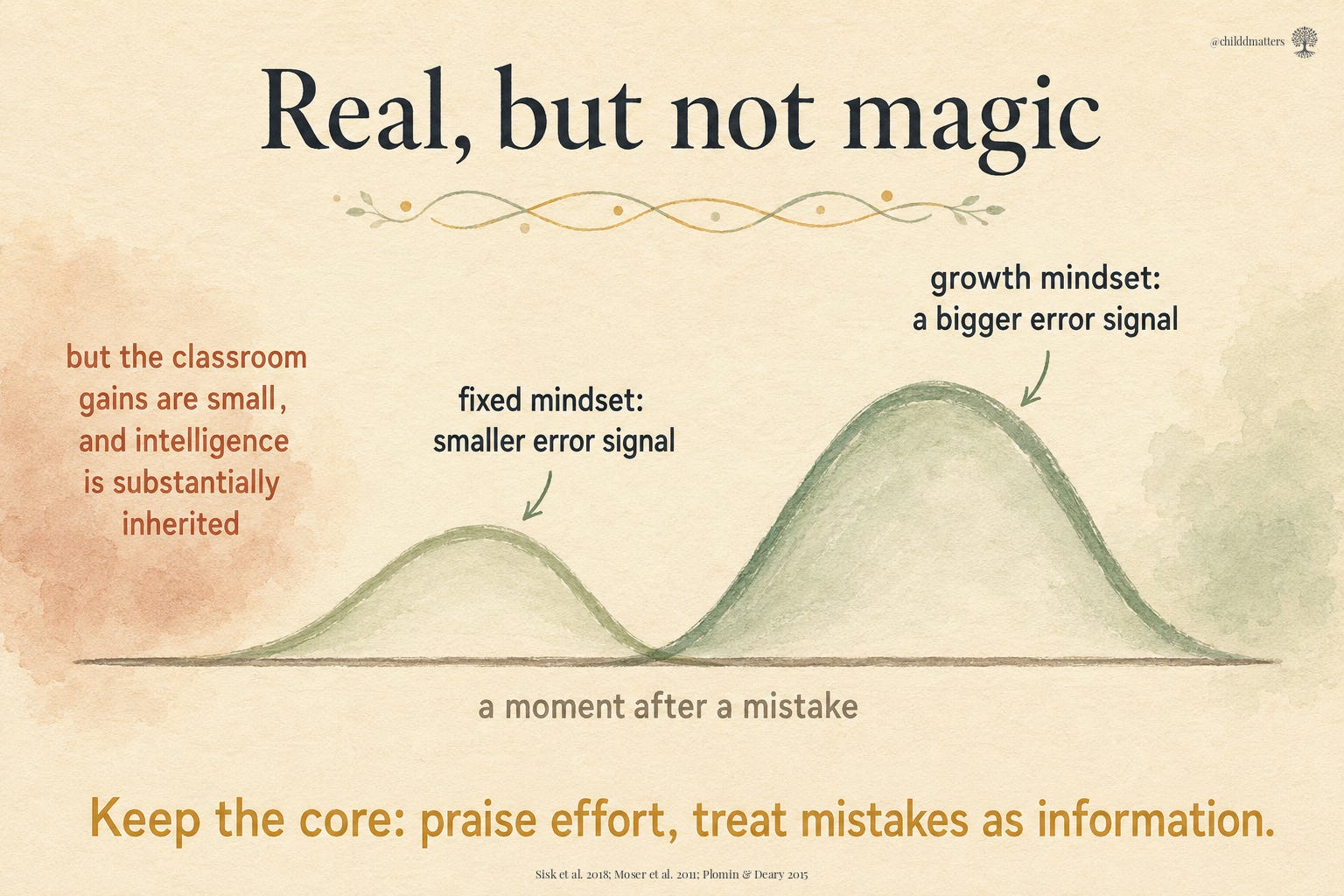
Start with the part that holds up, because it is genuinely interesting. When a person makes a mistake, the brain produces a small electrical response as it registers the error, within a fraction of a second. In people who lean towards a growth mindset, that error response tends to be larger, and they are a little more likely to put things right on the next attempt. So believing that ability can grow seems to go with how closely the brain attends to its own mistakes rather than flinching away from them. That is the strongest thing the theory has going for it, and it is a real result.
The interventions do less than promised
The leap is from that tidy laboratory finding to the promise that teaching every child a growth mindset will lift achievement across the board. When researchers pooled the actual school programmes and weighed them together, the average effect on achievement was small, and in places barely there. There are signs it helps most for the children who are struggling or disadvantaged, which is genuinely worth having. But it is not the broad transformation the assemblies imply. A real mechanism in the brain does not guarantee a powerful classroom programme.
Where belief meets biology
The harder thing to say is that ability is not endlessly stretchable by attitude. Intelligence has a strong biological and inherited component, and, strikingly, its heritability actually rises as children grow, from around a fifth in early childhood to the majority by adulthood. That does not lock a child’s future, because the environment they grow up in matters enormously. But it does mean that believing very hard does not erase the real differences in how easily different things come to different children. A growth mindset can keep a child in the game when something is difficult. It cannot make talent uniform, and pretending otherwise sets a child up to feel that any remaining struggle is their own fault.
What is worth keeping
So what survives, once the oversell is stripped away? The useful core, and it is not small. Praise a child’s effort and their strategy rather than a fixed cleverness, treat mistakes as information rather than a verdict on who they are, and keep them working at something a little beyond their reach. Those habits are good, they fit the mistake-monitoring finding, and they cost nothing to hold honestly. What to drop is the magical version, the idea that belief alone dissolves every limit, because that one comes back around to blame the child who believed and still found it hard. Effort matters. It is simply not the only thing that does.
The takeaway
A growth mindset rests on something real: believing ability can grow is associated with how closely the brain attends to its own mistakes. But the school programmes built on it produce small average gains rather than transformation, and belief runs up against biology, since intelligence is substantially inherited and becomes more so with age. Keep the useful core, praise effort and treat mistakes as information. Drop the promise that believing hard enough dissolves every limit.
Two quick questions, about ten seconds: who you are, and what you would like me to write about next. It helps me choose the topics.
Key references
Koenis, M. M. G., et al. (2018). Association between structural brain network efficiency and intelligence increases during adolescence. Human Brain Mapping, 39(2), 822-836. https://doi.org/10.1002/hbm.23885
Moser, J. S., Schroder, H. S., Heeter, C., Moran, T. P., & Lee, Y. H. (2011). Mind your errors: evidence for a neural mechanism linking growth mind-set to adaptive posterror adjustments. Psychological Science, 22(12), 1484-1489. https://doi.org/10.1177/0956797611419520
Plomin, R., & Deary, I. J. (2015). Genetics and intelligence differences: five special findings. Molecular Psychiatry, 20(1), 98-108. https://doi.org/10.1038/mp.2014.105
Schroder, H. S., et al. (2017). Neural evidence for enhanced attention to mistakes among school-aged children with a growth mindset. Developmental Cognitive Neuroscience, 24, 42-50. https://doi.org/10.1016/j.dcn.2017.01.004
Sisk, V. F., Burgoyne, A. P., Sun, J., Butler, J. L., & Macnamara, B. N. (2018). To what extent and under which circumstances are growth mind-sets important to academic achievement? Two meta-analyses. Psychological Science, 29(4), 549-571. https://doi.org/10.1177/0956797617739704