



Sleep does help a baby lock in what they learn. But waking is the norm all through the first year, and the best evidence says gentle sleep methods leave no lasting mark, for better or worse.
Child Development Matters
It is ten past three in the morning, and the baby is awake again, the fourth time tonight. A parent lies in the blue light of a phone, reading that every lost hour of infant sleep is an hour of brain-building gone. Then comes the anxious arithmetic about the child’s future. That is where the trouble starts, because almost every number in it is wrong.
What sleep really does for a baby’s brain
Sleep does genuinely help the infant brain, and we can say so with more than a hunch. In one careful experiment, six- and twelve-month-olds learned a new action, then either napped or stayed awake. Only the babies who slept within a few hours still remembered the action later that day, and even the next. The nap was arranged, not just observed, so this is a real cause and not a coincidence. A well-timed nap helps a fresh memory set.
The mechanism is quietly elegant. During sleep, the brain replays what it took in while awake and stabilises it, tucking the new memory in among what the child already knows. That is worth respecting. It is also much narrower than the slogan suggests. Sleep firms up a thing just learned. It is not a nightly verdict on whether the whole brain is on schedule.
Waking is the timetable, not a fault
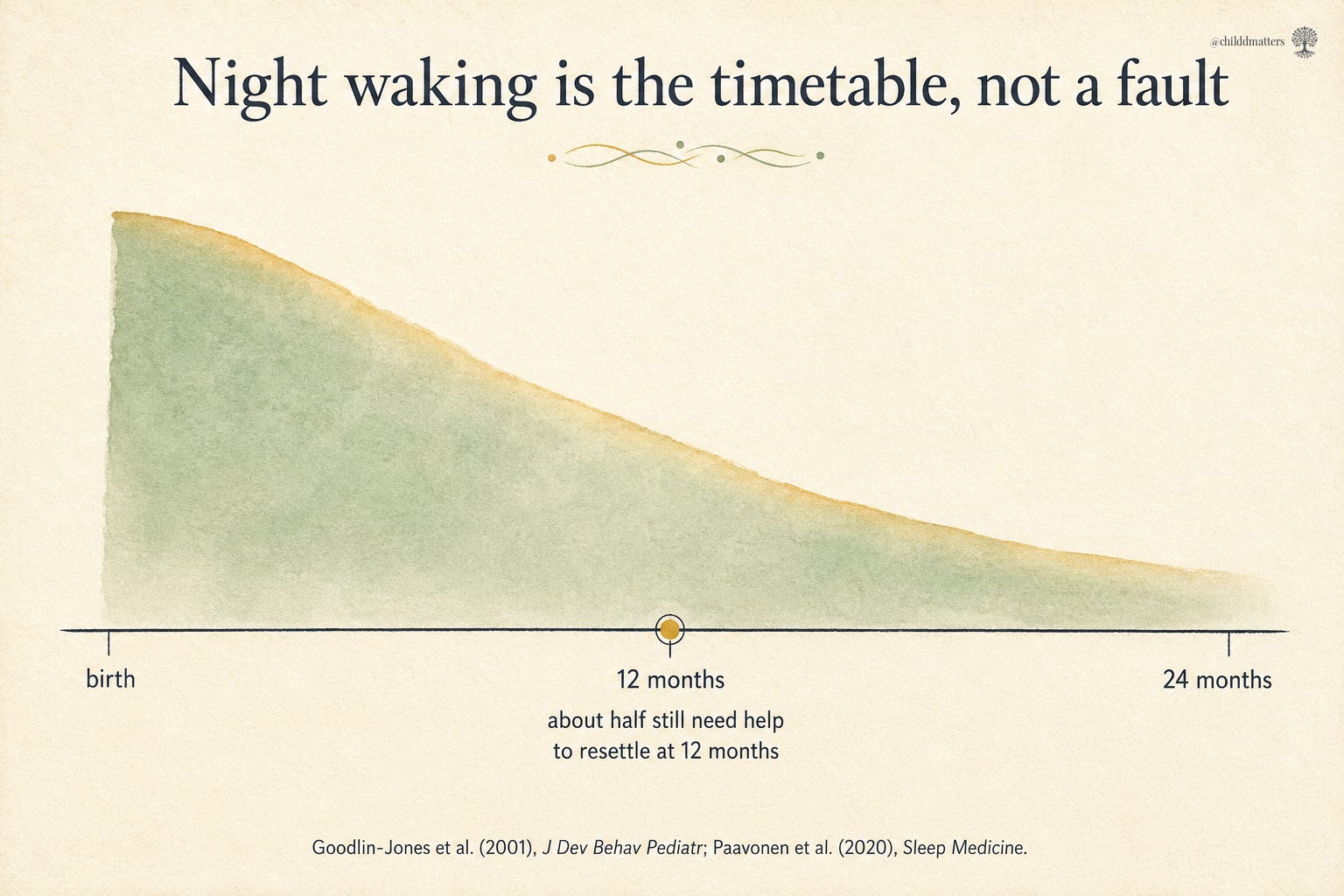
Filmed through the night, most babies wake, at three months and six and nine and twelve. Waking is simply what infant sleep does. What grows across the first year is not the absence of waking but the ability to settle again alone. And that grows slowly. Even at the first birthday, around half of babies still need a grown-up to help them back to sleep. That is not a malfunction. It is the middle of the range.
The wider picture agrees. Across two large birth cohorts, night sleep only begins to gather into long stretches during the second year. Parents report sleep problems all through, and most of them sit comfortably inside what is normal. Normal here is a wide band, and a great deal of worry is spent on babies squarely within it.
Correlation in a lab coat
So where does the frightening version come from? Mostly from studies that measure a baby’s sleep and a baby’s development at a single moment, then note that the two move together. The newest, following several hundred infants, links more night-waking to slightly lower scores on a developmental screen. The numbers are small. More importantly, a snapshot cannot tell you which way the arrow runs. A brain that is maturing well may sleep in longer stretches precisely because it is maturing well, so development drives the sleep rather than the reverse. Sleep also travels with feeding, with room-sharing, and with a parent’s own health and circumstances, any of which could be doing the real work.
The fear that sleep training breaks the bond
One worry deserves a straight answer, because it is the one that keeps parents frozen at 3 a.m. Does letting a baby resettle on their own damage the bond between child and parent? This has been tested about as well as such things can be. Children whose families used gentle behavioural sleep methods as babies were followed to the age of six. They showed no difference from other children in emotional or behavioural problems, in stress, in the closeness of the relationship, or in attachment. Their mothers’ mental health was no different either. The honest other half of the finding is that there was no lasting benefit on any measure. Gentle sleep methods are neither the brain-saver nor the brain-wrecker the two camps insist on.
The takeaway
Sleep helps a baby hold on to what they learn, and consolidated sleep is a real milestone. But it arrives slowly, on a wide individual timetable, so a baby waking at night is almost always ordinary. The evidence that infant sleep itself drives better or worse development is thin and correlational. The best causal evidence we have says gentle sleep methods leave no lasting mark, on the brain or the bond. If there is a number worth minding at 3 a.m., it is your own sleep, which has the clearest effect on the whole household.
Key references
Goodlin-Jones, B. L., Burnham, M. M., Gaylor, E. E., & Anders, T. F. (2001). Night waking, sleep-wake organization, and self-soothing in the first year of life. Journal of Developmental & Behavioral Pediatrics, 22(4), 226-233. https://doi.org/10.1097/00004703-200108000-00003
Paavonen, E. J., Saarenpaa-Heikkila, O., Morales-Munoz, I., et al. (2020). Normal sleep development in infants: findings from two large birth cohorts. Sleep Medicine, 69, 145-154. https://doi.org/10.1016/j.sleep.2020.01.009
Price, A. M. H., Wake, M., Ukoumunne, O. C., & Hiscock, H. (2012). Five-year follow-up of harms and benefits of behavioral infant sleep intervention: randomized trial. Pediatrics, 130(4), 643-651. https://doi.org/10.1542/peds.2011-3467
Seehagen, S., Konrad, C., Herbert, J. S., & Schneider, S. (2015). Timely sleep facilitates declarative memory consolidation in infants. Proceedings of the National Academy of Sciences, 112(5), 1625-1629. https://doi.org/10.1073/pnas.1414000112