




Story By Marta Iraola Iribarren.
India has confirmed two cases of Nipah virus in West Bengal, a region in the eastern part of the country bordering Bangladesh, Bhutan, and Nepal.
Both infected patients are healthcare workers from the region, and are hospitalised in intensive care.
The Indian government added that 196 contacts of the confirmed cases are all asymptomatic and have tested negative for the virus.
The health ministry states that available data suggest that there is no need for the general public to be apprehensive about the safety of individuals and their family members.
However, given the high potential mortality of the virus, up to 75 percent, and the lack of specific treatment or vaccine, every outbreak is closely monitored.
What is the Nipah virus?
Nipah virus is an illness that can be transmitted from animals, through contaminated food, or from contact with an infected person.
It is mainly found in bats in the coastal regions and on several islands in the Indian Ocean, India, Southeast Asia, and Oceania.
The Nipah virus has considerable epidemic or pandemic potential as it can be transmitted by domesticated animals, and secondary human-to-human transmissions are possible.
In infected people, it causes a range of illnesses from asymptomatic to acute respiratory disease and fatal encephalitis.
The mortality rate is between 40 percent and 75 percent, depending on the strain of the virus.
Neighbouring countries are cautious
Some of India’s neighbouring countries are implementing checks for travellers from the affected Indian region and issuing official alerts.
Thailand has introduced airport checks for people travelling from West Bengal. So far, no cases have been detected outside of India.
The country also advises special surveillance for visitors in bat-associated areas.
Nepal has also implemented new measures in response to the cases in India, increasing surveillance in their border with the country and at its airports.
Nipah outbreaks 2025
It is not that uncommon for outbreaks of the Nipah virus to happen in the higher-risk areas.
Since 1998, outbreaks have been reported in Bangladesh, India, Malaysia, the Philippines, and Singapore, according to the World Health Organization (WHO).
In July 2025, India confirmed four cases, including two deaths in two districts of Kerala State, in the southwest of the country – a region with regular outbreaks since 2018.
Bangladesh also reported four cases of the virus between January and August 2025. The disease is endemic in the country, and since the first recognised outbreak in 2001, human infections have been detected almost every year.
In both cases, the WHO considered the risk of international disease spread to be low.
However, the international agency stresses the need to raise awareness of the risk factors, as no specific drugs or vaccines are currently available for Nipah virus disease.
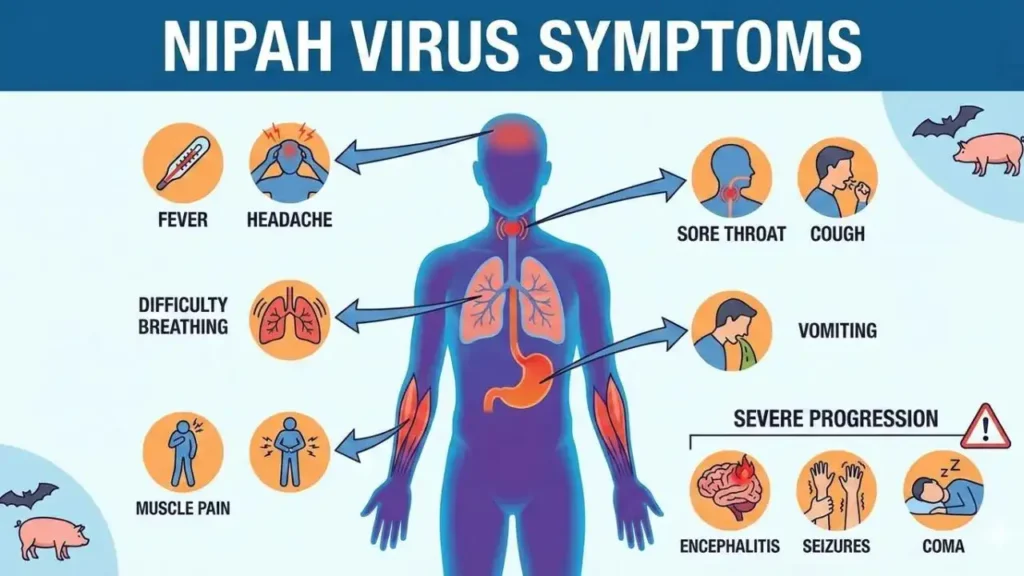
Symptom’s explained: Infected people initially develop symptoms including fever, headaches, myalgia (muscle pain), vomiting and sore throat. This can be followed by dizziness, drowsiness, altered consciousness, and neurological signs that indicate acute encephalitis. Some people can also experience atypical pneumonia and severe respiratory problems, including acute respiratory distress. Encephalitis and seizures occur in severe cases, progressing to coma within 24 to 48 hours.