



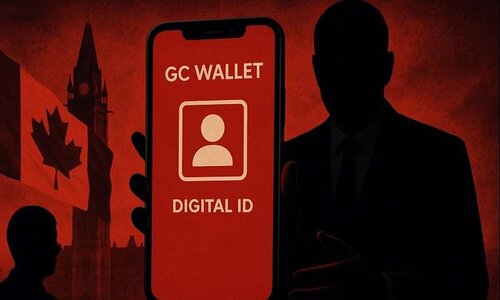
Canada is quietly moving toward a digital identity system, and most citizens barely know it’s happening. A tool called GC Wallet has already launched in limited form, promising to make government services easier to access, all from the convenience of a smartphone.
On the surface, it’s hard to argue with the idea of simplification: fewer passwords, fewer cards, and faster service. But beneath this glossy veneer lies a far deeper concern — one that touches on freedom, privacy, and control.
At first, digital IDs are sold as optional. Use them if you want; skip them if you don’t. But history shows how “optional” quickly becomes mandatory once governments and businesses integrate a system into everyday life. Banks, airlines, healthcare, and grocery stores could all eventually require digital verification. The moment participation becomes necessary to function in daily life, choice disappears. And with that disappearance comes control — control over how citizens access money, travel, healthcare, and even social interactions.
Critics warn that a centralized digital ID creates a single point of failure — a honeypot of personal information that hackers, corporations, or governments could exploit. But the threat isn’t just cyberattacks. A digital ID system allows authorities to monitor behavior, track purchases, record travel, and even restrict access based on conduct. Imagine your ID being suspended because of something you said online — a post critical of a government policy, or a social opinion deemed illegal under shifting rules. Suddenly, your ability to live and work is instantly curtailed.
This is not a far-off scenario. Once personal identity becomes digital, the government holds the keys. What starts as a convenience could very quickly become a mechanism of enforcement, shaping behavior in ways citizens never consented to. Your movements, your spending, your online speech — all become visible and accountable. And because these systems are designed to be interoperable across borders, a digital ID in Canada could one day connect to systems in Europe, or beyond. This is global control, wrapped in the guise of convenience.
The United States is moving in a similar direction. Several states are exploring or piloting digital driver’s licenses and identity wallets, and federal initiatives are quietly laying the groundwork for national interoperability. While officials frame these programs as tools for convenience and security, critics warn that the same pattern could take hold: optional participation quickly becoming essential, personal data aggregated and monitored, and citizens losing real control over how they access everyday services. The U.S. could soon find itself navigating the same privacy and liberty trade-offs already emerging in Canada.
The danger is compounded by corporations and financial institutions. Banks, retailers, and tech companies are eager to integrate digital IDs into their systems, seeing efficiency, fraud prevention, and customer data collection as major benefits. Once corporate adoption becomes widespread, citizens may feel they have no choice but to participate. Digital ID systems could become a requirement for banking, online shopping, flights, or even employment verification. Convenience for the consumer and profit for the companies could push society into a situation where opting out is no longer feasible — effectively normalizing surveillance and control under the guise of modern commerce.
The dangers are not theoretical. Look to China, where a nationwide digital ID and social credit system already monitor every aspect of life. Citizens’ access to travel, financial services, housing, and education is tied to compliance with government rules. Behavior deemed undesirable can trigger restrictions, punishments, or surveillance. The Chinese system demonstrates how digital identity can shift the balance of power from individuals to the state — how a society can be reshaped quietly, incrementally, until people realize their freedoms have been restricted in ways previously unimaginable.
Canada is moving quietly down a similar path. There is no fanfare, no public debate, no robust discussion of the consequences. Yet the framework is in place. The digital ID is live. Once this infrastructure becomes embedded in banking, healthcare, travel, and commerce, rolling it back will be far more difficult than implementing it. “Voluntary” becomes default, and citizens may only discover the limitations after the system is entrenched.
Convenience should never come at the price of freedom. Digital IDs may streamline daily life, but they also create a tool for monitoring, control, and restriction. Canada is taking small steps now, but the potential impact is enormous. Without careful legal safeguards, transparent oversight, and broad public debate, this quiet shift toward digital identity could redefine what it means to live freely.
History shows that once systems like this are in place, reversing them is almost impossible. Interoperable global digital IDs are already on the rise, and all it might take is a push from the economic or technological world to normalize them everywhere. Canada’s citizens — and the rest of the world — should ask themselves a simple but urgent question: how much convenience is too much if it comes at the cost of liberty?