



By Katy Nolan/Staff Writer, PNW News Agency
How far can a nation go in protecting people from being offended before it starts criminalizing its own heritage?
That question is becoming increasingly difficult to avoid in Finland, where authorities appear determined to ensure that Christian beliefs remain safely locked away from public view–lest someone hear them, disagree with them, or worse yet, be offended by them.
The warning signs have been flashing for years.
Many Christians around the world first became aware of Finland’s growing hostility toward biblical speech through the case of Päivi Räsänen, a grandmother, medical doctor, former Interior Minister, and long-serving member of parliament.
Her offense?
Quoting the Bible.
Räsänen found herself dragged through years of investigations, interrogations, court hearings, and legal battles because she publicly defended the historic Christian understanding of marriage and sexuality. Among the evidence cited against her were social media posts quoting Scripture, radio comments discussing Christian doctrine, and a pamphlet explaining biblical teaching.
Think about that for a moment.
A politician in a Western democracy was investigated and ultimately convicted because she expressed beliefs that Christians have held for nearly 2,000 years.
The message could not have been clearer: certain opinions are still allowed in Finland–as long as they align with the approved cultural narrative.
But if you thought the Räsänen case was an isolated incident, Finland’s latest controversy suggests otherwise.
The new target is not a politician.
It is not a pastor.
It is not even a church.
It is a school song.
Yes, really.
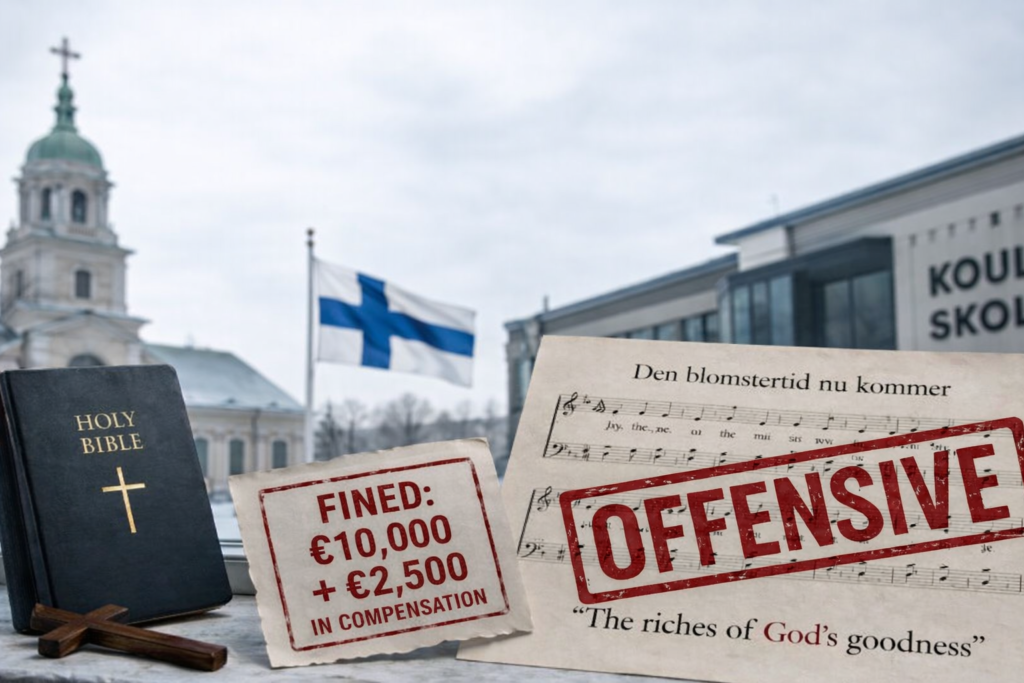
The Finnish Discrimination and Equality Board has fined the city of Espoo €10,000 and ordered it to pay an additional €2,500 in compensation to a student who was allegedly discriminated against after being exposed to Christian-themed songs during school celebrations.
The songs in question were not fiery sermons.
They were not evangelistic altar calls.
They were traditional songs sung by generations of Finnish schoolchildren.
One included the apparently offensive lyric: “God shall reward him who is a friend of the poor.”
Another referenced “the riches of God’s goodness” while celebrating the beauty of spring.
That’s it.
No threats.
No condemnation.
No political activism.
No coercion.
Just gratitude to God and encouragement to care for the poor.
Yet somehow this became a discrimination case worthy of government intervention.
The student claimed that hearing such songs over a six-year period violated his religious beliefs. The board agreed.
One cannot help but wonder what exactly those beliefs were.
The ruling never explains why hearing that God rewards kindness toward the poor was so harmful. Neither did authorities explain how thanking God for nature’s beauty constituted discrimination.
Apparently, merely hearing such ideas was enough.
And that is where this story moves from absurd to deeply troubling.
Because this is no longer about protecting freedom of religion.
It is about protecting freedom from religion.
There is a profound difference.
A free society allows people to believe–or reject–whatever they choose. It protects both the Christian who sings a hymn and the atheist who declines to join in.
But modern secularism increasingly demands something else entirely. It insists that religious ideas must disappear from public spaces altogether.
The goal is no longer coexistence.
The goal is sterilization.
Christian references must be removed. Historic traditions must be rewritten. Public ceremonies must be stripped clean of anything that reminds people of the faith that shaped the civilization around them.
Ironically, this campaign is being carried out in a country whose national identity was profoundly shaped by Christianity.
Finland’s churches, holidays, literature, customs, architecture, and moral foundations all emerged from centuries of Christian influence.
Trying to remove God from Finnish culture is a little like trying to remove the sea from Finland’s coastline.
At some point, you are no longer preserving neutrality.
You are erasing history.
What makes this trend especially alarming is that it never seems to end where it begins.
First it was pastors.
Then politicians.
Now school songs.
Tomorrow?
Will Christian artwork become offensive?
Will Bible verses in historical monuments be considered discriminatory?
Will Christmas programs need government approval to ensure nobody hears an unauthorized reference to God?
These questions sound ridiculous–until one remembers that many people would have considered the current case ridiculous just a few years ago.
The deeper issue is that Western societies are increasingly treating Christianity as uniquely dangerous. A faith that built hospitals, universities, charities, orphanages, and countless institutions of compassion is now viewed with suspicion whenever it appears outside church walls.
Meanwhile, the student at the center of this case has been awarded compensation because he heard a song mentioning God’s goodness.
Previous generations endured wars, economic collapses, and genuine persecution.
This generation receives financial compensation because someone sang about God rewarding kindness to the poor.
That contrast says far more about the state of modern Western culture than it does about Christianity.
The tragedy is that Finland once stood as a nation where faith and freedom coexisted. Today, it increasingly appears to be a place where faith must remain silent if freedom is to be preserved.
And when a society reaches the point where a school song becomes a human-rights violation, it may be worth asking whether the problem is Christianity–or whether the culture has simply forgotten how to tolerate beliefs it no longer shares.