


EDITORIAL: Mike Bain/cvnznews.com
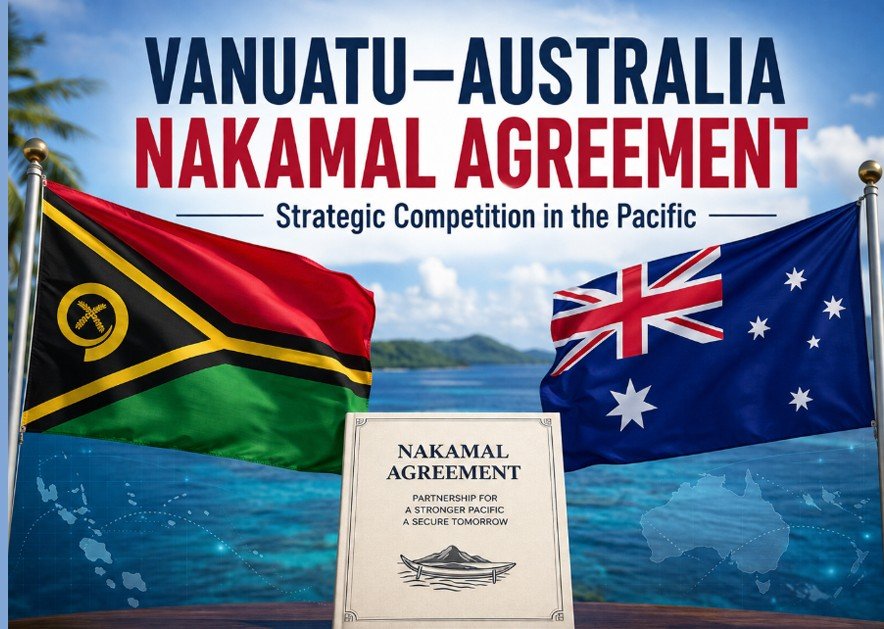
Australia and Vanuatu have signed what’s being called a landmark security and development pact — the Nakamal Agreement — designed to block foreign military bases, strengthen policing cooperation, and channel A$500 million in Australian aid over the next decade.
On paper, it’s a decisive move. In practice, it raises a harder question: Does it really change the balance of power in a region increasingly shaped by China’s military and economic reach?
What the Agreement Says
Finalised in Canberra on June 29, 2026, by Australian Prime Minister Anthony Albanese and Vanuatu Prime Minister Jotham Napat, the deal includes:
- Military Base Ban: Vanuatu cannot permit any foreign military base or militarization on its territory.
- Financial Support: Australia commits A$500 million in development aid over ten years.
- Infrastructure Consultation: Vanuatu must consult Australia before engaging third‑party nations on critical infrastructure projects.
- Security Cooperation: Expanded joint work in maritime patrols, cyber security, police training, and intelligence sharing.
The intent is clear — to curb Beijing’s growing influence in the South Pacific, especially after China’s funding of the Luganville wharf expansion and naval port calls that alarmed Canberra and Washington.
The Strategic Reality
The South Pacific has become a chessboard of soft power. China’s economic footprint — through loans, construction, and trade — dwarfs most Western aid packages. A$500 million sounds substantial, but compared to China’s multi‑billion‑dollar Belt and Road investments across the region, it’s a modest counterweight.
The military base ban may reassure Australia and its allies, but enforcement depends entirely on Vanuatu’s internal politics and future leadership. Agreements can be rewritten; influence is harder to erase.
Impact on New Zealand and the Region
For New Zealand, the Nakamal Agreement reinforces the Pacific’s tilt toward Canberra’s leadership in regional security. Wellington will likely welcome the stability but must also navigate the optics — ensuring its own Pacific partnerships don’t appear secondary to Australia’s.
For Vanuatu, the deal offers financial breathing room but also binds it closer to Australian oversight. Critics may see that as protection; others may see it as dependency.
For China, it’s a signal that the Pacific’s smaller nations are being courted more aggressively by Western allies — but it’s unlikely to slow Beijing’s investment drive. Money and infrastructure remain powerful diplomatic tools.
A Question of Influence
So, does the Nakamal Agreement truly shift the balance? Or is it a symbolic gesture — a polite “no” to foreign bases that won’t stop the deeper economic tide?
In the South Pacific, influence isn’t measured by treaties. It’s measured by who builds the roads, funds the ports, and answers the phone when a cyclone hits.
Australia’s move is strategic and welcome. But in a region where China’s presence is already woven into the fabric of development, the real test will be whether this agreement can hold its ground when the next cheque, ship, or diplomatic overture arrives from Beijing.