



Greg Bouwer/ Israel Institute of New Zealand.
As New Zealand approaches the 2026 general election, foreign policy will not determine most voters’ choices. But for New Zealanders concerned about Israel, antisemitism, terrorism and the direction of this country’s Middle East policy, there are meaningful differences between the political parties.
The Israel Institute of New Zealand (IINZ) asked political parties six questions intended to move beyond the familiar language of ceasefires, international law and support for a two-state solution. The questions addressed practical issues: New Zealand funding for organisations connected with terrorism or the promotion of violence; relations with Israel; rhetoric such as “from the river to the sea” and “globalise the intifada”; discriminatory campaigns against Israel; recognition of Palestinian statehood; and whether recognition in the aftermath of 7 October could reward terrorism and hostage-taking.
The responses are revealing. So, too, are the questions that were not answered.
New Zealand First and ACT provided direct answers to the questionnaire. National supplied a statement from its foreign affairs spokesperson, Todd McClay, rather than responding to the six questions individually. National MP Stuart Smith separately answered all six questions, but his responses are his own and should not be confused with official National Party policy.
Labour, the Green Party, and Te Pāti Māori were also approached. No response was received from them by the time of publication.
The questions
IINZ asked:
- Do you oppose NZ funding organisations that employ terrorists and run schools that teach children to glorify terror?
- Do you support closer ties with Israel (cultural, economic, technological)?
- Do you agree that chants such as “from the river to the sea” and “globalise the intifada” call for the elimination of Israel and would constitute “hate speech”?
- Do you believe that calls for boycotts or sanctions that uniquely target Israel, while ignoring comparable or worse abuses elsewhere, warrant scrutiny for discriminatory intent?
- Do you oppose unilateral recognition of a Palestinian state outside the framework of negotiated peace talks?
- If you support recognition, how do you address concerns that recognition following October 7 risks rewarding mass terrorism and hostage-taking?
The purpose was not to assign parties an arbitrary score for being more or less “pro-Israel”. The questions test different things, and voters will attach different importance to the answers. They also expose some genuine philosophical distinctions — for example, between regarding speech as hateful and believing it should be prohibited by law.
What matters is knowing where the parties stand.
New Zealand First: the most detailed position
New Zealand First provided the most developed answers.
On New Zealand funding, the party was unequivocal:
“NZ should not fund any organisation that employs terrorists or promotes violence and terror whether through schools, media, or other institutions.”
It added that funding should depend upon “clear opposition to terrorism, respect for international law, and genuine commitment to peace.” This is strong language from a party whose leader, as Minister of Foreign Affairs, approved funding for UNRWA.
The party also explicitly supports closer cultural, economic and technological relations with Israel, although it places those relations within its broader Middle East policy and continuing support for a two-state solution. It links engagement with Israel with support for Palestinian governance reform and peace efforts.
On rhetoric, NZ First described “from the river to the sea” and “globalise the intifada” as “deeply concerning and potentially inciting hatred”. Its response said such slogans are widely understood as rejecting Israel’s existence and glorifying violent uprising and could, depending upon their use, constitute hate-motivated expression in New Zealand.
NZ First also accepted that ostensibly human-rights-based campaigns directed selectively against Israel can warrant scrutiny for discriminatory motivation. Its answer was carefully qualified: human-rights abuses wherever they occur warrant scrutiny, but New Zealand should also be alert to “discriminatory or antisemitic intent disguised as human-rights advocacy” and should apply consistent standards between countries.
Perhaps the most significant response concerns Palestinian recognition.
NZ First opposes unilateral recognition “at this time”. That qualification matters. Its position is not that Palestinian statehood should never be recognised. Rather, recognition remains a matter of “when, not if”, but should support a negotiated peace rather than precede or undermine one.
Crucially, NZ First also addressed the relationship between recognition and 7 October. Recognition, it said, would need to be conditional upon the renunciation of terrorism and credible governance reforms demonstrating commitment to peaceful coexistence. Recognition should only occur when it advances a viable two-state solution and “does not legitimise or incentivise terrorism.”
That is a substantially more developed position than simply declaring support for a two-state solution.
ACT: clear positions, with an important free-speech distinction
ACT also answered the questionnaire directly.
It opposes New Zealand funding organisations that employ terrorists or teach children to glorify terror. It supports closer cultural, economic and technological ties with Israel. It believes selective boycotts and sanctions against Israel warrant scrutiny for discriminatory intent. And it opposes unilateral recognition of Palestinian statehood outside negotiated peace talks.
Its answer concerning political rhetoric deserves to be represented carefully.
ACT condemns “from the river to the sea” and “globalise the intifada” as hateful language. But it does not therefore support hate-speech legislation. Instead, ACT argues that existing laws concerning incitement to violence should be enforced where conduct reaches that threshold.
That is not an evasive answer. It reflects a distinction between condemning speech and criminalising speech. Someone can regard a slogan as hateful, threatening or eliminationist without believing the state should prohibit its expression.
On Palestinian recognition, ACT’s answer is simpler than NZ First’s: it opposes unilateral recognition outside a negotiated peace process. The final question concerning how recognition could avoid rewarding terrorism was therefore not applicable.
National: a statement, but not answers
National took a different approach.

Its foreign affairs spokesperson, Todd McClay, provided IINZ with a general statement rather than answers to the individual questions.
National reiterated its calls for a ceasefire and de-escalation, saying renewed fighting had caused devastating civilian suffering. It called for implementation of the ceasefire arrangements, protection of civilians and rapid, unimpeded humanitarian assistance into Gaza.
It also unequivocally condemned Hamas’s terrorist attacks of 7 October 2023 and supported international efforts to achieve a lasting end to the conflict through negotiations and diplomacy.
National reaffirmed its support for a two-state solution, “secure and recognised borders for both Israel and Palestine”, Israel’s right to exist in peace and security, and Palestinian self-determination. It said a permanent end to the conflict ultimately requires constructive negotiations between the parties.
These are substantive foreign-policy positions. But they do not answer the questions IINZ put to National.
The party did not state whether it supports closer cultural, technological and economic ties with Israel. It did not answer the question concerning New Zealand funding organisations that employ terrorists or promote terrorism. It did not address “from the river to the sea” or “globalise the intifada”. It did not answer whether uniquely targeting Israel for boycotts or sanctions warrants scrutiny for discriminatory intent.
Most importantly, while National reiterated its support for a negotiated two-state solution, the response did not answer the specific question of whether New Zealand should unilaterally recognise Palestinian statehood before such negotiations produce an agreement.
Those positions should not be inferred. Where National did not answer, the appropriate description is simply: not answered.
A different response from a National MP
National MP Stuart Smith separately answered IINZ’s questions. His responses are worth publishing, but they cannot be treated as National Party policy.
Smith answered yes to opposing New Zealand funding of organisations employing terrorists or teaching children to glorify terror. He also supports closer ties with Israel, adding: “we are a trading nation.”
His remaining answers are markedly different from ACT and NZ First.
Asked whether “from the river to the sea” and “globalise the intifada” call for Israel’s elimination and would constitute hate speech, Smith responded:
“Absolutely not.”
Asked whether boycotts or sanctions uniquely targeting Israel warrant scrutiny for discriminatory intent, he replied:
“No I do not.”
And asked whether he opposes unilateral recognition of a Palestinian state outside negotiated peace talks, he again replied:
“No I do not.”
The questionnaire then asked respondents supporting recognition how they would address concerns that recognition following 7 October could reward mass terrorism and hostage-taking. Smith answered:
“N/A.”
There is an ambiguity in the questionnaire’s third question that should be acknowledged. It asks both whether the slogans call for Israel’s elimination and whether they constitute hate speech. Smith’s “Absolutely not” does not establish whether he rejects both propositions independently or the combined proposition as framed. His answer should therefore be reported as given rather than interpreted further.
Likewise, his views on Palestinian recognition should not be attributed to National when the party itself did not answer that question.
The parties that did not respond
Labour, the Green Party and Te Pāti Māori were invited to respond to the questionnaire. No response was received by the publication deadline.
That does not establish their positions on the six questions. Nor would it be appropriate for IINZ to construct answers from previous speeches, social-media posts or policy statements and present those as equivalent to answers provided specifically for this survey.
Their entries are therefore recorded as “No response.”
Should those parties subsequently respond, this guide can be updated accordingly. However, we can look at statements from those parties and it would seem that a change in government would likely bring unilateral recognition of a Palestinian state and probably the continued funding of UNRWA despite all the issues. As MPs from each of the parties have either chanted hateful slogans or associated themselves with groups like PSNA, we can be confident that they will condone or even engage in divisive rhetoric. Perhaps therein lies possible reasons for their silence in response to our questions.
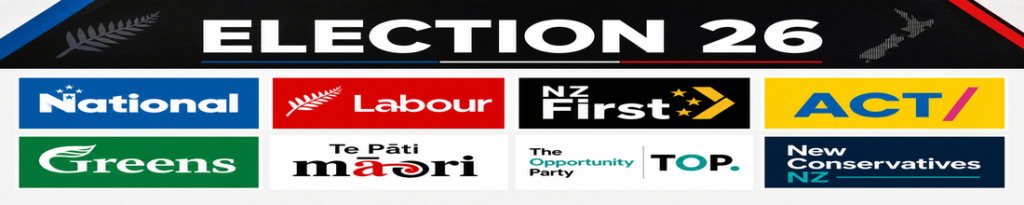
Election 2026: the positions at a glance

Beyond the familiar slogans
Perhaps the clearest lesson from the exercise is how little the phrase “support for a two-state solution” tells voters by itself.
National and NZ First both explicitly support a two-state solution. Yet NZ First goes considerably further in explaining the conditions it believes should precede recognition. ACT opposes unilateral recognition. Stuart Smith does not. National’s official response leaves that particular question unanswered.
Those differences matter.
A two-state solution is an objective. It does not tell us whether New Zealand should recognise Palestine tomorrow or after an agreement with Israel; whether recognition should depend upon Palestinian institutional reform; what role Hamas could have in a future state; or whether terrorism and hostage-taking should affect the timing and conditions of recognition.
The same is true of antisemitism. Almost every mainstream political party will condemn antisemitism in the abstract. Harder questions arise when antisemitism intersects with Israel: when Jews are held collectively responsible for Israeli policy; when the world’s only Jewish state is subjected to standards not applied elsewhere; or when slogans associated with violent confrontation are directed at Jewish or Israeli communities in New Zealand.
That is why specific questions matter.
There is no single “Jewish vote” or “pro-Israel vote” in New Zealand, and IINZ does not tell people how to cast their ballots. Voters will weigh foreign policy alongside the economy, health, education, crime and numerous other issues.
But voters are entitled to know what political parties propose to do.
On the questions IINZ asked, New Zealand First and ACT have provided the clearest answers. National has stated its broad principles but declined to answer the specific questions. One National MP has provided answers of his own, including positions substantially different from ACT and NZ First. Three other parties have provided no answers at all.
That does not tell New Zealanders how to vote.
It does tell them what information they have — and what information they still do not.