


Ashley Church
Regular readers of my articles could be excused for wondering whether I’ve finally gone off the deep end over the past few months.
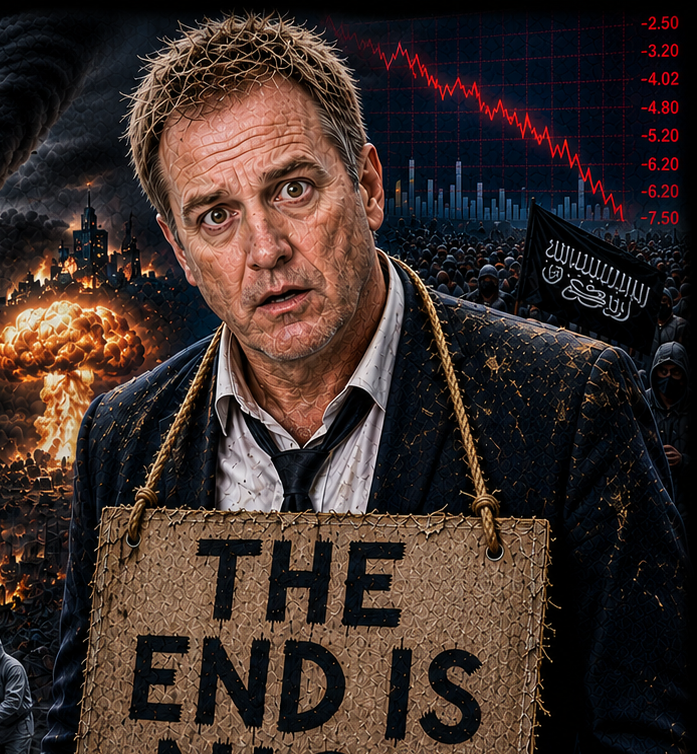
My Jewish friends, many of whom have appreciated my advocacy for Israel and the Jewish people, will note an increase in the number of articles that veer into distinctly apocalyptic territory and quietly wonder what on earth I’m doing. Christian readers may feel equally awkward because the things I’m writing are deeply challenging to what they’ve been taught to believe. And my non-Christian readers will simply see all of this ‘religious stuff’ and conclude that I’ve finally become the modern equivalent of that strange, wide-eyed figure that people once saw in newspapers, cartoons and on city streets, wandering around with a sandwich board over his shoulders declaring:
THE END IS NIGH.
I get it. Prophecy is one of those subjects that can make people edge slowly towards the door because of the reputational damage that has been done to it. Human beings have been announcing impending catastrophe for centuries and the track record hasn’t worked out so well. Self-proclaimed Prophets have predicted destruction from disease, famine and judgement from the heavens. In more recent times a new generation of prophets have warned of impending doom through nuclear annihilation, climate catastrophes, pandemics, artificial intelligence, economic collapse and wars that might spiral beyond anyone’s control.
Some of those threats are real. Some are exaggerated. Some will undoubtedly prove to have been badly misunderstood. But the instinct behind them is familiar. Every generation seems to find reasons to believe it may be living close to the final crisis – and Christians have been no less prone to this.
William Miller, a Baptist preacher in nineteenth-century America, became convinced that biblical calculations pointed to Christ’s return around 1843 or 1844. The expectation eventually centred on 22 October 1844, when thousands of his followers waited for an event that never came – an experience that became known as the Great Disappointment.
More than a century later, former engineer Edgar Whisenant published 88 Reasons Why the Rapture Will Be in 1988. He narrowed his prediction to the Jewish festival of Rosh Hashanah in September of that year and distributed the booklet widely, only to revise his calculations when the predicted Rapture failed to occur.
Then there was Harold Camping, whose story I discuss in my book Prophecy Shock. Through his international Family Radio network, Camping predicted that judgement would arrive in September 1994. That month came and went without incident so, years later, he announced that 21 May 2011 would be Judgment Day, followed by the final destruction of the world that October. When May passed uneventfully, he reinterpreted it as a “spiritual” judgement and shifted the physical conclusion to October – which also came and went.
Each of these believed that they had ‘solved’ the mystery of Christs return. Each attracted people who trusted the prediction. And in every case, the appointed date arrived and the world carried on.
Camping is perhaps the most striking modern example because he just wasn’t the dishevelled man with the sandwich board. He was well organised, well funded, and able to reach an enormous audience. But the claim was essentially the same: “the end is nigh, and this time we know when”.
Except Christians have been specifically told that we don’t.
In Matthew 24:36, Christ says that no one knows the day or the hour of his return. Mark records the same warning. The meaning is clear enough: the precise timing of Christ’s return has been deliberately withheld from us.
That means that Camping was always going to fail. So was Whisenant. So was Miller. So is anyone who announces that they have finally discovered the year, month or day on which Christ will return.
They aren’t merely taking a risk with interpretation. They’re attempting to identify the one thing Christ expressly said couldn’t be known.
But that doesn’t mean that the end isn’t coming. For Christians, the return of Christ isn’t an eccentric theory or an optional extra. It is a central part of the faith. History is going somewhere, Christ will return, the present age will end and the world as we know it won’t continue forever.
But that creates another problem. Prophecy invites study – but Christ’s warning is often used to shut down discussion of any foreknowledge of fulfilment of that prophecy. Since publishing Prophecy Shock, I’ve had private messages and social media comments from people who clearly haven’t read the book but who quote the words about no one knowing the day or the hour as though they settle every possible argument.
Except they don’t.
Christ’s warning that we cannot know the date of his return doesn’t mean that prophecy itself is unknowable or that Christians are forbidden from studying it – and it certainly doesn’t mean that every prophetic event must remain permanently hidden from human understanding. There’s an enormous difference between claiming to know the date of Christ’s return and identifying the meaning of prophecies that have already been fulfilled.
In fact, that’s the distinction that lies at the heart of my book – and it makes the extraordinary claim that every prophecy in the Book of Daniel has now been fulfilled, as have a substantial proportion of the prophecies in the Book of Revelation.
It also argues that many passages that evangelical Christianity has spent the past century projecting into the future were not about Christians, a future Antichrist or a coming persecution of the Church at all. Instead, they were overwhelmingly about Israel and the Jewish people and mostly focused on the recreation of the Jewish state in 1948 and the recapture of Jerusalem in 1967.
In my book these are referred to as ‘time-defined’ prophecies and, through them, God didn’t merely tell us what would happen – He also told us ‘when’.
For most of Christian history, those ‘time defined’ prophecies couldn’t be fully understood because the events to which they pointed hadn’t yet taken place – but the last of them were fulfilled in 1948 and 1967.
This is groundbreaking stuff but is all clearly detailed in scripture for those who are prepared to read these prophecies honestly and without preconceptions – and it places us at a genuinely unusual moment in history. For the first time, we can look back at the prophetic periods in Daniel and Revelation, compare them with completed events and see what earlier generations simply weren’t in a position to see.
That isn’t arrogance. It is the advantage of hindsight, and it was built into these prophecies from the beginning. The words were given in advance, but their full meaning couldn’t become clear until history supplied the people, events and dates to which they referred.
This matters because it gives us absolute confidence in God’s foreknowledge. We’re no longer dealing only with predictions about events still beyond the horizon. We can examine prophecies whose periods have run their course and whose outcomes now sit in recorded history. We can see that God said what would happen, and that it happened just as he said it would.
But it also allows us to understand the distinction between prophecy that has been fulfilled and prophecy that still lies ahead.
The Book of Revelation provides an excellent example of this distinction. The book, itself, is structured as seven separate visions, each approaching prophecy from a different perspective and each ending at or around the time of the return of Christ.
The first four visions largely cover the past two thousand years, with only the return of Christ yet to be fulfilled in each – whereas the final three visions deal much more directly with a succession of events that are still future from where we stand today.
Those future visions tell us a great deal about what will happen. They identify forces, places, conflicts, outcomes and the broad shape of what lies ahead.
But they don’t tell us when.
That’s not a gap in the prophecy. It is deliberate.
God gave time periods for events that have now been fulfilled, and those periods allow us to recognise their fulfilment. But when Scripture turns to the events that remain ahead, it gives us no calendar from which we can calculate the date of Christ’s return.
We can know the road but we can’t know the precise moment at which we reach its destination.
That is the balance which has so often been lost.
Some Christians have tried to calculate the one date Christ told them they couldn’t know. Others have reacted by assuming that because the date is unknowable, prophecy itself must be beyond understanding.
Both positions are wrong.
So perhaps I am the man with the sandwich board after all, although I’d like to think that I have a better haircut and a slightly more coherent argument.
The end is coming.
It will affect every person on earth – including you.
Scripture is very clear about that.
It is equally clear that none of us knows when…