
By Daniel Westbrooke/PNW News Agency
As America prepares to welcome millions of visitors for the 2026 FIFA World Cup, another kind of visitor may be arriving as well–one far less welcome than soccer fans.
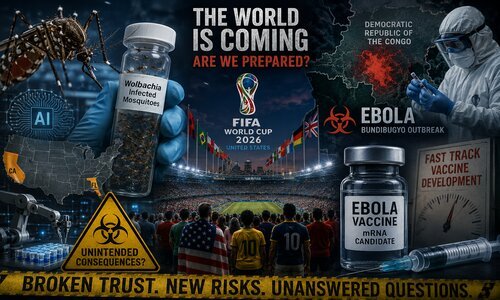
A dangerous Ebola outbreak is spreading through central Africa. Global health officials are rushing to develop a new vaccine using mRNA technology. At the same time, Google-backed researchers are seeking permission to release up to 32 million specially modified mosquitoes into parts of Florida and California.
Individually, each of these stories raises important questions. Together, they paint a picture of a world entering a new era where biological threats, biotechnology, global travel, artificial intelligence, and public trust are all colliding.
The timing is difficult to ignore.
The World Cup is expected to bring millions of travelers from virtually every corner of the globe into the United States. Large international events have always created concerns about the spread of infectious disease, but today’s world is different from previous generations. International travel is faster, populations are more mobile, and outbreaks can move across continents before authorities even know they exist.
Former CDC Director Robert Redfield recently warned that he would not be surprised to see Ebola cases appear inside the United States as a result of increased global travel surrounding the World Cup. While he emphasized that widespread transmission remains unlikely, even a handful of imported cases would instantly dominate headlines and place public health systems on high alert.
The current outbreak in the Democratic Republic of Congo is particularly troubling because it involves the Bundibugyo strain of Ebola–a relatively rare variant for which there is currently no approved vaccine or treatment. More than 1,000 suspected cases and hundreds of deaths have already been reported, making it one of the largest Ebola outbreaks in history.
That reality has triggered a familiar response.
Governments, pharmaceutical companies, and global health organizations are rapidly mobilizing to develop vaccines. Moderna alone has received funding that could exceed $50 million to develop a new mRNA-based Ebola vaccine. Other institutions, including Oxford University and the Serum Institute of India, are also racing to create vaccine candidates.
The speed is impressive.
But it also raises an uncomfortable question.
How many people will trust the next emergency vaccine?
The COVID pandemic fundamentally altered public confidence in health authorities. Regardless of where one stands politically, it is undeniable that trust was damaged. Public officials repeatedly changed guidance. Questions surrounding vaccine effectiveness, mandates, side effects, and long-term risks created deep divisions that remain unresolved years later.
For millions of Americans, the phrase “safe and effective” no longer carries the same weight it once did.
That presents a serious challenge. Future outbreaks may require rapid medical responses, but public compliance cannot simply be assumed. Health officials now face a credibility deficit that may prove almost as difficult to overcome as the diseases themselves.

Meanwhile, another biological experiment is unfolding much closer to home.
Google’s parent company, Alphabet, is seeking approval to release millions of mosquitoes infected with Wolbachia bacteria into Florida and California. The goal is to suppress mosquito populations that spread diseases such as West Nile Virus and St. Louis encephalitis.
Supporters argue the approach is environmentally safer than pesticides and offers a powerful tool against disease-carrying insects. Critics worry about unintended consequences that may not become visible for years or even decades.
The project highlights a broader trend that is increasingly shaping modern society: the belief that technological intervention can solve virtually every problem.
Artificial intelligence is being used to sort and breed insects. Gene-editing technologies continue advancing. Scientists are discussing engineered mosquitoes, synthetic biology, gain-of-function research, laboratory-grown viruses, and AI-assisted drug development.
The line between medical innovation and biological manipulation is becoming increasingly blurred.
Most of these technologies are being developed with beneficial intentions. Yet history repeatedly reminds us that unintended consequences often accompany technological breakthroughs.
What happens when biological systems are modified at scale?
What happens when AI begins accelerating biotechnology faster than regulators can understand it?
What happens when public trust collapses at the exact moment authorities need cooperation most?
These are not fringe questions anymore.
The COVID pandemic demonstrated how quickly global supply chains, healthcare systems, economies, and governments can be disrupted by a microscopic organism. The next biological crisis may not emerge from nature alone. It could involve laboratory research, engineered organisms, AI-assisted development, or some combination of all three.
Even beyond Ebola and mosquitoes, concerns continue to grow about avian influenza, antimicrobial-resistant bacteria, synthetic viruses, and the expanding accessibility of biotechnology tools that were once available only to nation-states. The biological threat landscape is becoming more complex, not less.
None of this means panic is warranted.
But vigilance certainly is.
The challenge facing society is no longer simply protecting itself from naturally occurring diseases. It is learning how to navigate a world where biological risks are increasingly intertwined with advanced technology, artificial intelligence, and global connectivity.
As millions gather for the World Cup, most will rightly focus on the celebration of sport and international unity. Yet beneath the excitement lies a reminder of how interconnected–and vulnerable–our modern world has become.
A virus emerging in a remote African village can become a concern in American cities. A laboratory experiment in California can influence ecosystems across an entire region. A breakthrough vaccine can save lives, while simultaneously encountering unprecedented public skepticism.
We are entering an era where biological threats may move faster than ever before–and where trust may be the most important defense of all.
The question is whether that trust can be rebuilt before the next crisis arrives.