



Wars are often framed as contests of courage, strategy, and political will. But beneath the speeches and battlefield maneuvers lies a far more fundamental force: supply and demand.
If this conflict has revealed anything in its first three days, it is that modern war is not just about who fires first — it is about who has enough inventory to finish quickly.
The United States openly acknowledged that it accelerated its timeline because of a narrow strategic window.
That window was not merely political. It was logistical. For months, assets were quietly moved into position — carrier strike groups, missile defense batteries, air refueling tankers, precision munitions stockpiles. The goal was not open-ended engagement. The goal was a one-month war. And to ensure that timeframe, you must have overwhelming supply ready to meet explosive demand.
Israel demonstrated this principle immediately. In the first hours of what it dubbed “Roaring Lion,” the Israeli Air Force launched the largest opening salvo in its history — 200 fighter jets striking more than 500 targets, deploying 500 munitions in a tightly coordinated wave.
Within 72 hours, the IDF reported striking 600 Iranian targets using 2,500 bombs. That level of output is not improvisation. It is stockpiling turned into decisive force.
The United States moved with similar intensity. On the first day alone, American forces struck 900 targets, nearly double Israel’s count. Meanwhile, U.S. naval and air assets dismantled the majority of Iran’s navy, removing its maritime leverage from the equation almost overnight.
Why such speed? Because in war, prolonged timelines multiply risk. The longer a conflict drags on, the more strain is placed on missile inventories, interceptor supplies, and industrial replenishment rates. Demand spikes violently. Supply must already be in place.
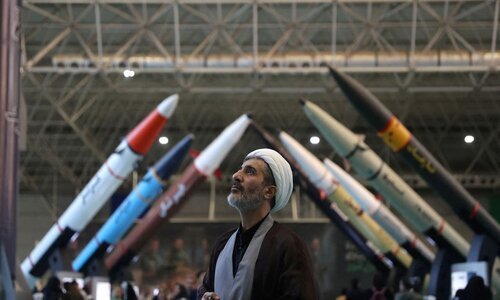
The clearest example of this dynamic is unfolding in the missile war. Israel and the United States understand a basic truth: no launchers means no missiles. Intelligence assessments indicated Iran possessed roughly 2,500 ballistic missiles prior to the operation, with production accelerating by dozens per month and ambitions to reach 8,000 by 2027. That trajectory represented an existential threat.
Within two days, approximately 200 ballistic missile launchers — roughly 50 percent of active launch capacity — were destroyed. Hundreds of missiles were eliminated outright.
Production of an estimated 1,500 additional missiles was prevented by strikes on explosives plants and engine-mixing facilities. Four key mixing centers critical to ballistic missile engines were hit. The central explosives production site — essential for warheads, rockets, cruise missiles, and UAVs — was dismantled.
This is supply chain warfare. It is not enough to shoot down incoming missiles. You must destroy the assembly lines that produce them.
That same principle explains the methodical targeting order. First, decapitate leadership. Second, dismantle air defenses. Third, eliminate launchers and firepower arrays already loaded for launch. Fourth, target production infrastructure. Each step reduces Iran’s ability to regenerate supply.
The result is strategic suffocation. Iran’s air force has been neutralized. Its navy has been largely eliminated. Half its ballistic missile launch capacity is gone. Its research facilities have reportedly been damaged in ways that could delay development for years. Without missiles, and without air or naval leverage, a regime becomes exposed — a sitting duck in purely military terms.
But supply constraints are not one-sided.
There are already reports that Arab nations are requesting additional U.S. missile defense support. Patriot batteries. Interceptor reloads. Regional shield reinforcement. The problem is simple: there are only so many interceptors to go around. Anti-missile systems are extraordinarily effective, but each defensive missile costs millions of dollars and must be physically present to function.
If the demand for interceptors across Israel and U.S. regional bases spikes faster than production or pre-positioned stockpiles can accommodate, defensive strain becomes a real factor. That is precisely why Iran’s launchers are being targeted so aggressively. Reducing incoming volume protects finite interceptor supply.
In economic terms, both sides are racing against depletion curves.
For the United States and Israel, the objective is to front-load the conflict — expend high volumes of precision munitions early, destroy regeneration capacity, and shorten the war before supply lines tighten. For Iran, the objective was to expand missile stockpiles to raise the cost of confrontation. That buildup was accelerating. The strategic window existed because intelligence indicated that waiting longer would mean facing a far larger arsenal.
Supply and demand do not just determine markets. They determine the length of wars.
A quick war requires overwhelming initial supply. It requires pre-positioned assets, stockpiled munitions, synchronized intelligence, and production capacity already humming. It requires eliminating the enemy’s capacity to replenish faster than you expend.
History shows that wars rarely end quickly when either side believes it can regenerate faster than it loses. What we are witnessing is an attempt to break that cycle immediately — to destroy not just weapons, but the ability to build them.
The next few weeks will reveal whether the strategy holds. If missile production remains crippled, if launch capacity continues to shrink, and if interceptor inventories remain sufficient to absorb retaliation, the one-month objective may be achievable.
If supply falters — on either side — the demand of war will stretch beyond projections.
Modern warfare is often described in moral or geopolitical terms. But beneath the rhetoric lies a simple equation: whoever controls the supply chain controls the timeline.
And in this conflict, time is everything.