


By Michael Swanson.
Budget Day in New Zealand is one of the most choreographed events in the political calendar. While the government spends months crafting its fiscal plan in careful secrecy, the opposition must prepare for a moment when they are handed thousands of pages of documents, often with only hours to react publicly, and a parliamentary debate beginning the same afternoon. The challenge is enormous, and how parties handle it reveals a great deal about their political competence and strategic priorities.

The Lockup: A Race Against the Clock
The lockup is where journalists reporting on the Budget get locked into a big room for several hours with all the Budget documents, a few hours before they’re publicly released. At 2pm on Budget Day the doors and wifi connections are opened, the embargo lifts, and the Budget becomes public knowledge, accompanied by the journalists’ reports on it.
The opposition parties get a parallel version of this experience through their own restricted briefing. Opposition parties are able to briefly view the documents in a transmission-free room before they are released at 2pm and then debated in Parliament. While the media lockup runs for several hours, opposition access has historically been more limited and a source of frequent complaint. In 2019, National’s then-finance spokesperson Amy Adams protested that her party was being given only 60 minutes to review documents, compared to three-and-a-half hours for media, arguing that “if we want a fully-functioning democracy in this country, then the Opposition must be afforded a proper opportunity to read the Budget before it is debated in the House.”
The tension over who gets into the lockup (and on what terms) hasn’t gone away. A 2024 email seen by Newsroom showed officials’ concern about the optics of the exclusions, with Treasury’s assistant secretary of budget and fiscal strategy acknowledging that in the past, it had not been formally agreed who would have final say over lockup attendance. This bureaucratic ambiguity has repeatedly created political friction.
The Shadow Finance Role
At the heart of the opposition’s Budget Day operation is the finance spokesperson, effectively the ‘shadow’ Finance Minister. They are responsible for digesting the government’s plan at speed, identifying the political vulnerabilities, and delivering a credible critique both in Parliament and to the media within hours of the documents being released. It demands a combination of economic literacy, political instinct, and stamina.
After the finance minister delivers the Budget speech in Parliament, the Budget Economic and Fiscal Update is published with all the numbers, and media, public, and opposition then scrutinise the choices. Opposition MPs must be ready to front cameras almost immediately, armed with talking points about what the government got wrong, who was left out, and what they would do differently.
The Strategic Game Before Budget Day
In an election year Budget Day takes on an even sharper strategic dimension. The opposition faces a fundamental tension: they want to criticise the government’s choices, but they also don’t want to be caught making expensive promises before they know what the fiscal books actually look like.
Labour leader Chris Hipkins has been explicit about this calculation. Hipkins told Morning Report he would not be announcing policy until Budget Day, “when I make those commitments I want to know I can deliver on them. I want to wait until after the Budget so we know what we’re dealing with. I think that’s very responsible.”
With six months until the 2026 election, Labour has been slow to make election announcements. Speaking to Q&A, Hipkins said he was waiting for the budget to be released on May 28 and would not “fall into that trap.” It’s a strategically defensible position, one that lets Labour frame whatever it announces post-Budget as a direct and costed response to the government’s choices. But it has some major drawbacks, not least the amount of clear-air it provides the government to take a firm hold of the political narrative.
What the Government Is Trying to Do, and How Opposition Responds
Understanding how the opposition plays Budget Day also requires understanding what the government is trying to achieve. In an election year, the government will try to make the case for another term in November. “They will do their best to signal their suitability to govern again, while at the same time, leave as little money in future budgets as possible, so the opposition cannot make big promises, without unwinding what is already announced,” economist Shamubeel Eaqub said.
This is the fiscal trap the government sets: by spending close to the limit of what’s available (in a traditional economic sense, though other perspectives are available), they force an opposition to either make hollow promises or explicitly commit to reversing popular programmes. For Budget 2026, Finance Minister Nicola Willis has trimmed the operating allowance (the money available for new day-to-day initiatives) by $300 million to $2.1 billion, and much of that is already committed to pre-announced moves. There is limited room for an incoming government to play with, and that’s entirely intentional.
The Parliamentary Debate & Select Committees
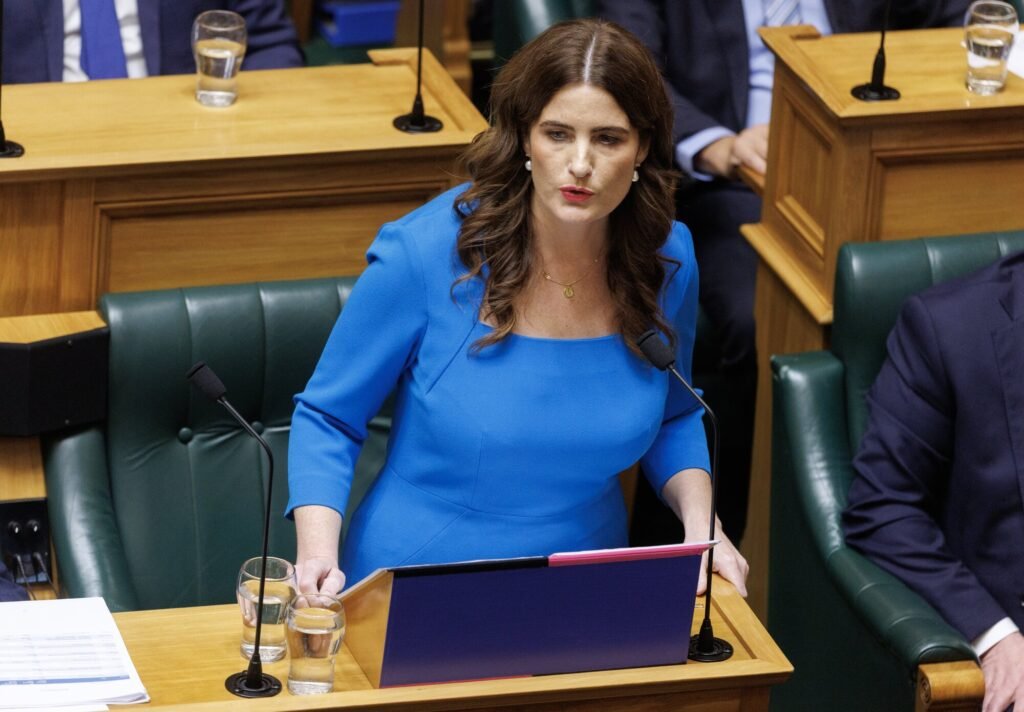
In Parliament, after Willis gives a presentation, the prime minister and other political parties will all weigh in as debate begins on the Budget. Expect kudos and criticism in equal measures, followed by a lengthy period of hot takes and analysis that will continue for days to come.
The opposition leader’s response in the House is a set-piece moment. It needs to be sharp, credible, and capture a narrative the public can grasp quickly because by that evening, the political media cycle will be in full swing. Labour, the Greens, and Te Pāti Māori will each present their own responses, often attacking from different angles: Labour on fiscal credibility and economic management, the Greens on climate and inequality, Te Pāti Māori on the impact on Māori communities.
The opposition’s work doesn’t end with the parliamentary debate. Following the delivery of the Budget, select committees examine the Estimates of Appropriations, a process that often involves the hearing of evidence from ministers and government officials. Select committees must report on the “Votes” allocated to them within two months of Budget Day, and the House then holds a further debate on the government’s spending plans. This is where opposition MPs can dig into the details of specific spending lines, interrogate officials, and build a longer-term critique beyond the heat of Budget Day itself.
The 2026 Context
Budget 2026, landing on Wednesday 28 May, arrives at an unusually loaded political moment. It is the last Budget of this term, delivered by a government trying to demonstrate fiscal competence heading into a November election, against an opposition that has deliberately held its policy powder dry. Labour is standing by its commitment to no new revenue measures beyond a capital gains tax, and is considering changes to interest deductibility rules for investment properties, saying that will be detailed in its fiscal plan after the government delivers its Budget.
For Chris Hipkins and Labour, Budget Day is the starting gun for the final phase of the election campaign. Everything they’ve been holding back (the costings, the priorities, the alternative vision) now has a baseline to push against. The opposition’s job on Budget Day is not simply to criticise what the government has done. It is to plant the seed of an alternative, and convince voters that a different set of choices was possible all along.