


By Mike Bain/cvnznews.com
The Ebola virus disease outbreak rapidly spreading through the Democratic Republic of the Congo (DRC) and into Uganda could become the “deadliest on record” without urgent action, warns aid agency International Rescue Committee (IRC).
The outbreak is caused by a rare Bundibugyo version of the virus, which has no approved vaccine or therapeutics, and is already the third largest Ebola outbreak on record. It is currently only behind the 2018-20 Kivu Ebola epidemic in DRC and the 2014-16 West African epidemic.
However, experts have said the speed it is spreading and the current circumstances, with global aid cuts and ongoing conflict, mean it could soon move up the ranks.
More than 1200 cases and 250 deaths (suspected and confirmed) have been reported (as of 27 May) since the World Health Organization was first made aware of a potential outbreak in early May.1 This means cases have doubled in a week, from only 551 reported cases and 136 deaths.2
At this point in the 2018 outbreak (approximately three weeks in) only around 111 suspected and confirmed cases of Ebola had been reported.
And in the 2014 outbreak (the worst on record) 270 cases were reported.
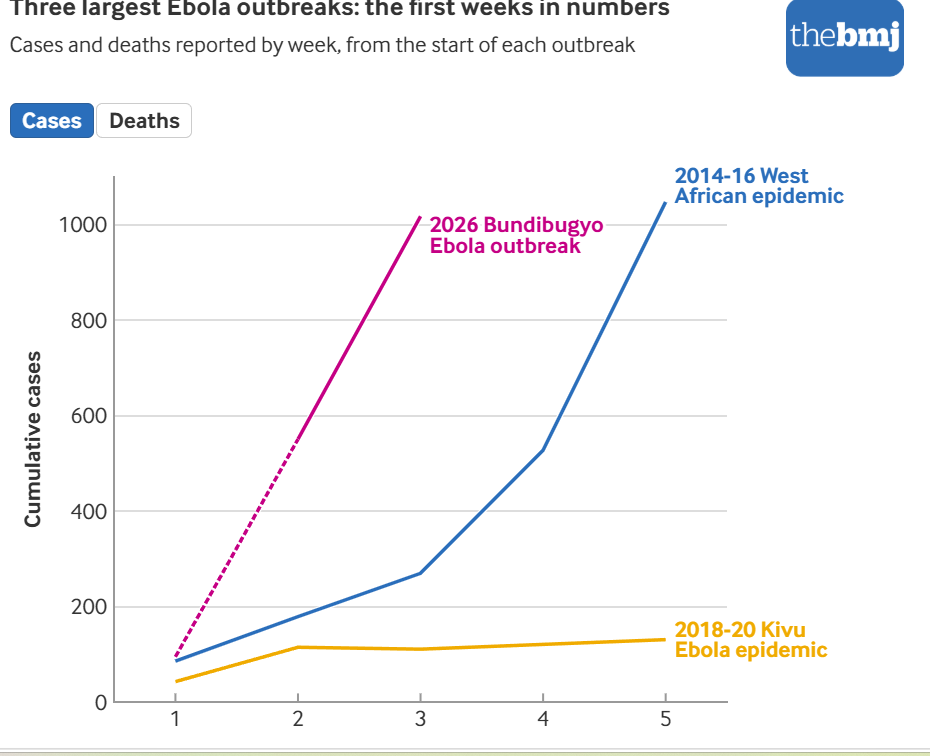
Earlier this week the chief executive officer of the Coalition for Epidemic Preparedness Innovations, Richard Hatchett, warned that the current outbreak “is already at a point that, in terms of suspected cases, the [August] 2018 outbreak did not reach until January of 2019”.3
Commenting, Bob Kitchen, IRC’s vice president of emergencies, said, “The warning signs are flashing red. Eastern DRC is confronting this outbreak more fragile and less prepared than during the 2018-2020 outbreak that killed more than 2000 people and with fewer resources to fight it.”
Kitchen said the “increased conflict and cuts to global aid funding have dismantled defences at exactly the wrong moment.”
Last year US president Donald Trump left international relief agencies in shock after he cut 90% of USAID funding and permanently cancelled funding for nearly 10 000 projects supporting health and development around the world.4
A further blow has come from the UK, which announced that from 2027 it would cut its foreign aid budget by 40%.5
Looking ahead, the IRC has called on leaders around the world to take steps to contain the Ebola outbreak, including establishing a UN coordinator who can work with Africa CDC on the response. It said that frontline healthcare, surveillance, and treatment centres must be given an immediate funding boost and that all barriers to resources must be removed, including restrictions on importing personal protective equipment (PPE).
On top of this, it said the response must be centred on women and girls, “who currently make up two thirds of suspected cases”.
The IRC’s warning came as the US announced it was building a facility in Kenya to quarantine and treat Americans who are suspected of or confirmed to have contracted Ebola.6 This contrasts to US policy in previous Ebola outbreaks when US citizens suspected of having Ebola were flown back to the US for treatment.78
The US has also banned green card holders who have recently travelled to DRC, Uganda, or South Sudan from returning to the US.