


OPINION: Michael Swanson.
So far I’ve written about ACT, the Greens, TOP, and Labour as we look towards the November general election. Today, I’m going to have a brief look at how New Zealand First are positioned as we continue rolling towards election day.

Six months from polling day, New Zealand First finds itself in the most commanding pre-election position it has occupied in years, polling well above its 2023 result, fielding experienced new candidates, and projecting an air of calculated aggression toward its own coalition partners. The party that historically struggles in its third year of government is, for now, defying its own pattern. Whether that momentum holds through to 7 November is the central question of Winston Peters’ latest, and perhaps final, electoral rodeo.
The Polling Picture
The numbers are striking. New Zealand First was sitting at 11.7% in the most recent Taxpayers’ Union-Curia poll, conducted in early May. The Roy Morgan poll for May, the most recent available, projects NZ First winning 14 seats, up six from the 2023 election. That represents a near-doubling of its 2023 party vote of 6.08%. Across the polling range, the party has consistently tracked between 10% and 15% through early 2026, a range it has not seen since before its near-wipeout in 2020.
The surge is partly structural. National’s support dropped to 26.5% in March (its lowest since being elected to government in late 2023) and NZ First has absorbed a substantial chunk of that disaffected centre-right vote. But the party is also drawing from beyond its traditional base. NZ First is now judged by 20% of New Zealanders as best to manage immigration, sitting just behind Labour on 27% and National on 21%, a striking result for a party that has made immigration restriction a signature issue. Analysis has noted that pessimistic voters are increasingly looking to Peters to be the change candidate inside the coalition, an unusual position for a governing party to occupy.
The coalition bloc as a whole retains a narrow lead, but the internal composition has shifted dramatically. Where National dominated the right bloc in 2023, the most recent Taxpayers’ Union-Curia projection has Labour on 41 seats, National 39, and NZ First 15, a scenario in which NZ First would be the second-largest party in the government and Peters the most powerful ‘minor-party’ leader in the country’s MMP history.
Peters: Liberation Through the Foreign Affairs Portfolio
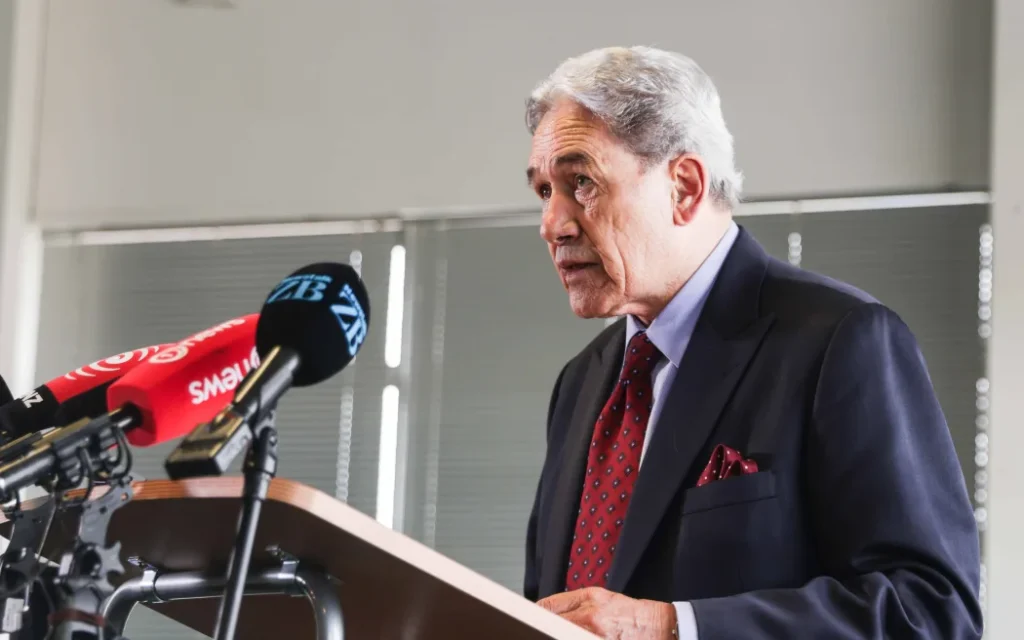
Winston Peters, now 81, has turned the Foreign Affairs role into both a platform for statesmanship and a vehicle for electoral differentiation. The most consequential episode of the past two months has been the Iran emails affair. In late April 2026, Peters was involved in a political dispute with Prime Minister Luxon over the release of OIA documents showing Luxon had sought advice on whether New Zealand should express more explicit public support for the United States-led strikes on Iran. Peters called the Prime Minister “imprudent” on Newstalk ZB, while Luxon publicly accused his Foreign Minister of putting “politics ahead of the national interest.” Most analysts concluded the release was deliberate and a way of positioning NZ First as the defender of an independent New Zealand foreign policy in an election year.
This is consistent with Peters’ openly declared approach. He previously told the Herald that in 2026 it was “every human being for themselves, politically speaking”, and has been true to his word ever since. Having stepped down as Deputy Prime Minister in May 2025, Peters is unencumbered by the constraints of that role and is free to campaign while remaining in Cabinet. He has pledged to repeal his coalition partner David Seymour’s flagship Regulatory Standards Act and suggested that Luxon’s talk of asset sales proves National has failed to run the economy properly. Peters brands his own party’s maneuverability as a virtue: the balance between extremes, the steady hand willing to disagree.
Shane Jones: The Indispensable Combatant
If Peters provides the brand and the authority, Shane Jones, deputy leader since 17 September 2025 and current Minister for Regional Development, Resources, Oceans and Fisheries, provides the daily combat. Jones is the engine of NZ First’s presence in news cycles, particularly on the resource and regional development agenda. His push to break up the energy gentailers became official party policy, with Peters confirming at the March State of the Nation address that the party would campaign on splitting them, bolstered by promises of long-term fixed-price contracts for new-build generation and regulated returns for rooftop solar.
Jones has contested the Northland electorate unsuccessfully since 2020, and re-entered Parliament in 2023 as a list MP after the seat remained out of reach. As a former Labour Cabinet minister who crossed the aisle, Jones embodies the cross-partisan appeal NZ First is consciously cultivating, a man who can speak credibly about workers’ rights and regional investment while sitting in a centre-right coalition. His combative style, once a liability, now fits the moment.

New Recruits
One of NZ First’s acknowledged vulnerabilities entering 2026 is the depth of experience beyond Peters and Jones. Aside from Peters and Jones, the party’s current caucus lacks significant government experience, though first-term MP Casey Costello has survived considerable scrutiny as a Cabinet minister. Peters has moved to address that weakness through recruitment.
The headline announcement came at the March State of the Nation, when former National minister Alfred Ngaro was introduced as a candidate, announcing his candidacy before Peters’ address to a crowd of about 1,000 in Tauranga. Ngaro is New Zealand’s first MP of Cook Islands heritage, served three terms in Parliament from 2011 to 2020, and was Minister for Pacific Peoples between 2016 and 2017. The announcement didn’t go entirely smoothly (some in the audience called out “Who are you?”) but Ngaro presented as a polished politician comfortable under a spotlight. His Pacific networks and Christian community ties give the party potential reach into demographics it has historically struggled to penetrate.
The other significant recruit is former Labour Cabinet minister Stuart Nash. Nash confirmed on 25 May 2026 that he will contest Napier for NZ First at the general election, ending three years out of politics since being sacked from Labour’s Cabinet. Nash held the Napier electorate across three terms and knows the constituency well. His candidacy carries risk (his controversial comments about women on a podcast in late 2024 effectively ended his post-politics career at that point) and it is unclear whether redemption is possible given those remarks would follow him on the campaign trail, although, those remarks may not deter many NZ First voters in the way they may deter those from his old camp.
Peters has hinted further candidate announcements are coming, suggesting former MPs from both major parties continue to circle.

The Road to November
The fundamental tension in NZ First’s position is that its surge is built partly on National’s weakness, a weakness that National, having survived a caucus confidence vote in April, is now trying to reverse. Peters has been in a strong position before: in early-to-mid 2017, an election year, NZ First edged into double digits on several polls before weakening after Jacinda Ardern’s leadership ascension. History cautions against assuming the current numbers are durable.
There is also the coalition question. Peters has never been less equivocal about ruling out Labour under Chris Hipkins, but his critics and coalition partners note his track record of finding creative interpretations of past commitments. Nicola Willis has warned voters that a vote for NZ First risks propping up a Labour-led government, a line Peters dismisses with visible irritation. For now, Peters maintains that long-term change will take more than a single term and that he is working to get “realism and common sense back into New Zealand politics.”
Whatever one makes of that framing, the structural reality is clear: NZ First is outperforming expectations (or, perhaps a new era of politics in New Zealand is upon us), its caucus is growing in experience, and Peters is operating with the confidence of a man who believes the political environment has caught up with him at last. Whether November delivers the watershed year he is predicting depends on factors well beyond his control, but for the first time in a long while, he is not the one being written off.