


OPINION: Michael Swanson
Note: I wrote this just before the latest polls, so doesn’t take into account the latest from Curia of Freshwater
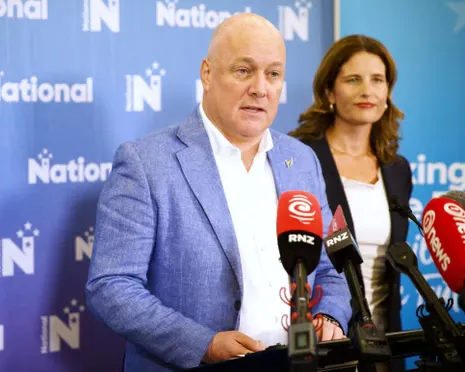
After whipping around all the other parties currently in contention for the election in, I’ve arrived at the last one…the National Party.The National Party enters the campaign in a more precarious position than anyone in its ranks would have anticipated when it swept to power in October 2023.
Having won government with 38% of the party vote and built a three-way coalition with ACT and New Zealand First, the party now finds itself polling significantly below that result, navigating internal tensions, and facing a resurgent Labour party.
Whether it can recover enough ground to secure a second term is the defining question of New Zealand politics this year
Leadership: Luxon Survives, But Questions Linger
Christopher Luxon, the former Air New Zealand CEO who led National from opposition to government, enters the election year as Prime Minister, but the security of his tenure has been the subject of sustained scrutiny. A string of poor polling results in early 2026 brought simmering caucus discontent to the surface.
By April, the NZ Herald was reporting that a group of MPs who no longer supported Luxon had begun signalling their unhappiness, and that he would face the most difficult fortnight of his prime ministership.
Rather than wait for a formal challenge, Luxon moved first. He called a confidence vote in caucus in late April, which he survived, though the result was not declared publicly and deputy leader Nicola Willis confirmed only that he had received a majority. Luxon declared the matter “closed” and vowed to focus on the election campaign.
Political commentators were less certain. As one Newsroom analysis put it, when internal leadership tensions spill publicly into the open, “it is usually the beginning of the end and only a matter of time before change occurs.” Coalition partner Winston Peters added to the noise, suggesting the self-imposed confidence vote risked inviting further challenges rather than settling them.
The wounds, if not fatal, are real. Luxon’s preferred prime minister ratings have taken a significant hit, falling to just 16 by April, his worst result since taking the party’s leadership. Labour’s Chris Hipkins, himself a leader who has endured his own challenges, briefly overtook Luxon as the public’s preferred PM. The episode reinforced a perception that Luxon, effective as an economic manager in the corporate world, has struggled to project the kind of personal authority that voters respond to in political leaders.
His deputy and Finance Minister Nicola Willis has become an increasingly important figure, both as a policy face and implicitly as a potential successor should the pressure on Luxon intensify before November. I have personally been quite a critic of Willis, particularly in the first two years of this term, but in 2026 she’s really stepped up her game, and I’m not sure that’s 100% good for Luxon.

Policy: Economy First, But Headwinds Persist
National’s core pitch has always centred on economic management and fiscal responsibility. The government’s third Budget, delivered in late May 2026 by Nicola Willis, was widely described as a deliberately cautious and focused on stability over ambition.
But the economic backdrop has made it difficult to translate “fiscal discipline” into political reward. Growth for the current year is forecast at just 1.2 percent, unemployment is expected to rise to 5.5 percent before recovering, and the government’s net core Crown debt is not projected to fall back to pre-term levels until well after 2030. The three major credit rating agencies have all voiced concern about the pace of fiscal consolidation.
On the spending side, the coalition has faced persistent criticism over public services. Reports of strain in the health system, cuts to school lunch programmes, and local government restructuring have all generated negative headlines. The government has sought to frame these as necessary adjustments following Labour’s spending era, but the message has had limited cut-through with voters feeling the pinch in their daily lives.
Beyond fiscal policy, National has pursued a range of reforms: RMA replacement legislation, changes to local government including abolishing elected regional councils in some areas, and a gas transition loan scheme to support businesses pivoting away from gas. The Treaty of Waitangi has also emerged as a flashpoint, with the government’s approach (driven in part by ACT’s advocacy) triggering considerable public debate early in the year and contributing to a dip in National’s support around Waitangi Day.
Polling: A Rough Term, But Still Afloat
The polling picture tells the story of a government that has never quite found its footing with the public. National entered 2026 tracking in the low-to-mid 30s, well below its 2023 election result of 38%. By early March, the Taxpayers’ Union–Curia poll had the party at just 28.4%, its worst showing since Luxon took over as leader in 2021. This triggered the leadership speculation that culminated in the April caucus vote.
The most dramatic moment came with the April 1News-Verian poll, which placed National at 30%, down four points, while Labour rose to 37%. On those numbers, the left bloc of Labour, the Greens, and Te Pāti Māori would command 66 seats, enough to govern, compared with 58 for the coalition. This was the poll that made a leadership discussion unavoidable.
Since then, the numbers have been volatile but show some stabilisation for the right bloc. By the May Taxpayers’ Union–Curia poll, National sat at 30%, with NZ First recording a strong 11.7% (its highest level in some time) and ACT at 6.5%, keeping the coalition bloc mathematically competitive. A Herald-Motu Research poll-of-polls model, as of mid-May, was putting the coalition ahead in roughly 88% of election simulations, giving them an average of 63 seats, a sign that despite National’s struggles as the anchor party, the right bloc remains favoured to hold power, largely on the strength of its minor partners.

Coalition Dynamics
One of the defining features of this term has been the unusual vitality of National’s coalition partners. Both ACT, led by David Seymour, and New Zealand First, led by Winston Peters, have maintained their own distinct identities and public profiles, at times overshadowing the Prime Minister himself. Peters in particular has proven adept at commanding media attention and differentiating NZ First from the coalition’s broader direction, including publicly opposing a trade deal that National was advancing and saying NZ First would vote against it.
This dynamic presents National with a double-edged challenge heading into the election. On one hand, the minor parties polling above 5 percent is essential, it means coalition seats are not being wasted below the threshold. NZ First in particular has surged in some polls to as high as 15 percent, which, paradoxically, compensates for National’s weakness as the lead party. On the other hand, as the election nears, Seymour and Peters will have every incentive to further distinguish their parties from National, potentially drawing votes directly from National’s pool and reducing the PM’s ability to present a unified government narrative.
There is also the question of whether a reconstituted National-ACT-NZF coalition would be governable for a second term, given the tensions that have surfaced during this one. Peter’s public warnings about Luxon’s caucus vote and ACT’s ideological independence have both complicated the image of a stable, united government.
General Outlook: Competitive, But Precarious
National heads toward 7 November in a position that is better described as survivable than comfortable. The coalition bloc, taken as a whole, appears more resilient than National’s own party numbers suggest. Economic recovery, if it materialises meaningfully in the second half of 2026, could shift public sentiment in the government’s favour, the economy remains (as it almost always does) the central battlefield.
But the risks are real. Luxon’s personal authority has been visibly diminished by the leadership episode, even if he survived it. National’s own vote share will need to recover toward the mid-30s (which I think is unlikely) to avoid excessive dependence on the minor parties in a second term. And Labour, now consistently ahead in many polls, has steadied under Chris Hipkins and has begun rolling out its own policy agenda (finally, even if it has holes in it).
The election is genuinely competitive. National can still ‘win’, but it will need a sharper campaign message, an economic story that resonates with cost-of-living pressures, and a leader who can reclaim his authority in the public imagination, all in the space of five months.