



Ashley Church
For several years I’ve followed AUT’s annual Trust in News survey and treated it as a useful guide to public confidence in the media.
The long-term trend has been clear. Trust in news fell from 53% in 2020 and continued to decline to 32%.
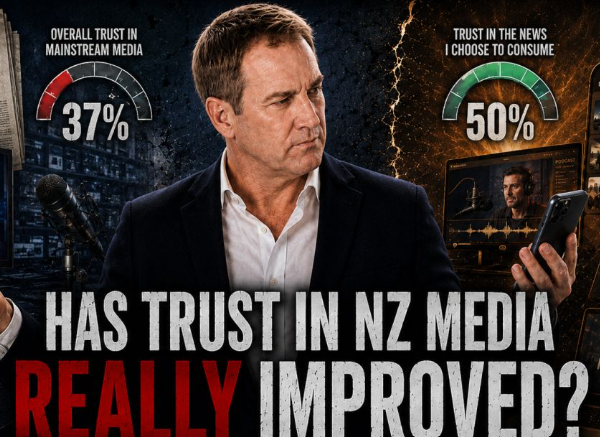
However, when the latest survey came out in April this year, trust had risen to 37%.
Trust in “the news I consume” had also increased, from 45% to 50%.
So what happened? Have we all started trusting the media again?
That was certainly the view of the AUT researchers themselves who attempted to explain the increase by suggesting that concern about misinformation, AI-generated content, deepfakes and unreliable material online may be leading people back to professional journalism.
That’s possible – but it’s not proved by the survey itself – and there is another explanation that fits the results better.
Remember, the survey is effectively asking two different questions.
The first is how much people trust the media generally. When AUT measures trust in individual media brands, it uses a fixed list made up largely of established mainstream outlets.
The second is whether people trust “the news I consume”. That’s a much broader question and, when they answer it, many respondents will also be thinking about independent journalists, digital publishers, podcasts, and other newer sources that do not appear in AUT’s brand rankings.
This distinction matters because, instead of reflecting a rediscovery of the value of traditional journalism, it could equally mean that people remain suspicious of the mainstream media but have become more confident in the alternative sources that they have chosen for themselves.
Think about it: the media landscape has changed dramatically over the past few years. New Zealanders are no longer dependent on a small group of newspapers, television networks and radio stations. They can compare reports, test competing claims and build their understanding from a much wider range of voices – meaning that they have more reason to have greater trust in their own media consumption than in “the media” as a whole.
Sadly, the AUT survey does not properly test this possibility. Had respondents been given a broader list that included newer independent and digital media, we could have measured whether some of those sources may have recorded substantially higher trust than the established brands. But we can’t know because they weren’t included.
None of this invalidates the survey. It remains useful, and the increase in trust is worth noting. But AUT’s explanation is only one interpretation of the result.
A more convincing conclusion may be that New Zealanders have not returned to the old media model at all. They may simply be happier with the wider range of news and commentary now available to them, even while their overall trust in the mainstream media remains low.
This is a far more logical interpretation…..
ADVERTISEMENT