

Michael Swanson/The Periodical
Last week I posted some predictions, and I got a range of reactions. Most thought I was well over what the outcome would be, that I was overstating the potential for an overhang, and that my predictions were too positive for the coalition government of the past three years. As it stands the coalition is back, there’s (at least) a ten-seat overhang, electorates have been won by National that they probably shouldn’t have, and despite the “success” National’s front bench has been gutted.
What a time to be alive.
The overhang was huge, the wasted vote was tiny. There’s a big old Opportunity in the middle, and record results on the flanks. National’s front bench has been gutted, but they’re the biggest party in Parliament. This has truly been the strangest MMP election yet.
The Preliminary Results
As I predicted, the overhang was very much in play. As the chart below shows, National are currently sitting on 29.2% of the party vote, yet will receive 32.1% of seats in the House, and that primarily comes at the expense of Labour, but impact all the other parties to some degree. national’s overall performance is a shadow of three years ago – their party vote has dropped over 8%, and thanks to the overhang, they’ve now lost some of their biggest names. Overall, the campaign was negative, and their actual number of seats is largely thanks to vote splitting campaigns than their own strategic brilliance.
Labour can’t exactly turn around and say they did a good job, either. While they’re up around 2% from 2023, they really struggled for traction, ran a small target campaign, and as a result the slide by National in the polls was not something Labour were the beneficiaries of. They currently sit on 29.4%, but with only 36 seats are comfortably second on seats in Parliament. For me, Chris Hipkins is in a precarious position – he either becomes Prime Minister (which I have as a very slim chance) or he’s gone a leader of the Labour Party.
The Greens did have a pretty good night. with 13.3% and 16 seats this goes down as their best result yet. They ran a really effective campaign, weathered a storm of hate (particularly directed at Chloe Swarbrick), and had probably the most complete policy manifesto of all the parties. Bizarrely though, and this is my personal take that will annoy a few readers, I don’t think the night was actually as good as it could/should have been. The Greens have made massive in-roads with Māori voters, climbing from 10% of the Māori vote in 2023 to 37% in 2026. Overall, though, their results are below where they’ve been polling for most of the campaign, by over 3 percent against some polls. Their general electorate performance is also mixed – their campaigns in Christchurch Central and Dunedin which were billed as being big runs at Labour held seats, have not eventuated. Julie-Ann Genter is also getting run very, very close by Craig Rennie in Wellington Bays – while this is a new electorate, and Renney is a high profile candidate, that race is far tighter than they’d be happy with. So while the results, on the face of it, are pretty good, the overall picture is aa bit more mixed.
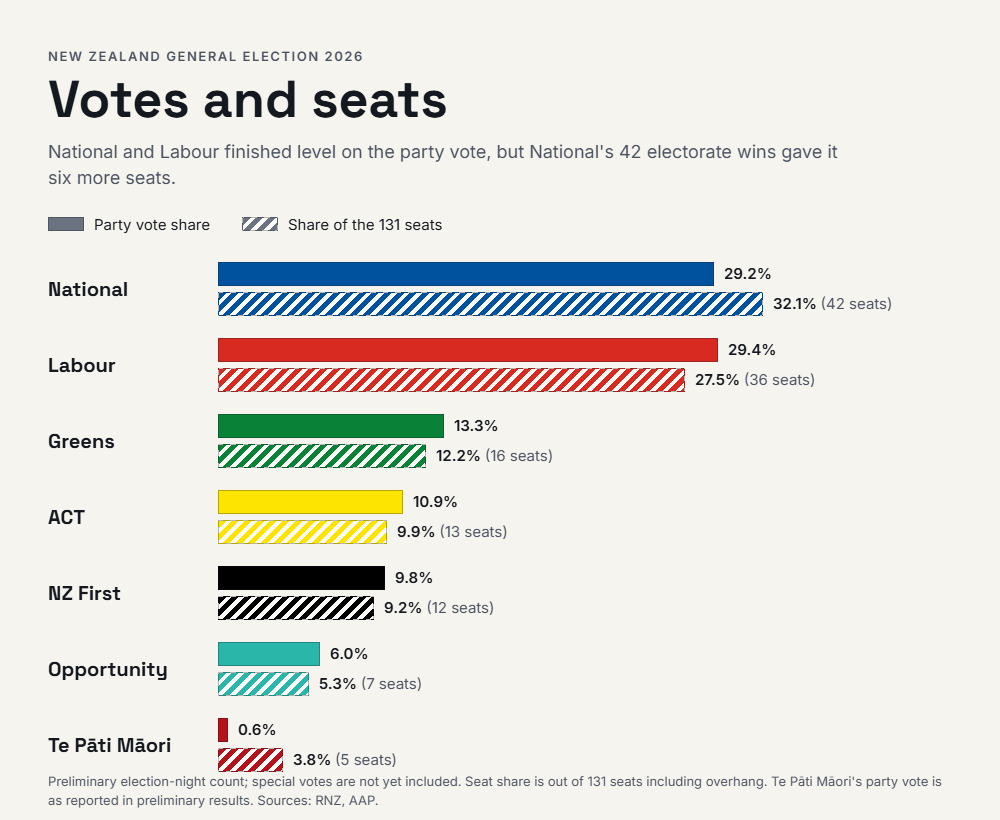
ACT also had their most successful election yet. At 10.9% and 13 seats they bring a pretty big team in, a team that includes Paul Henry who was, bizarrely, part of the TVNZ coverage on election night; side note on this, I thought it was weird, wrong, and shouldn’t be repeated. A bit like the Greens, it was great at the top level, but just below the surface there were a few not so great things. The main “not so great” was Tamaki – previously won by Brooke van Velden, James Christmas (ex-National candidate, and ex-right-hand-man to Christopher Finlayson) jumped into the breech and…lost. Now, this isn’t great for ACT because Christmas actually ran to win that seat, despite the vote splitting campaigns being run at the margins. Speaking of vote splitting, if the National Party electorate wins were impacted by vote splitting, was ACT’s party vote boosted artificially in the same way? Possibly, it’s really hard to tell but you can’t ignore that some National voters may have thrown ACT a party vote because they felt that’s what they were supposed to do.
NZ First had a funny one. It’s a good result, but not a great one. I don’t think the Michael Laws incident actually impacted them that much at all – the people voting for NZ First this time around are pretty unfazed by that sort of thing. But, while they are looking at 12 MPs, polls at times had them slightly higher, so behind closed doors they probably aren’t thrilled with the end result. They also won’t be massively happy that the ended up as the fifth biggest party, and most of all, third biggest in the coalition behind ACT. Also, like ACT, was their vote impacted by vote splitting? Quite possibly. Overall, good, but probably hoped for more.
The big story in terms of pure seats in the House (besides the overhang) is the inclusion of Opportunity. They have been hammered from both sides in recent weeks, so to successfully get across the line with (currently) seven seats, is a massive achievement. I’m going to revisit Opportunity in the coming weeks and have a look at what they might look like in Parliament, but the achievement of entering Parliament without the support of a sitting MP is a huge milestone under MMP.
Finally, despite a hectic term, Te Pāti Māori had a great night. Sure, they’re down a seat from 2023, but given the absolute trainwreck of a term they’ve had in terms of party and MP management, this is an absolutely huge result. Sure, a few things went their way (such as the Kerin Leoni “sacking”), but boy did they make it work for them. They now have a pretty strong line-up coming back to Parliament that will be pretty formidable if they can stay organised.
The other really big thing worth noting here is the “wasted vote”. In 2023 the wasted vote was around 6%, whereas this time around it’s <1%. Why is this important? In practice, the wasted votes drop out of the calculation, so every qualifying party ends up with a slightly bigger share of seats than its raw percentage of the vote. If 6 percent of party votes are wasted, the remaining 94 percent effectively gets spread across all 120 seats. That’s why the effect is often described as the wasted votes being redistributed indirectly to the parties that did pass. For this election, that redistribution is negligible and will have no impact on final numbers.
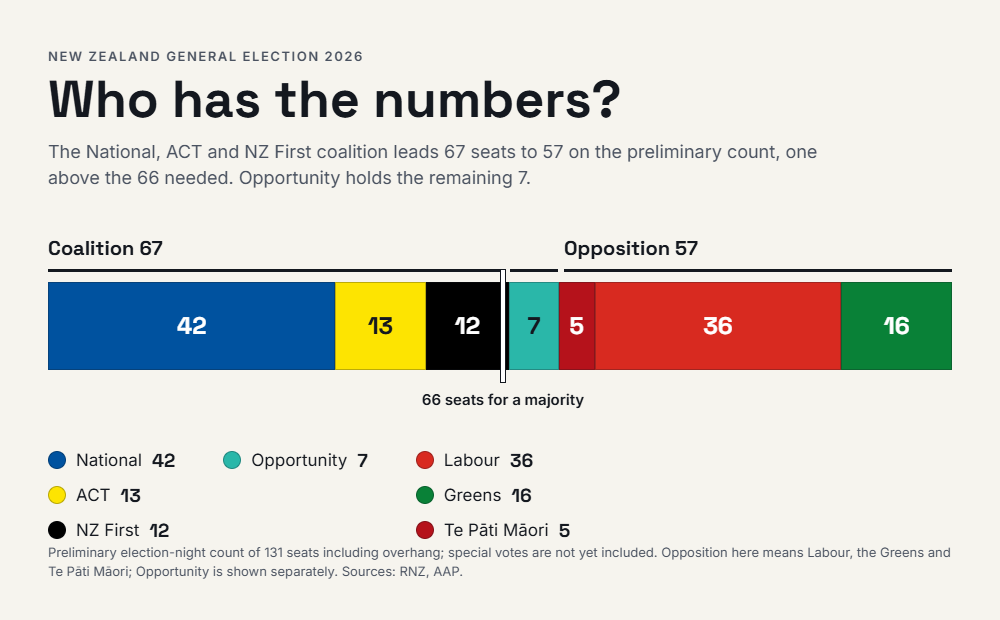
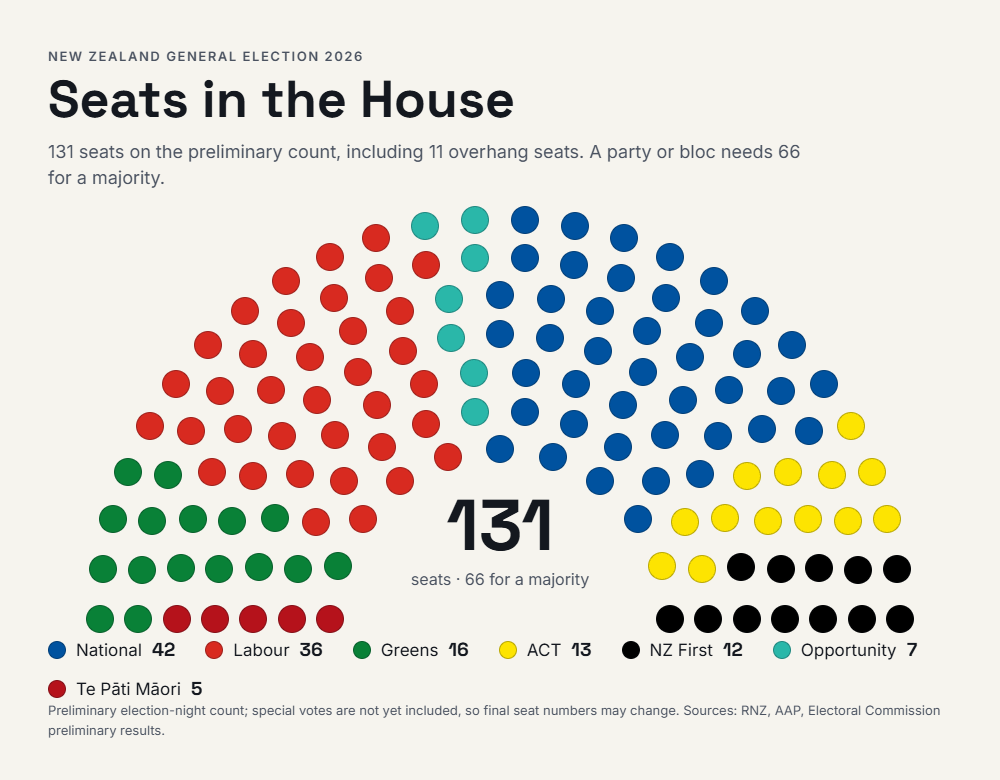
Remembering these are preliminary numbers, at this stage the coalition would be able to reform and retain power with a wafer thin majority. On these numbers, more importantly for the coalition, they wouldn’t need Opportunity. I’m in two minds about what this means for Opportunity – on one had, their whole campaign was that they would like to be an influence on government to unify and on these numbers that won’t be happening; on the other hand, small parties in coalition often end up getting blamed for things or suffer electorally as part of coalitions, so not being caught up in the coalition kerfuffle make actually be a good thing for them.
These numbers could shift. Special votes may see the left pick up a seat or two, but they’re also relying on the likes of Wairarapa and (possibly) Hamilton East flipping to Labour, and that is far from a done deal. The left also, weirdly, don’t want the Greens to win Te Tai Tokerau; why? Because a win there for Te Pāti Māori will help their overhang, and a win for the Greens would reduce the overhang on the left.
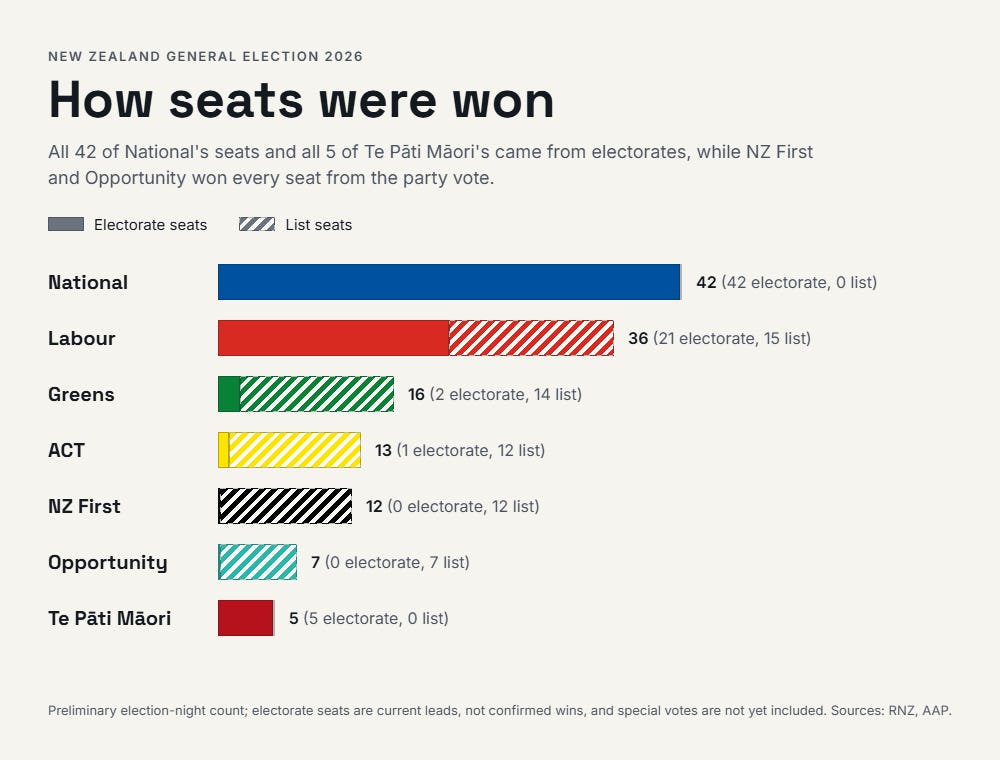
The most telling information concerning the story of the election is in the chart above. The heavy imbalance between electorate and list seats for National (and to a lesser extent, Te Pāti Māori) will have a profound impact on the overall outcome, and future discussion about the state of New Zealand’s electoral system. While we’re waiting on results I’ll revisit this issue, and in particular have a look at options for fixing the overhang issue. But any fix is for a future election, and won’t help us right now – as it stands National are looking to have won roughly six or seven more electorate seats than their party vote would have provided them, so despite winning less votes than Labour, they’ll be comfortably the biggest single party.
To be clear, these are just preliminary numbers, We have to wait for the roughly 400,000 special votes to be included in the numbers before we get a final outcome, and those could have a really interesting impact. However, while historically these have benefitted the left, this election is so wacko compared to previous elections that we just don’t know what they will look like.
The Next Stage of the Process
27 November. That’s the day things will really swing into action. It’s the day the final results are announced, and the day real progress can be made towards forming a government. While talks can start whenever they like, people like Winston Peters have always argued that acting before the final results is silly as you don’t know the full picture until that point.
Once we have the final results, then the real work can get underway. Parties will start talking, going through the negotiations, and try to cobble together the next government. There are some statutory requirements that come into play – New Zealand must assemble its Parliament by mid-January because of a strict statutory deadline: under section 19 of the Constitution Act 1986, Parliament is legally required to meet no later than six weeks after the formal return of the election writs. Following election day on November 7, the formal return of the writs is scheduled for December 3. This places the absolute legal deadline for Parliament to sit on January 14, 2027 (often rounded or referred to in media timelines as January 15)
Now, contrary to some of the commentary, this isn’t a fixed date for a government to be in place. It’s the legal date when Parliament must sit. Until a new government is sworn in, the current government keeps governing, but under the caretaker convention. Day-to-day administration continues while significant decisions are deferred where it isn’t clear who will form the next government.
Negotiations have taken varying lengths of time in the past. In 2020 a single-party government was sworn in after 20 days, in 2023 it took 44 days, and the longest was 65 days in 1996. But we shouldn’t panic if there isn’t a government by Christmas, and probably not even by early January. Parliament could sit and swear in members, but defer to the caretaker government for as long as needed. However, at some point a government will be required, and if no arrangement can be finalised…we get to do this all over again.
Enjoy the Silence
Back in 2023 I wrote about the need to enjoy the silence and accept that government formation can take time, and I still think that is valid today. Until 27 November we are largely going to be resigned to rehashing old discussions, asking why things can’t be done quicker, and going over a bunch of the mechanics that we don’t need final numbers to talk about. MMP will be the big discussion – how to fix it, whether to keep it, whether an overhang is acceptable, and what we might do instead. All perfectly reasonable things to discuss, but it might be a good chance to take a breath, gain a bit of clarity, and come back fresh and ready to go once the next phase kicks off.
After the results later this month, it’s negotiation time. No matter what the final scenarios are, things won’t happen quickly, even if the existing coalition is back in government. During that time, we should be focusing on areas we want to drive forward with over the next three years – for me thats institutional reform both in the electoral system, and in the institutions of Parliament. For others, thats housing issues, inequality, climate and environment, market competition, or the energy sector.
Use this time wisely, because whatever the final outcome, the next three years will be chaotic.