



Sarah McMillan/cvnznews.com
Two years after the Abuse in Care Royal Commission delivered its landmark report, survivors say the Government’s slow progress toward preventing further harm is not just disappointing — it’s “bordering on a crime.”
Outside Parliament on Wednesday, survivors placed bouquets of flowers into the hands of ministers and MPs. Each bouquet was gathered from institutions where children were abused — a symbolic reminder of the trauma still echoing through Aotearoa’s care system.
Survivor Keith Wiffin, who handed a bouquet to Minister Erica Stanford, said he quietly told her the Royal Commission’s legacy would not fade. “It’s not going away until justice is delivered,” he said.
Wiffin’s frustration was clear. More than 100 recommendations were made, yet only a fraction have been implemented, and some rejected outright. “That is the biggest Royal Commission we’ve had in our country’s history, representing the biggest human rights issue to affect our country,” he said. “Not only is there slow progress and stall around that, things are moving in the wrong direction.”
He pointed to youth boot camps and the repeal of Oranga Tamariki’s Treaty obligations as examples of backsliding. A redress system should already exist, he said — yet abuse in state institutions continues.
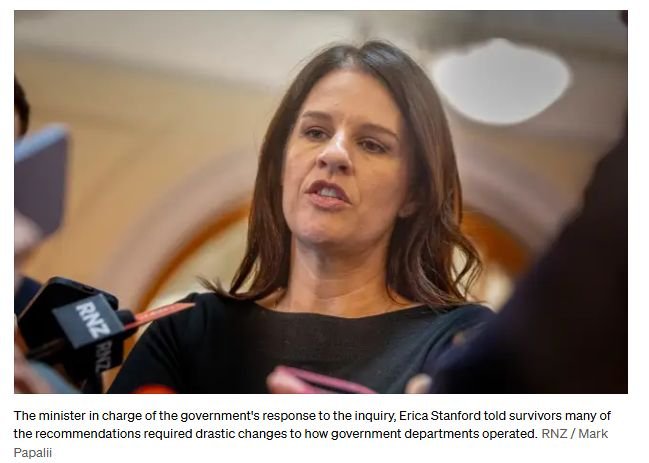
Stanford, the minister responsible for the Government’s response, acknowledged the scale of the challenge. She said nearly three‑quarters of a billion dollars had been committed to compensation and prevention systems. “We stand by our apology. We’re listening. We’re making changes,” she said, adding that meaningful reform would take years.
But Wiffin wasn’t convinced. “Things can move quite quickly if there’s a will to do it — and that is the secret here. There isn’t that will.”
Children’s Minister Karen Chhour, herself a survivor, was moved to tears throughout the ceremony. She urged survivors to keep pushing. “It reminds me each and every day of the burden on my shoulders to be that advocate in that space.”
Human Rights Commission chief executive Meg de Ronde said survivors had given the Government a clear roadmap. “This is not a political choice. This is the right thing to do.”