

Mike Bain/cvnznews.com
As coalition negotiations continue following New Zealand’s closely fought election, an idea once considered politically unthinkable is attracting renewed attention: a “Grand Coalition” between National and Labour.
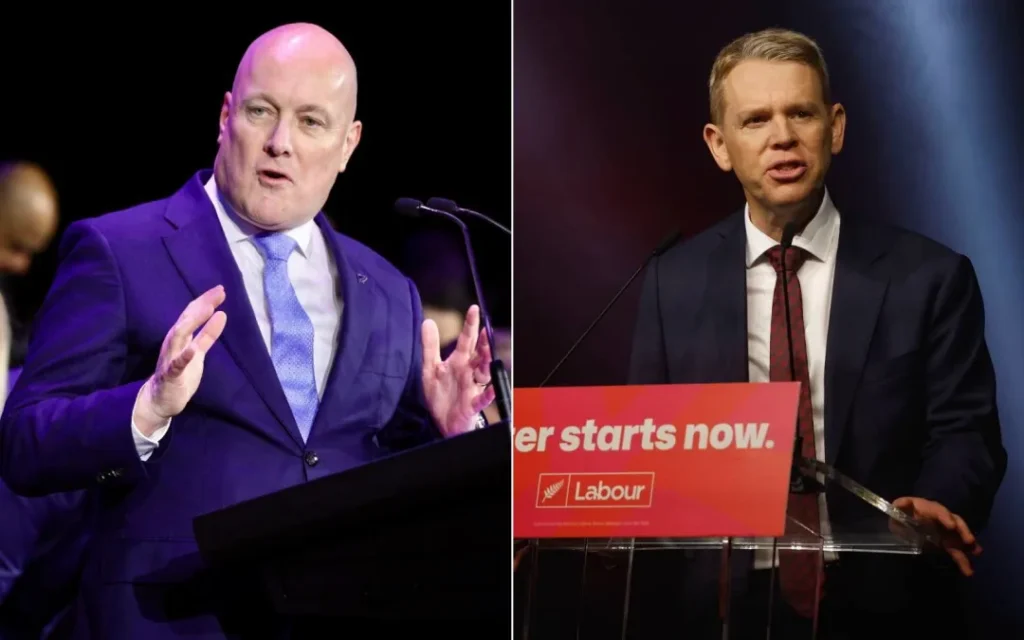
The proposal gained fresh momentum after businessman Guy Haddleton suggested that Christopher Luxon and Chris Hipkins should sit down together before negotiating with smaller parties. The argument is simple enough. In an increasingly uncertain world, a government backed by the country’s two largest parties could provide stability, long-term planning and a stronger parliamentary majority.
But columnist Ani O’Brien, writing on Substack, argues that while the idea may sound appealing on paper, history suggests Grand Coalitions often create more problems than they solve.

Ani O’Brien
The attraction is easy to understand. Together, National and Labour would command a commanding majority in Parliament, reducing the leverage smaller parties often wield in coalition negotiations. Supporters argue this could help New Zealand tackle difficult long-term issues such as infrastructure, housing shortages, healthcare reform and the growing cost of an ageing population.
A Grand Coalition could also deliver policy certainty. Major projects would be less vulnerable to being cancelled every time the government changes, potentially saving taxpayers billions and providing confidence for investors.
Yet O’Brien warns that stability comes at a cost.
One of her central arguments is that democracy relies not only on government but also on effective opposition. If National and Labour governed together, Parliament would lose its two largest adversaries challenging each other’s decisions.
“The Opposition aren’t there to be a pest,” she argues. Their role is to scrutinise government decisions, expose mistakes and provide voters with a credible alternative government.
History, she notes, offers warnings. Germany’s Grand Coalitions between the centre-right CDU and centre-left SPD delivered political stability, but critics argue they also weakened meaningful political choice and contributed to the rise of Alternative for Germany (AfD) as the primary opposition voice.
Ireland provides another example. Repeated cooperation between the traditional establishment parties helped stabilise government, but also created opportunities for Sinn Féin to emerge as a powerful alternative.
The lesson, according to O’Brien, is that political dissatisfaction never disappears. It simply finds a new outlet.
Rather than forming a government together, she suggests National and Labour can still work across party lines on areas of common national interest while preserving the robust adversarial system that holds governments accountable.
After all, voters did not spend an election campaign choosing between competing visions for New Zealand only to see both sides govern together. As O’Brien concludes, cooperation on major issues is desirable. A Grand Coalition, however, may be a cure that creates problems of its own.