

Daniel Westbrooke/PNW News Agency
At a gathering in the Knesset sukkah this month, Benjamin Netanyahu read from the Book of Samuel and spoke of a “great deliverance.” Whether the prime minister was expressing personal conviction or reading the political moment, he chose language that reaches beyond military strength alone.
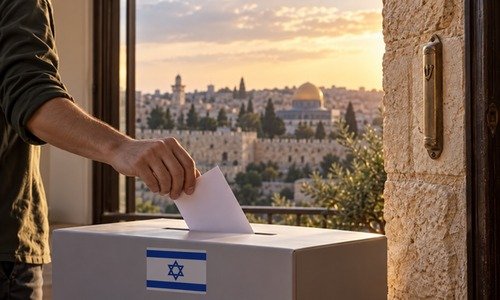
On October 27, Israel’s youngest voters will have their say. Estimates put the number of first-time voters at between 550,000 and 640,000—enough to make this cohort a significant force in an election shaped by war, national security and the country’s future. Netanyahu has been prime minister for roughly 16 of the 18 years these voters have been alive.
A Channel 12 survey conducted by the Midgam Research Institute found that 80 percent of first-time Jewish voters believe in God or a higher power, compared with 75 percent of older voters. Forty-three percent said they kiss the mezuzah on their doorposts, compared with 33 percent of older voters. And 56 percent said they believe the Messiah will come, versus 51 percent of the older group.
The survey was a snapshot of Jewish first-time voters, not every young person in Israel. Still, the mezuzah figures point to a notable rise in a visible expression of Jewish tradition. In a country where identity, history and faith are closely linked, even a measured change can carry political weight.
The shift is unfolding among young people raised in the shadow of conflict. They have grown up with rockets from Gaza, repeated rounds of fighting and, for many, the shock of October 7 and its aftermath. Friends and relatives served in the military. Some lost loved ones. The experience has left a generation weighing questions of survival, responsibility and what holds the nation together.
For some, the answer is not only a stronger army or a tougher government. It is a renewed sense that Israel’s story has a spiritual dimension—that the country’s survival cannot be explained by military power alone. The return of religious language to public life may reflect that search for meaning, even among voters who are not religiously observant.

Faith and politics, however, do not point neatly to one party. About three-quarters of first-time voters describe themselves as right or center-right, yet their support is divided. In one recent poll, Gadi Eisenkot’s Yashar led among the sampled voters with 16 percent, while Likud received 14 percent. Ten percent remained undecided. A generation may be more religious and more conservative without automatically lining up behind Netanyahu or any single party.
There is also a demographic force shaping Israel’s future. Haredi families have many more children on average than secular families, and the ultra-Orthodox population is especially young. That means religious communities will account for a growing share of future voters, even apart from any change in belief among secular Israelis.
A separate example of faith and identity entering politics is Yoseph Haddad, an Arab Christian IDF veteran and pro-Israel advocate who is running for the Knesset. Israel’s Christian population is about 185,000, nearly 80 percent of it Arab. Haddad’s candidacy does not explain the trend among young Jewish voters, but it reflects another part of Israel’s religious and civic landscape: citizens whose Arab, Christian and Israeli identities can coexist in public life.
For religious Zionist voters, faith can also shape how they think about the land, including Judea and Samaria as the biblical heartland of Israel. Whether that conviction is becoming more influential among younger voters is a question the survey alone cannot answer. The election may offer clues, but party choices will also reflect security, leadership, military service and the cost of years of conflict.
Israel’s next election will still be fought over familiar political questions. But the generation entering the electorate may bring a different sense of what those questions mean. The ballot will not measure faith directly. It will show how much religious identity, tradition and biblical history influence the choices young Israelis make about their country’s future.
On October 27, Israel will show whether it votes the way it prays.