




OPINION: Michael Swanson
MMP asks voters two questions. The party vote decides how many seats each party deserves, and the electorate vote decides who fills the local ones. For three decades most New Zealanders treated these as one preference expressed twice, with Epsom the famous exception.
At the 7 November election, both ends of the political spectrum are openly trying to turn the gap between the two votes into a weapon. The tactic is the overhang, and it says far more about the system’s design than about the people exploiting it.
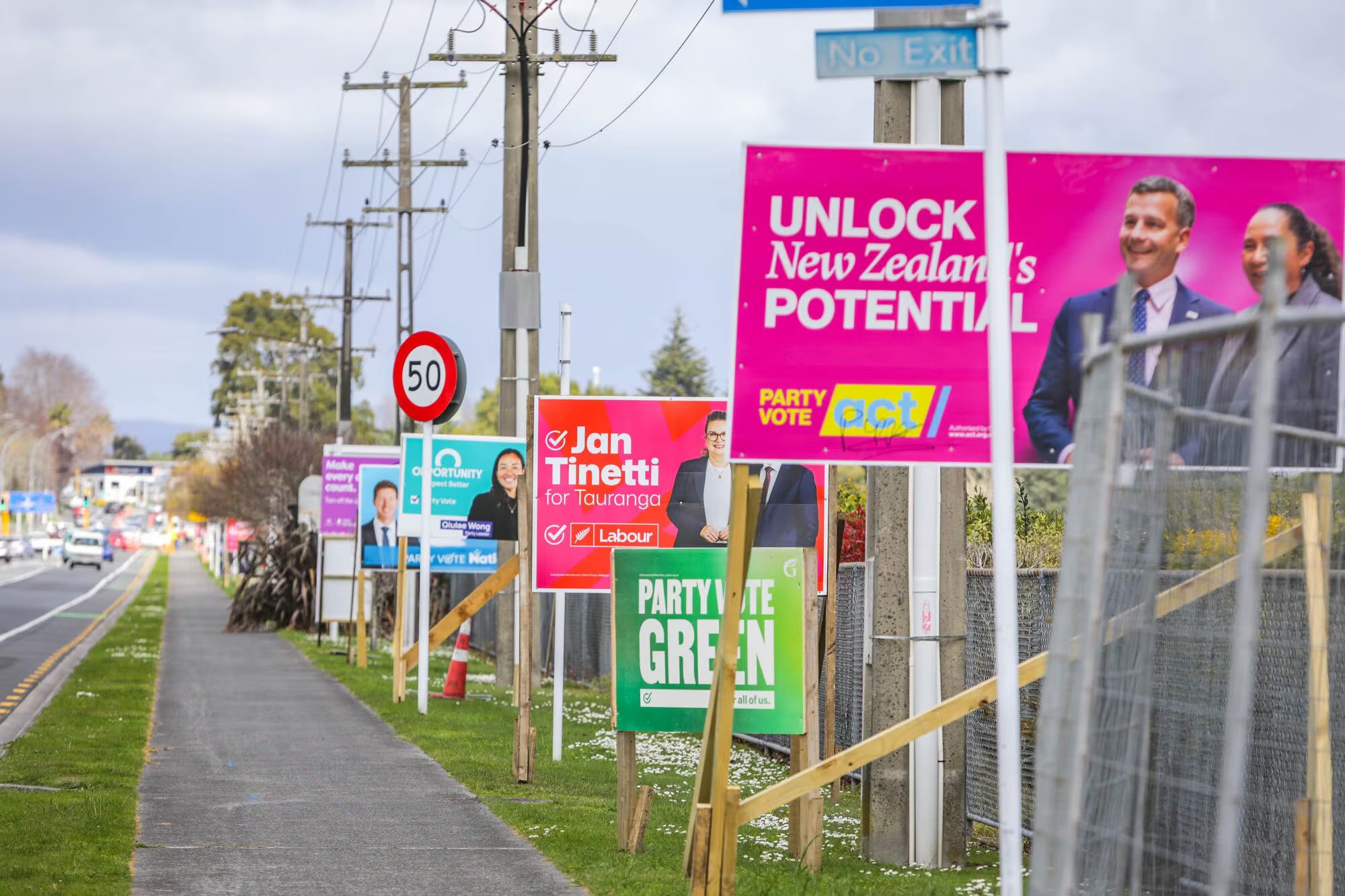
The right’s split-vote scheme
The campaign is fronted by Harry Mowbray, father of the Zuru billionaires Nick and Mat, with support from Don Brash and other assorted rightists. His Split Your Vote website tells National supporters to keep electing their local National candidate but give their party vote to ACT or NZ First.
The logic is that, on current polling, National will win around 40 electorates but too few party votes to earn any list MPs, so every National party vote is effectively lost. Shift those votes to the coalition partners and National keeps its electorates while ACT and NZ First gain seats on top. The result is an overhang, with estimates of 10 to 30 extra seats and Mowbray himself claiming as many as 40. His stated aim is to keep a centre-right coalition on the Treasury benches for the foreseeable future.
The execution is sucks. Newsroom noted that the site carries no exemption for Epsom or Tāmaki, the two seats where ACT needs National voters to back its candidates, while advising ACT and NZ First to pull candidates from marginal seats. Mowbray told reporters he has no approval from National, ACT or NZ First, and David Seymour confirmed ACT had not even been approached.
The bigger flaw is human behaviour. Liam Hehir pointed out that in 2023, with no campaign at all, more than 5 percent of National voters gave their electorate vote to ACT. Tell tens of thousands more to split, and some will hear permission to abandon National altogether while others will garble the instructions and do the reverse. National itself isn’t backing the scheme, and Chris Hipkins has called it an absolute rort. Winston Peters flirted with it, then said he would not instruct voters how to cast their candidate vote.
Te Pāti Māori’s mirror image
Te Pāti Māori’s version is more disciplined, because it is the party’s official strategy.
At its campaign launch in Gisborne, the party asked supporters for their candidate vote in the Māori electorates and their party vote for another left party. Its released list reinforces a one-vote-only campaign, with the party vote directed to Labour or the Greens. Co-leader Rawiri Waititi told Parliament that only Te Pāti Māori created an overhang this term and it would do so again next term.
There is history here. The Māori Party first produced an overhang in 2005, and in 2023 Te Pāti Māori won six electorates on a party vote worth four seats, adding two overhang seats. What has changed is intent. An accident of strong local support has become a plan, with the party deliberately surrendering its own party vote to a bloc partner.
It may be working. A Horizon poll of 607 Māori roll voters put the Greens on 28 percent and Labour on 27, with Te Pāti Māori on 16. Newsroom’s poll of polls suggests three Māori electorates would produce a one-seat overhang, and four a two-seat one. Labour and the Greens are happy to collect the party votes but are not reciprocating with candidate votes. Peters called the strategy a disgrace, which sits awkwardly beside his own flirtation with the right’s version.
The two schemes aren’t equivalent in scale. Te Pāti Māori can only create a handful of extra seats, while the right’s version, if it worked, would be far more explosive. But the principle is identical, and so is the hypocrisy on both sides.
What it does to representation
Each overhang seat enlarges Parliament and lifts the bar for a majority. At 123 MPs, 62 rather than 61 seats are needed. An engineered overhang means a bloc can win more seats than its share of the party vote justifies. MMP exists to make Parliament reflect how people voted, and it is being turned into a way to defeat that purpose.
There is also a cost to the voters being recruited. Asking a National voter to abandon their own party vote, or a Te Pāti Māori voter to give up theirs, treats the ballot as a tactical token rather than an expression of belief.
National’s list could be gutted if its party vote falls significantly, with senior figures such as Chris Bishop at risk of missing out. Willie Jackson has warned that gaming the system risks a backlash that could threaten the Māori seats themselves. And Christopher Luxon has already floated a referendum on MMP, which stunts like these only make easier to justify.
A flaw in the design
Neither camp is breaking a rule. They are exploiting a feature, and a defensible reaction is to blame the rules rather than the players. Overhang is the system’s way of keeping an electorate winner whose party vote does not cover their seat. When it becomes the centrepiece of two campaigns, the quirk is a structural weakness.
I have written about this before, and the case for fixing it only gets stronger. In Fixing MMP’s flaws, I noted that overhang is largely a side effect of coat-tailing and the 5 percent threshold, and that the 2023 Independent Electoral Review proposed a fixed 60:40 ratio of electorate to list seats so Parliament does not need a variable size to balance its own arithmetic. The same piece argued for ending coat-tailing and lowering the threshold to between 3.5 and 4 percent, something reviews have recommended for decades without action. In Rebalancing Representation, I looked at the New Zealand Initiative’s proposal to abolish overhangs, which would involve a threshold cut and a move towards a 50:50 split between electorate and list seats, closer to Germany’s fully compensatory model. That has trade-offs, including a larger Parliament or fewer electorates, but at least it takes the incentive to game the system away.
A more radical option is the one I explored in What Sweden’s open list system could look like in New Zealand. Swedish voters cast a single vote for a party, with an option to nominate a candidate, so there is no second ballot to split. That gives up the single-member electorate, a real loss, but it makes the Mowbray and Waititi tactics impossible by construction.
None of this is an argument for dumping MMP, as I said in MMP needs fixing, not ditching. The system still delivers a Parliament that looks far more like the country than first past the post ever did. But Luxon’s referendum is the wrong question when the real ones are sitting unanswered: why do the review recommendations keep gathering dust, and why would any party that benefits from the quirks volunteer to remove them?
Voters can split their ballots for their own reasons. What should trouble us is organised engineering of the two votes to manufacture seats nobody voted for. It is legal, and so it will keep happening until the rules are changed. The sooner the next Parliament fixes them, the better.