



Mike Bain/cvnznews.com
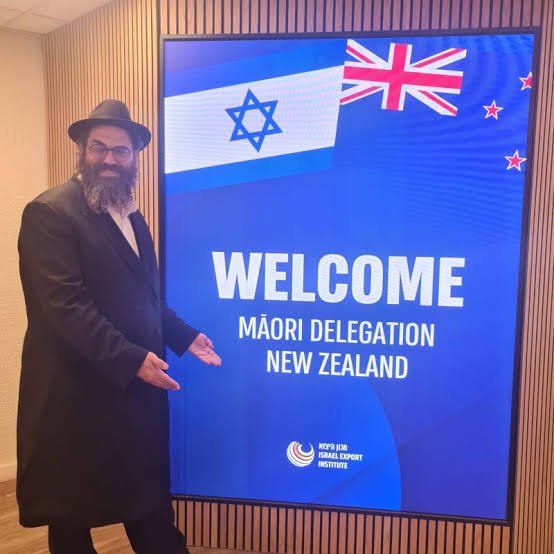
A recent Māori delegation to Israel has sparked controversy in New Zealand. Questions have been raised about who funded the trip, why Māori leaders chose to visit Israel during the war in Gaza, and whether delegates were exposed primarily to an Israeli perspective.
Those are legitimate questions. Journalists should ask them.
In a recent article published on the Indigenous Embassy Jerusalem website it raised another question that deserves attention: what happens when people visit a conflict zone and return with conclusions that challenge the prevailing narrative?
That issue surfaced during a recent episode of Te Ao with Moana, where broadcaster Moana Maniapoto interviewed iwi leader Renata Hakiwai and former broadcaster Neil Waka about their visits to Israel.
Both men said the experience changed their understanding of the conflict.
Hakiwai said the trip left him with a more balanced perspective. Waka said he wanted to form his own judgment rather than simply adopt the views of others. Yet both were met with scepticism for reaching conclusions that differed from those commonly expressed within much of Māori public discourse.
When Disagreement Becomes Suspicious
Criticism of Israel is entirely legitimate. Like any nation, its actions should be open to scrutiny.
But a different problem arises when certain conclusions become effectively beyond challenge.
Anthropologist Adam Louis-Klein, in his 2026 paper Antizionism as a Distinct Anti-Jewish Bigotry, argues that some contemporary anti-Zionist narratives can become resistant to counter-evidence. In such frameworks, evidence supporting a claim is accepted, while evidence contradicting it is dismissed as propaganda or manipulation.
The result is a self-sealing logic.
If someone condemns Israel, they are seen as responding appropriately to the evidence. If they become more sympathetic after visiting Israel, their change of mind is treated as proof that they have been influenced or misled.
The possibility that exposure to new information genuinely altered their judgement disappears.
The Genocide Debate
Neither Hakiwai nor Waka denied the suffering in Gaza.
Hakiwai described the war as brutal and acknowledged that Israel may have responded too harshly. However, he rejected the claim that Israel is committing genocide. He also pointed to the Hamas-led attacks of October 7, 2023, saying that viewing footage of civilians being massacred helped him understand the intensity of Israel’s response.
Waka similarly rejected the genocide label, while acknowledging mistakes and suffering on both sides of the conflict.
Whether one agrees with their conclusions is not the central issue.
The accusation of genocide remains fiercely contested. Some international bodies, legal experts and human rights organisations argue that Israel’s actions meet the threshold. Other legal scholars dispute that conclusion, arguing that proving genocidal intent requires a far higher standard than has yet been established.
As of October 2026, the International Court of Justice has not delivered a final ruling that Israel has committed genocide.
In a healthy democracy, contested claims should remain open to examination.
What Evidence Would Change Minds?
The most revealing aspect of the controversy may not be the trip itself, but the reaction to those who returned from it.
Māori leader Maui Solomon suggested participants may have been subjected to “brainwashing”. Neil Waka was told he sounded like an Israeli government spokesperson.
But the validity of an argument does not depend on who else makes it.
Arguments should be assessed on evidence.
Otherwise an obvious circularity emerges: if delegates return critical of Israel, they have understood the facts. If they return more sympathetic, they have absorbed propaganda. If they say the trip changed their minds, that itself becomes proof of manipulation.
No alternative conclusion is permitted.
That is not journalism. It is orthodoxy.
The real question raised by the Māori delegation is not whether Renata Hakiwai and Neil Waka came back with the “right” view.
It is whether New Zealand’s public discourse still allows people to change their minds.
A free society depends on the ability to examine evidence, challenge assumptions and arrive at different conclusions without being accused of bad faith.
If that freedom disappears, honest inquiry disappears with it. And when dissent becomes unacceptable, journalism risks becoming little more than the enforcement of approved opinion.