



Foreign Correspondents
There was no warning as torrents swept villages away in scenes of extraordinary devastation
The tourists glanced over their shoulders, then began to run for their lives as a wall of water surged towards them down the narrow, tree-lined valley.
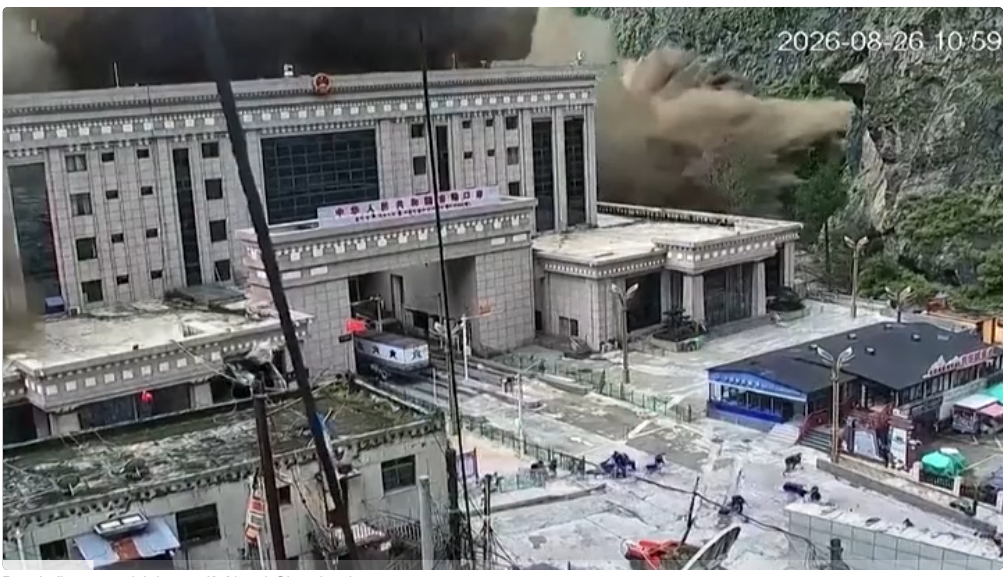
Seconds before 8.45am, the flood waves hit. In CCTV footage from Gyirong Port, a mud-filled wave rises more than 70ft into the air as it engulfs the multi-storey facility spanning the border between Nepal and Tibet.
It smashes back to the ground, picks up the fleeing travellers and barrels onwards on a devastating journey that left at least 160 people dead and nearly 1,400 missing.
There was no warning. Although it remains too early to confirm the cause of the worst natural disaster to hit Nepal since the 2015 earthquake that killed 9,000, analysis of satellite imagery suggests an avalanche of ice plunged into the Bhotekoshi River, falling for more than half a mile before it drove into the river bed.
Twelve British tourists had just crossed through Gyirong Port on a tour led by Alpine Eco Trek, which arranges regular 10-day trips from the Nepalese capital of Kathmandu to Kailash, the Tibetan mountain revered by Hindus, Buddhists and Jains.
Ram Kumar Adkhikari, the manager of the tour company, told The Telegraph: “Both guides went offline at 8.42am. The whole area was swept away by the flood. Even the Tibet immigration office.”
The fate of the 12, who included “young girls”, remains unknown. They were among almost 600 tourists who remained unaccounted for by the early hours of Thursday, according to Nepalese authorities.

The Nepal Tourist Board said the missing tourists were from 28 nations – including Britain, the US, Canada, Australia, New Zealand, India, Malaysia, Italy, the Netherlands, Portugal, Ukraine, South Africa, and South Korea.
Andy Burnham said the Government would provide support to British nationals impacted by the disaster.
“These scenes emerging from along the Nepal-China border are devastating,” the Prime Minister said.
“My thoughts are with all those affected, including the families and loved ones of British nationals missing in this tragedy.
“We will do everything we can to support British nationals impacted in the region and are in touch with the relevant authorities to offer support.”
In total, 33 British citizens and 54 Americans could not be reached as night fell on scenes of extraordinary devastation.
Anthony Albanese, the Australian prime minister, confirmed 34 Australians were missing.
“Our thoughts are with all those who will be concerned about their loved ones today,” Mr Albanese said.
Britain, Australia and European countries issued a joint statement, saying “we express our solidarity with the people of Nepal during this difficult time”.
“We encourage all those in affected areas to follow the guidance of local authorities and official safety advisories as the situation continues to evolve,” the statement read.
By the early hours of Thursday, Nepal’s National Disaster Risk Reduction and Management Authority upgraded the total number of people missing in Nepal to 826. Chinese state media reported that 558 people were unaccounted for in Tibet’s Gyirong County.

Nepalese residents, and relatives of the missing tourists, told how they would work through the night to search for signs of their loved ones.
Bhupesh Bector told The Times he had flown to Nepal to look for his wife Leena Bector, 53, after discovering her location on the Find My Friends app had not changed for more than seven hours, remaining on the Pasang Lhamu Highway.
FishTail Tours, the agency managing her itinerary in Nepal, has not heard from the sherpa leading her group.
Mr Bector said: “All I know is she was one hour away from the Friendship Bridge and the tour operator said its last contact with the sherpa Gelu Dai was at around 8.16am local time.”
Despite calling the Home Office three times, he said he was “still waiting for a callback to check if she’s one of the 33 British people who are on the missing list”.
Mr Bector said: “I want to go to Kathmandu now … as I’m sure she’s on the Nepal side… She must be in trauma … wherever she is safe and sound.”

A 61-year-old British woman and her 60-year-old sister were following the same route as the Alpine group when the mudslide struck.
Leaf Holidays, the organiser of their trip, said it had lost contact with all 54 of its pilgrims and staff.
Gopal Thapa, one of the company’s trek leaders, told The Telegraph: “My brother is the guide. He is missing. I rented a helicopter myself and went out for an hour looking for them.”
Survivors spoke of family members washed away in front of their eyes. Kaplana Malla saw her father, mother, sister and sister’s children caught up in the floodwaters.
She told the BBC: “They could not escape, there was no chance at all. This flood took everything, but my son and I climbed the rooftop of a house and survived somehow.”
As the waves churned south, they tore through 19 bridges and destroyed more than 25 miles of road, according to a statement from the prime minister’s office.
Bodies were deposited in towns all the way along the river – some as far as 180 miles away. Several settlements were completely obliterated.
Nepal’s army launched rescue missions, winching more than 100 people to safety via helicopter. Photographs showed rescuers using excavators to recover survivors trapped in mud.

Across the border, the Chinese air force launched drones above the town of Gyirong to search for survivors.
According to Chinese state media, at least three people were killed by the torrents that swamped the border post.
Xi Jinping, the Chinese president, said that “the most urgent task is doing everything possible to search for and rescue the missing people”, state media reported.
Every pilgrim or tourist seeking to enter Tibet must pass through Gyirong, the only crossing open to foreign travellers.
Around 20,000 pilgrims visit Kailash each year – walking around the sacred mountain’s perimeter, rather than attempting to scale its 6,638m peak. Summer is the busy season.
Sadhguru, a guru whose Isha Foundation leads regular pilgrimages to the site, said that one of his Kailash groups had been caught in the flood.
At least 77 people returning from the mountain were at the immigration office in Gyirong when the flood hit, he wrote on social media.
Maa Gambhiri,the Isha Foundation co-ordinator, told Indian media: “They [the pilgrims] were at the immigration centre on the Chinese side and looks like within 10 minutes this flood struck them.
“There were 77 of our people on this side and three of our volunteers on the Nepal side and we have not been able to reach any one of them.”
One local helicopter rescue service told The Telegraph that its office had been washed away, with the staff member in charge among the missing.

Bidhan Thapaliya said: “Weather conditions have been challenging and are affecting access and helicopter operations in some areas.”
Balen Shah, the prime minister of Nepal, appealed for unity as he promised that rescue efforts would continue around the clock.
“Please be patient,” he said. “The government takes full responsibility for your rescue, treatment, food and shelter. In times of such a disaster, we all need to stand together.”
International support teams were being mobilised to help with rescue and recovery efforts, António Guterres, the United Nations secretary-general, confirmed.
“I am saddened by the severe flooding in Nepal and China, which has claimed many lives, left people missing, and caused widespread destruction,” Mr Guterres said in a post on X.
The International Federation of Red Cross and Red Crescent Societies (IFRC) pledged £888,000 in emergency funding to the Nepal Red Cross.
The US announced $500,000 (£368,000) in aid, and the Indian government said it was sending supplies, including medicines.
More than 1,600 soldiers have been deployed and 800kg of tents sent to the worst-hit areas.
Only by morning will the full extent of the carnage start to become clear. By then, for some of those caught up in the flood, it may be too late.