


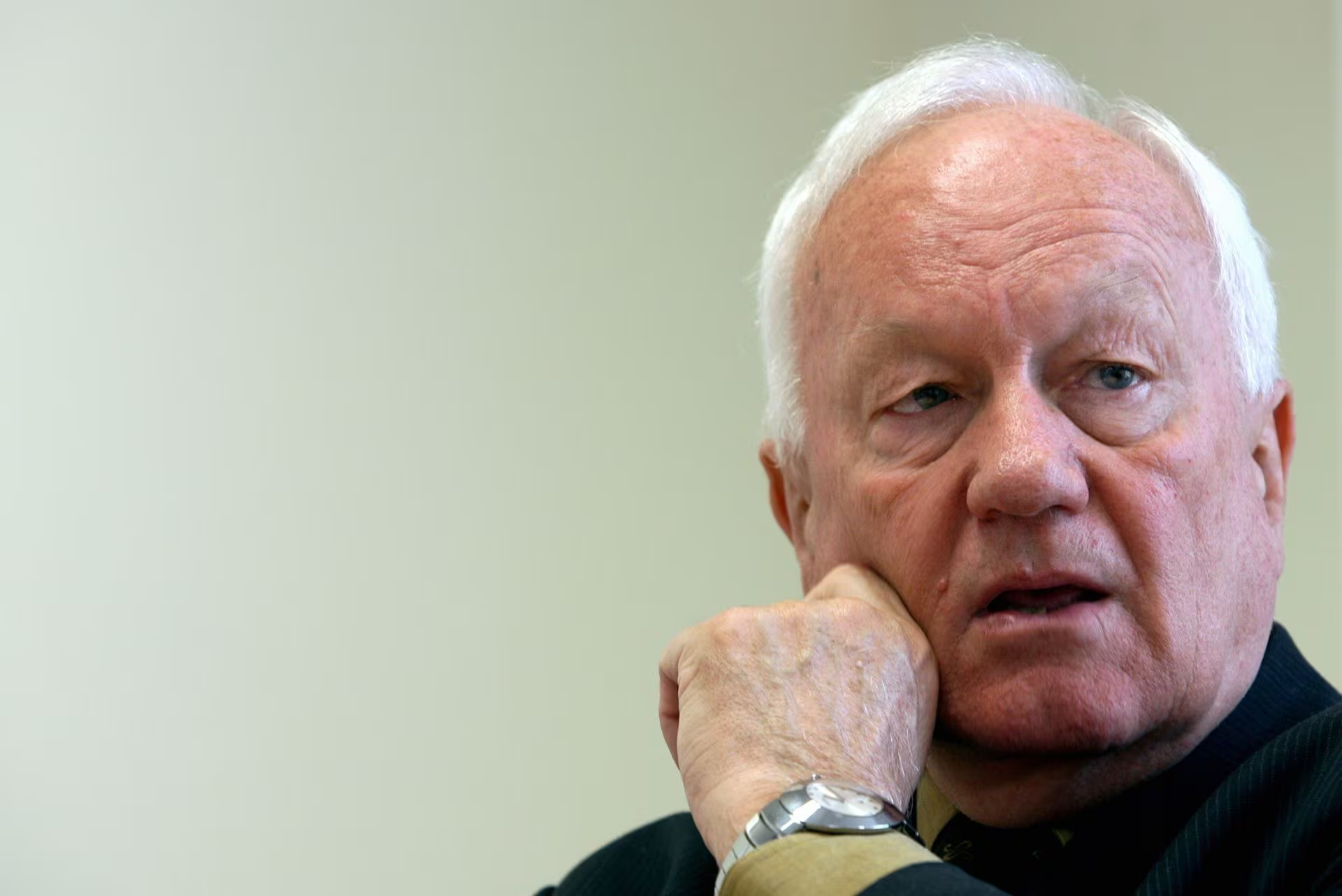
OPINION: Sir Roger Douglas.
New Zealand’s serious superannuation problems began in 1976 when the Muldoon Government replaced Labour’s compulsory super savings scheme with a Pay-As-You-Go (PAYGO) system. That single decision changed everything. PAYGO allowed politicians to make generous promises without having to fund them properly. It created massive unfunded liabilities — IOUs that future generations would have to pay. Today those unfunded liabilities stand at around $2 trillion. The burden falls squarely on the young.
Successive governments have conveniently kept these liabilities off the official books, misleading the public about the true state of our finances. This is not just bad accounting — it is dishonest politics.
PAYGO is essentially a Ponzi scheme. It relies on a growing number of new contributors to pay the benefits of those already in the system. Delaying reform has only made the long-term consequences worse. The global debt crisis we have seen in recent years is partly the result of exactly this kind of welfare expansion.
From a political perspective, dogmatic ideology has repeatedly blocked genuine reform. Socialists, such as Helen Clark and Michael Cullen, deliberately promoted dependency in order to secure votes. Libertarians, ironically, supported compulsory PAYGO taxes instead of genuine retirement savings. Both approaches have failed the country.
In fact, the system has been failing for the past 80 years, and those problems are now coming to a head.
Today in 2026, many people classified as “poor” could actually look after themselves if they were allowed to keep more of the tax they pay. Instead, governments redistribute income in ways that create unnecessary dependency. Most New Zealanders could be self-sufficient with lower taxes and less bureaucratic interference.
This raises some fundamental questions: Why do so many voters continue to support politicians who spend billions unnecessarily, promote envy instead of aspiration, focus only on the short term — the next election, encourage dependency rather than individual independence, and stubbornly maintain a failing system?
The same issues appear across key sectors. In health, we cannot fund all the services the public needs, yet we happily expand the bureaucracy. In education, we have major failures in basic areas such as maths and reading but allow parents limited choice. In unemployment and income support, we see heavy bureaucratic controls that discourage self-reliance.
The Government’s latest Budget continues the pattern of short-term political management rather than the deep structural change New Zealand now desperately needs. While some restraint is being shown in public service numbers, the hard decisions on superannuation, welfare dependency, and genuine incentives for self-reliance are once again being avoided.
Looking ahead to the next 50 years (2026–2076), the problem is stark. The $2 trillion in unfunded liabilities we now face is growing by around $80 billion each year. Unsustainable welfare promises, combined with a serious lack of competition and choice in public services including education and health, are locking New Zealand into long-term decline.
We cannot keep kicking the can down the road. The unfunded liabilities are real. The demographic pressures are real. The declining productivity and growing dependency are real. It is time for honesty and courage.
New Zealanders deserve a system built on individual responsibility and genuine opportunity, not one that promises security while quietly mortgaging our children’s future.
The choice is clear: continue with the failed Pay-As-You-Go model and watch the debt and dependency grow or move to a savings-based system where each generation funds its own retirement and healthcare. The second path is the only one that offers long-term solvency and dignity for New Zealanders.
We have known this for decades. The question is whether this generation of politicians will finally have the courage to act.
In other words, the only viable policy direction for the future is to replace the Pay-As-You-Go system with a proper retirement savings scheme. This must be funded by reductions in government spending, not by loading more debt onto future generations. Until we make this fundamental shift, the problems will only get worse.
The reality is that the current superannuation system, which was sold as a safety net, has become an expensive universal benefit that can no longer be afforded as the population ages. Every year we delay reform, the problem gets larger and the required adjustments become more painful.
The same pattern exists in health and education. We pour more money into systems that deliver poor results because we refuse to address the underlying incentives. We protect failing structures instead of empowering individuals and families to make better choices.
New Zealand must break this cycle. We need to move from a welfare state to a society where people are encouraged and enabled to take responsibility for themselves and their families. This requires lower taxes, greater choice, and much stronger incentives to work and save.
The Budget before us offered an opportunity to begin this shift, but the signals are mixed. There is some welcome restraint in public spending, but the really hard decisions – particularly on superannuation and welfare dependency – are still being deferred.
We cannot afford to wait any longer. The demographic clock is ticking. The unfunded liabilities are mounting. If we do not act now, future generations will pay a terrible price for our political cowardice.
The time for half-measures and political expediency is over. New Zealand needs fundamental reform based on sound principles: individual responsibility, genuine opportunity, and fiscal honesty. Only then can we build a prosperous and fair society that works for all New Zealanders — not just those who know how to work the system.
Please note: Sir Roger’s plan would enable New Zealanders to retire with millions of dollars in retirement savings. By redirecting a portion of the income tax that people pay to the government into their own personalised super savings accounts, thanks to the ‘magic’ of compound interest, over a working lifetime modest savings are turned into substantial funds that can be converted into generous annuities on retirement.
The only losers are the politicians who will be forced to surrender some of their power as tax money that would have gone into government coffers for them to redistribute, is redirected into the personal retirement savings accounts of Kiwis, to cover off the major cost of superannuation.
Sir Roger’s full plan is outlined HERE.
Sir Roger Douglas is a retired New Zealand politician, economist and accountant who served as a minister in two Labour governments.
This article was sourced from NZCPR