



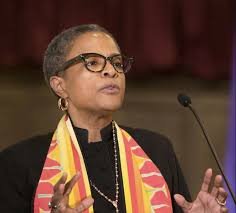
When Yvette Flunder stood before an audience connected to the Center for Public Theology & Public Policy, she didn’t hedge, soften, or qualify her words. She leaned into them. “This is a very dangerous thing that I’m about to say,” she admitted–before saying it anyway.
In her view, the Bible has become “problematic.” The New Testament is not the Word of God. And if certain passages offend? “We need to pull that page out.” Her conclusion: perhaps Christianity now needs a “Third Testament.”
Those statements weren’t abstract theology. They were direct, unambiguous, and rooted in a broader worldview she has long embraced.
Flunder is the senior pastor of the City of Refuge United Church of Christ (UCC) in Oakland, California and the presiding bishop of The Fellowship of Affirming Ministries. She of course identifies as a lesbian and is married to another female. She openly identifies with womanist and liberation theology frameworks–approaches that prioritize lived experience, social justice, and marginalized perspectives as interpretive lenses for faith.
In her remarks, that framework was unmistakable. Scripture, she argued, is not the Word of God itself, but merely “words about God”–and therefore open to revision.
That distinction may sound subtle. It is anything but.
Because once Scripture is reduced to human reflection rather than divine revelation, its authority collapses. It becomes negotiable–subject to editing, deletion, and reconstruction based on cultural or personal preference. In that framework, “pulling pages out” is not shocking. It is logical.
And that’s precisely what makes her comments so consequential.
For two millennia, Christianity has rested on a fundamentally different claim: that the Bible–Old and New Testaments alike–is inspired, authoritative, and binding, even when it confronts human desires or cultural norms. From the early church through the upheaval of the Protestant Reformation, debates over interpretation have been fierce. But the authority of Scripture itself was the common ground.
Flunder’s position removes that ground entirely.
If the Bible is not the Word of God, but merely human commentary, then it carries no inherent authority. It becomes one voice among many–useful when it affirms, disposable when it challenges. The result is not a reinterpreted Christianity. It is a reinvented one.
And this is not happening in isolation.
Across segments of the United Church of Christ and similar progressive spaces, there has been a growing willingness to move beyond reinterpretation into outright revision. Some clergy have described biblical teachings on gender and sexuality as outdated constructs rather than enduring truths.
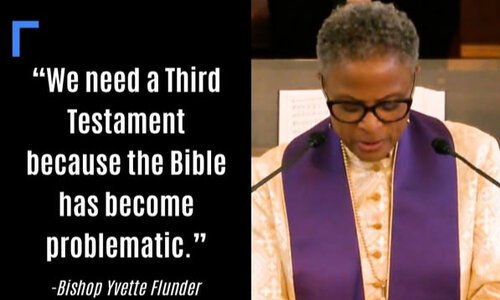
Others have reframed sin as a social category rather than a spiritual reality, or elevated personal identity above scriptural instruction. In certain sermons and public statements, the Bible is treated less as a foundation and more as a flexible resource–one that can be reshaped to align with contemporary values.
That trajectory leads somewhere.
Because if Scripture can be rewritten, then doctrine has no fixed form. If doctrine has no fixed form, then truth itself becomes fluid. And if truth becomes fluid, the church loses its ability to speak with clarity, authority, or conviction.
What remains is not historic Christianity–it is something else entirely.
To be clear, Christians have always wrestled with difficult passages. The tension between faith and culture is not new. Early believers faced persecution for refusing to conform to Roman norms. Reformers challenged corruption within the church at great cost. Every generation has had to decide whether to conform Scripture to the culture–or allow Scripture to confront the culture.
What feels different now is the openness with which some leaders are choosing the former.
Flunder didn’t present her view as a struggle. She presented it as a solution. If the text is difficult, change the text. If the doctrine is offensive, rewrite the doctrine. If the Bible no longer fits the moment, create a new one.
But that solution comes at a price.
It removes any stable foundation for belief. It fractures unity within the broader church. And perhaps most significantly, it leaves those listening–especially younger believers–with a faith that feels endlessly adjustable and ultimately uncertain.
There is, however, a kind of clarity in what she said.
Because it forces a question that many churches have tried to avoid: Is Christianity something we receive–or something we revise according to our own standards?
Those are not two paths to the same destination. They are entirely different roads.
One begins with the assumption that God has spoken, even when His words challenge us. The other begins with the assumption that we must speak for God, correcting what no longer aligns with our understanding.
Flunder chose her path–and stated it plainly.
The question now is whether the church is willing to recognize just how far that path leads.