


Tom Cotterill – Joe Barnes /European correspondents
Trove of data gathered over years of war with Russia will help train AI used by British forces
Ukraine has handed over a “goldmine” of secret battlefield intelligence to help protect the UK from Russian spies and saboteurs.
Britain is the first country to be given access to Kyiv’s vast “Avenger” labs repository, containing millions of images of Russian tanks, air defences, troops, drones and artillery systems from the war.
The data will be used to train technology at UK bases to help them detect saboteurs and spies trying to gain access to Britain’s secrets or military sites.
The agreement comes amid growing concern over Russian activity in Britain. Vladimir Putin was accused last month of launching drones from Russia’s shadow fleet to spy on nuclear weapons in the UK, while in April the Royal Navy disrupted a covert submarine operation carried out by the Kremlin in British waters.
AI technology from Ukraine could eventually be used to protect British airports, prisons, hospitals and even railways and energy plants.
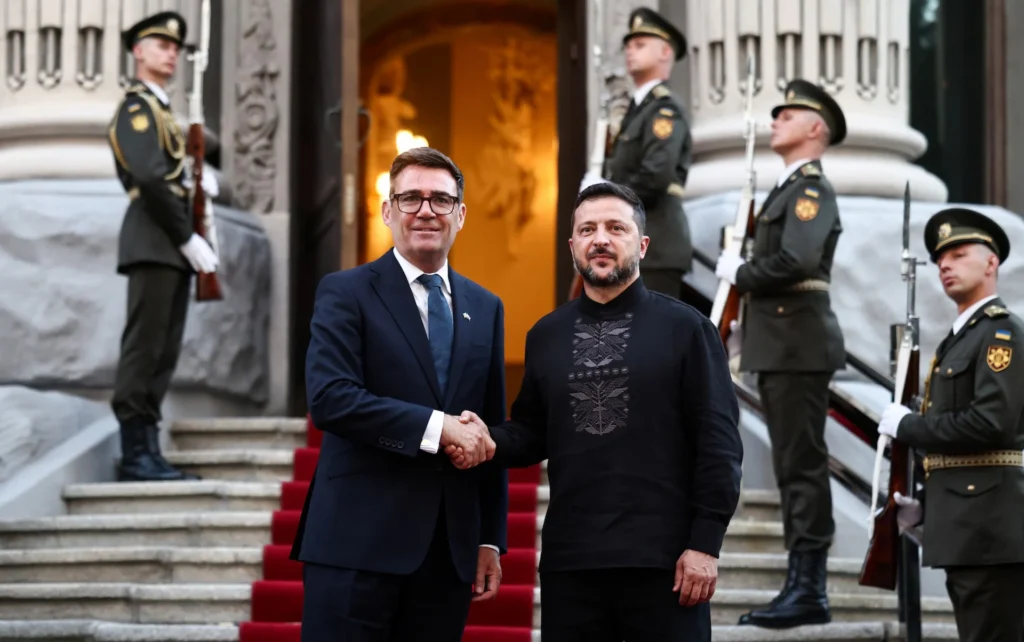
The deal was struck as Andy Burnham paid his first visit to Ukraine as Prime Minister on Monday, where he condemned Russia’s “outrageous” threats against Britain in a speech in front of St Sophia cathedral in Kyiv.
The Prime Minister also agreed to give Kyiv classified information on the British components in Storm Shadow missiles so that Ukraine could manufacture the long-range weapon for use in its war against Russia.

Dmitry Peskov, the Kremlin spokesman, accused Britain of becoming more involved in the war, saying: “Britain is methodically and regularly adding fuel to the fire and methodically and regularly plotting to prevent any progress in the peace process.”
Responding to the sabre-rattling from Russia, Mr Burnham said: “Who started the fire? That’s the question, isn’t it?”
The battlefield intelligence handed to Britain has been collected from thousands of cameras and infrared sensors across Ukraine.
It will help to “revolutionise all parts of public life” by training AI how to respond to emergencies involving Britain’s critical infrastructure.
The Ministry of Defence, which described the data as a “goldmine”, said it would be used in the first instance to protect bases “from protesters and hostile actors trying to gain intelligence”.
Palestine Action protesters broke into RAF Brize Norton in June 2025, causing £1.7m of damage to military planes.
The Ukrainian data will enable Britain to identify and respond to threats, such as Russian drones, more rapidly than ever before.
Three British startups, including Bristol’s Sintela, Oxford’s Mind Foundry and London’s Skyral, are using the data in pilot projects.
One project will turn buried fibre-optic cables in the UK into a giant AI-enabled sensor for use by the British military.
Speaking in Kyiv, Mr Burnham hit out at Moscow, telling a crowd in front of the cathedral: “Despite Russia’s outrageous threats to my country, we will continue our support for Ukraine.
“This is the moment to keep up the pressure on Russia, the moment to squeeze their ability to fund this illegal war.”
British defence firms and scientists will gain access to Ukraine’s battlefield data, which will be used to build new AI-powered computer chips for future smart drones and robots.
If successful, the technology could underpin a new generation of intelligent machines capable of operating for longer, responding faster and functioning in environments where conventional systems struggle.
The deal was signed by Volodymyr Zelensky, the Ukrainian president, and Mr Burnham in Ukraine on Monday.
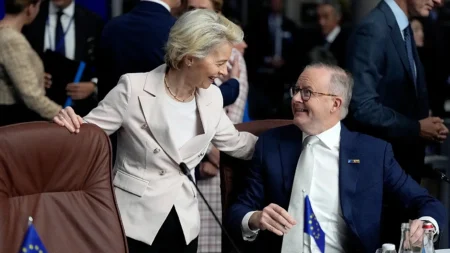
Mr Burnham chaired his first coalition of the willing meeting alongside France’s Emmanuel Macron and Germany’s Friedrich Merz while in Kyiv.
Mr Macron told the meeting that a string of deadly attacks on Ukrainian cities in recent weeks had shown that allies needed to step up the deliveries of interceptors.
Mr Zelensky told the meeting that Ukraine needed $27bn (£19.8bn) to take on Russia this winter. He suggested that Moscow’s frozen overseas assets could be used to finance the fight.
During his visit, Mr Burnham played a song by The Smiths after being handed a guitar by a Ukrainian soldier.
The Prime Minister said music could help “lift spirits” on the front line. In reply, soldiers sang him an Oasis song.
He later went to a shopping centre that was destroyed in a Russian attack, where he spoke to residents and took selfies with them.